
The Universe Might Be Spinning: The Record's Strangest Claim Just Got Interesting
The Urantia Book describes a cosmos that rotates, in alternating directions, level by level. In 2025 two peer-reviewed lines of research gave cosmic rotation its first serious observational case. Here is the claim, the new science, and what would have to happen next.
The Strangest Claim in the Book
Every scientific cosmology of the last century has been built on one quiet assumption: the universe as a whole does not rotate. Space expands, galaxies swirl, clusters collide, but the cosmos itself has no preferred direction, no axis, no spin. This assumption is called isotropy, and it has held up so well for so long that most working astronomers never think about it.
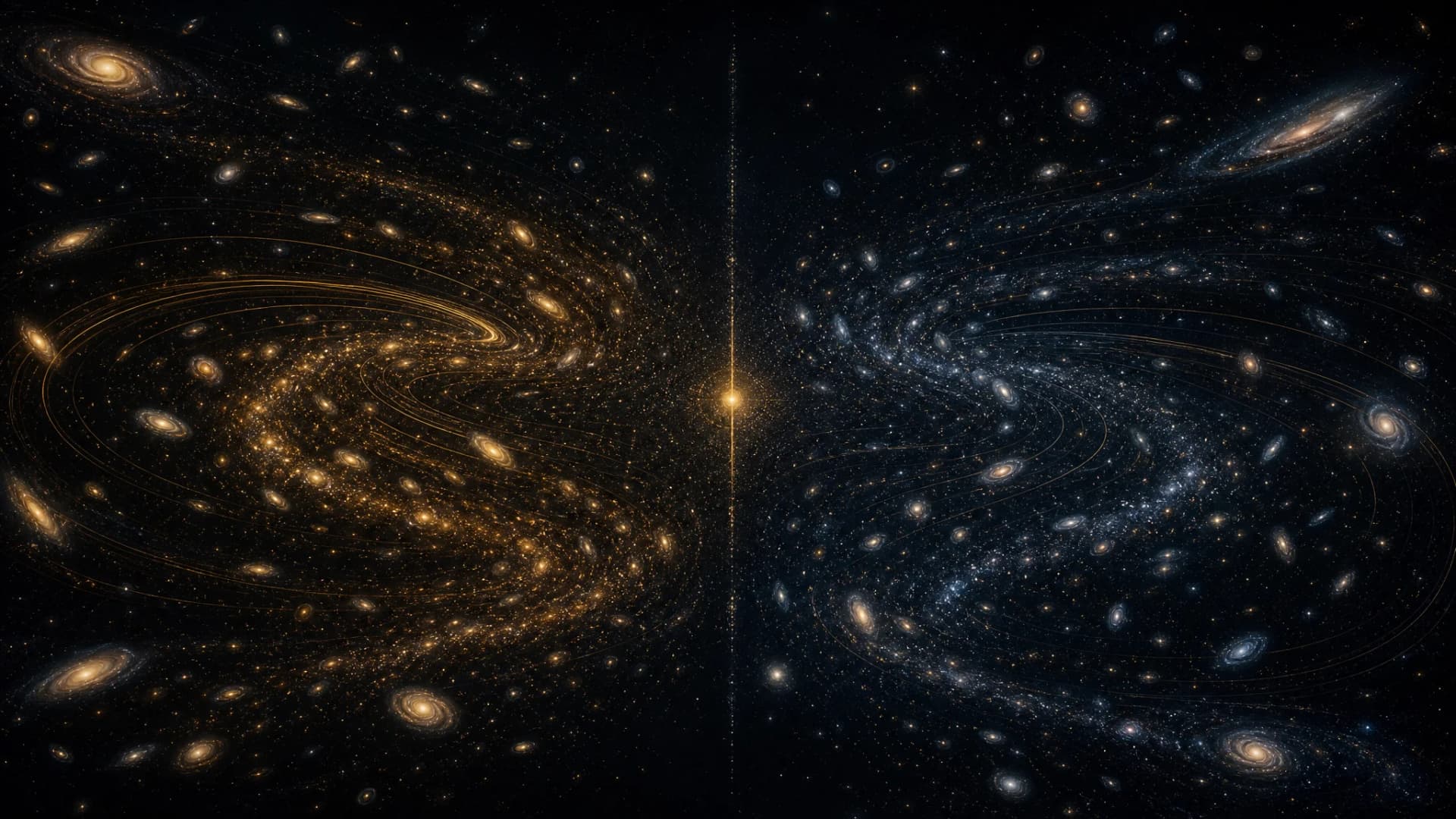
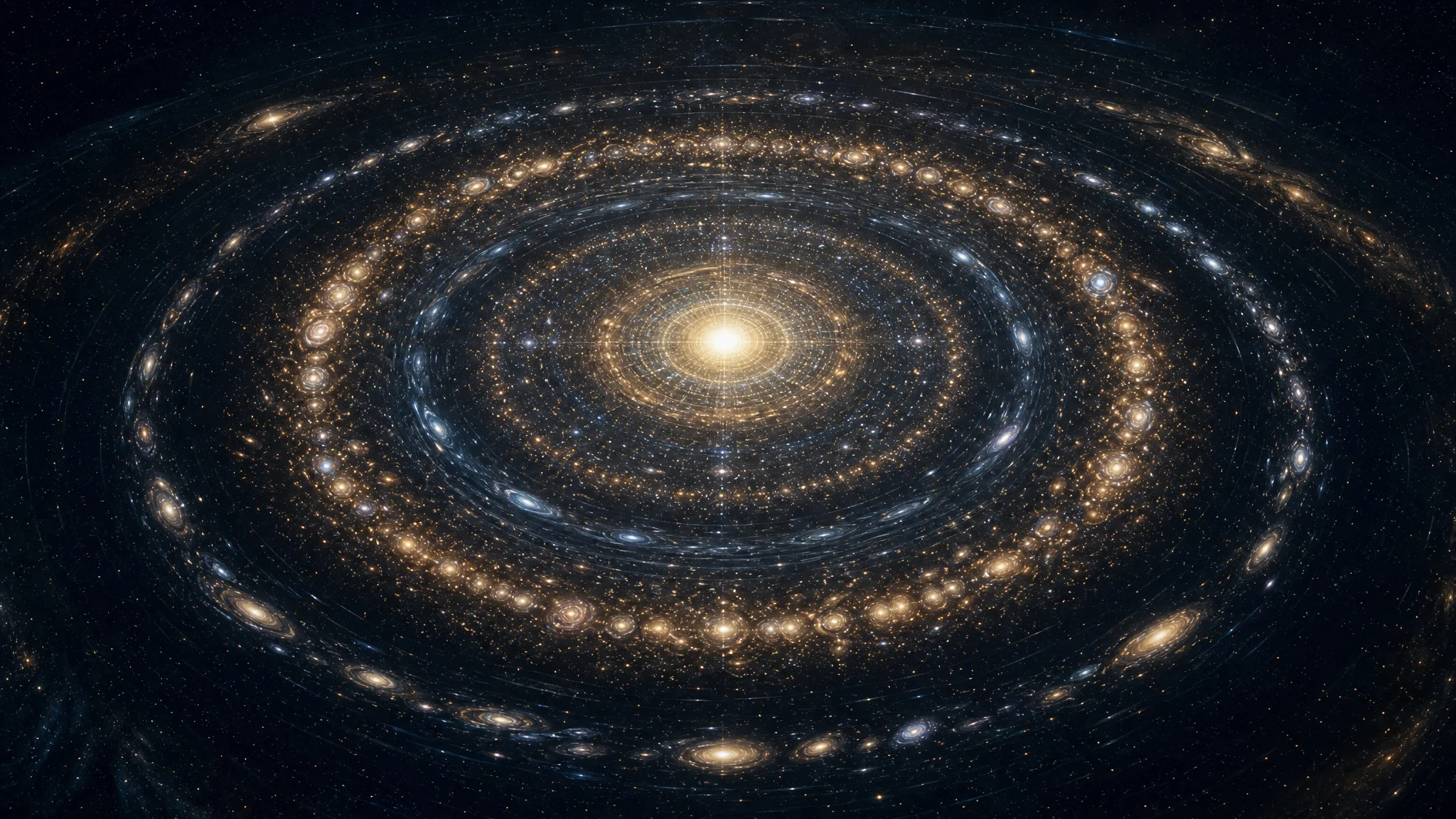
The Urantia Book makes the opposite claim, in detail, and commits to it. The record describes a master universe built as concentric space levels wheeling around an eternal center, and it says the levels alternate their direction of rotation:
"But the greatest of all such distortions arises because the vast universes of outer space, in the realms next to the domains of the seven superuniverses, seem to be revolving in a direction opposite to that of the grand universe. That is, these myriads of nebulae and their accompanying suns and spheres are at the present time revolving clockwise about the central creation. The seven superuniverses revolve about Paradise in a counterclockwise direction. It appears that the second outer universe of galaxies, like the seven superuniverses, revolves counterclockwise about Paradise. And the astronomic observers of Uversa think they detect evidence of revolutionary movements in a third outer belt of far-distant space which are beginning to exhibit directional tendencies of a clockwise nature." (12:4.15)
The record even gives this arrangement a job to do. The alternation is not decoration; it is described as a stabilizing mechanism:
"This alternate zoning of the master universe, in association with the alternate clockwise and counterclockwise flow of the galaxies, is a factor in the stabilization of physical gravity designed to prevent the accentuation of gravity pressure to the point of disruptive and dispersive activities. Such an arrangement exerts antigravity influence and acts as a brake upon otherwise dangerous velocities." (11:7.9)
And it frames the whole scheme as physics rather than poetry:
"It is probable that these alternate directions of successive space processions of the universes have something to do with the intramaster universe gravity technique of the Universal Absolute, which consists of a co-ordination of forces and an equalization of space tensions. Motion as well as space is a complement or equilibrant of gravity." (12:4.16)
For seventy years this has been one of the easiest parts of the book to dismiss. A rotating universe was never a mainstream contender; after Kurt Godel's famous 1949 rotating solution to Einstein's equations it survived mostly as a mathematical curiosity, and it never had an observational case. Then came 2025.
At a Glance
| Key figure | The record (published 1955) | Modern science |
|---|---|---|
| Direction of galaxy flow | Alternating clockwise and counterclockwise by zone (11:7.9) | JADES deep field: 158 clockwise vs 105 counterclockwise of 263 spirals (MNRAS, 2025) |
| Universe rotation | Space levels revolve in opposite directions around Paradise (12:4.15) | Model: one revolution per 500 billion years would resolve the Hubble tension (MNRAS, 2025) |
| Deep-space velocity measurements | "wholly unreliable" at the greatest ranges (12:4.14) | Hubble tension exceeds 5 sigma, the field's defining anomaly (2026 review) |
| Verdict as of 2026 | Contested. Isotropy remains the default; watch Rubin Observatory data |
The First Line: A Spinning Universe Could Fix a Broken Measurement
Cosmology's most famous open problem is the Hubble tension. Measurements of how fast the universe expands disagree. The early-universe method, using the cosmic microwave background, gives about 67 kilometers per second per megaparsec. The local method, using stars and supernovae, gives about 73. The disagreement exceeds five sigma in many analyses, which in physics is the threshold where a discrepancy stops being a fluke and starts being a problem. A June 2026 review called it the defining anomaly of the field.
In March 2025, a team led by Balazs Szigeti and Istvan Szapudi of the University of Hawaii published a proposal in Monthly Notices of the Royal Astronomical Society with a startling title: "Can Rotation Solve the Hubble Puzzle?" Their model adds one ingredient to standard cosmology, a slow global rotation, about one full revolution every 500 billion years. That is close to the maximum spin the universe could have without violating general relativity's prohibitions. The authors report that this single ingredient reconciles the two conflicting expansion measurements "without contradicting current astronomical measurements."
It is a proof of concept, not a detection. Nobody has measured the universe rotating. But a peer-reviewed paper in a major astronomy journal now argues that the cleanest fix for cosmology's biggest problem is to let the cosmos spin.
The Second Line: The Galaxies Are Not Flipping a Fair Coin
The second development comes from the deepest images ever taken. If the universe has no preferred direction, spiral galaxies photographed across the sky should appear to rotate clockwise and counterclockwise in equal numbers, the way a million coin flips come out close to half and half.
Lior Shamir of Kansas State University has spent years counting. In a 2025 paper in Monthly Notices of the Royal Astronomical Society, he analyzed the James Webb Space Telescope's JADES deep field and reported that of 263 spiral galaxies with an identifiable spin direction, 158 rotate clockwise and 105 counterclockwise. That is roughly 60 to 40 where 50 to 50 is expected, a deviation he calculates as far beyond what chance should produce, and he reports the asymmetry growing stronger with distance. He has published similar counts from other surveys, including the Sloan Digital Sky Survey, Pan-STARRS, and the DESI Legacy imaging.
Here is what makes this result safe to write about honestly: Shamir himself offers two interpretations, and both are interesting.
The first interpretation is that the universe was born rotating, with a preferred axis stamped into it from the beginning. That would break isotropy and echo, at least in spirit, what the record describes.
The second interpretation is that the asymmetry is not in the sky but in our instruments. The Milky Way itself rotates, and if that motion biases how galaxy spin directions appear from Earth more than astronomers have assumed, then, in Shamir's words, the finding would imply small systematic biases in redshift-based distance measurements. Hold that thought against what the record says about redshift reckonings at the greatest distances:
"Although your spectroscopic estimations of astronomic velocities are fairly reliable when applied to the starry realms belonging to your superuniverse and its associate superuniverses, such reckonings with reference to the realms of outer space are wholly unreliable." (12:4.14)
Either the counts reveal a rotation the record describes, or they reveal a measurement bias the record warns about. It is a rare situation where both branches of a scientific dispute run toward the same old paragraphs.
What the Skeptics Say, Because It Matters
Honesty requires the other side of the ledger, and here it is substantial. Independent teams have reanalyzed galaxy spin catalogs and found them consistent with a fair coin. Patel and Desmond concluded in 2024 that the spin data show no significant departure from isotropy. The largest crowdsourced galaxy classification project, Galaxy Zoo, found that apparent spin asymmetries in its data traced back to human annotation bias: people are slightly better at recognizing one spiral direction than the other. Earlier claimed detections have been attributed to duplicate images and methodology choices. No independent group has confirmed a preferred cosmic axis, and isotropy remains the default assumption of the field.
So the honest status report reads: one respected modeling group says rotation would solve cosmology's hardest problem, one persistent researcher keeps counting lopsided galaxy spins across multiple telescopes, and the majority of the field expects both results to dissolve under better data. They may be right. The record's specific architecture, concentric space levels turning in opposite directions around an eternal center, is not what any astronomer has proposed, and nothing in the 2025 papers confirms it.
But notice what has already changed. The claim has moved categories. A rotating cosmos went seventy years without an observational case worth arguing about. Now there are peer-reviewed papers, named datasets, published rebuttals, and testable predictions. The record's strangest cosmological claim has become a live scientific question, and live questions get answered.
The Watching Brief
The record says more about the outer regions where these questions point. It describes vast physical creations organizing beyond the inhabited universes:
"There actually is a vast and new system of universes gradually organizing in the domains of outer space. New orders of physical creations, enormous and gigantic circles of swarming universes upon universes far out beyond the present bounds of the peopled and organized creations, are actually visible through your telescopes. At present, these outer creations are wholly physical; they are apparently uninhabited and seem to be devoid of creature administration." (31:10.16)
And it warned its 1955 readers that its own physical science would age:
"...within a few short years many of our statements regarding the physical sciences will stand in need of revision in consequence of additional scientific developments and new discoveries." (101:4.2)
That disclaimer cuts in both directions. It tells us not to lean on the book's era-bound numbers, and it tells us not to be surprised when a claim that sat outside science for seventy years suddenly acquires a literature. The rotation question now has one. The Vera Rubin Observatory in Chile released its first images in June 2025, ten million galaxies from ten hours of test observing, and its decade-long survey will image billions more with a single uniform instrument, which is exactly what settling a spin-count dispute requires. Within a decade, the fair coin will have been flipped enough times to know.
We are not announcing a vindication. We are marking a date. As of 2025, the question "does the universe rotate?" is being asked out loud, in the journals, by people who have never read Paper 12. The record has been asking it in print since 1955, and, if its internal dating holds, since before the Palomar telescope saw first light.
Keep Reading
This article extends our earlier survey of the record's astronomy, The Record and the Science, which covers the Sagittarius center, the expanding universe, the geometry of the Milky Way, and an honest accounting of where the book's numbers show their age. The redshift warning quoted above has its own story, told in The Breathing Universe, Act Two, on the new dark energy measurements. And the companion piece Dark Islands of Space follows the record's dead suns to the quietest discovery of the decade.
Connecting Articles
The Record and the Science: Five Places Where the Urantia Book Meets Modern Astronomy
Dark Islands of Space: How Astronomers Learned to Find What Cannot Be Seen
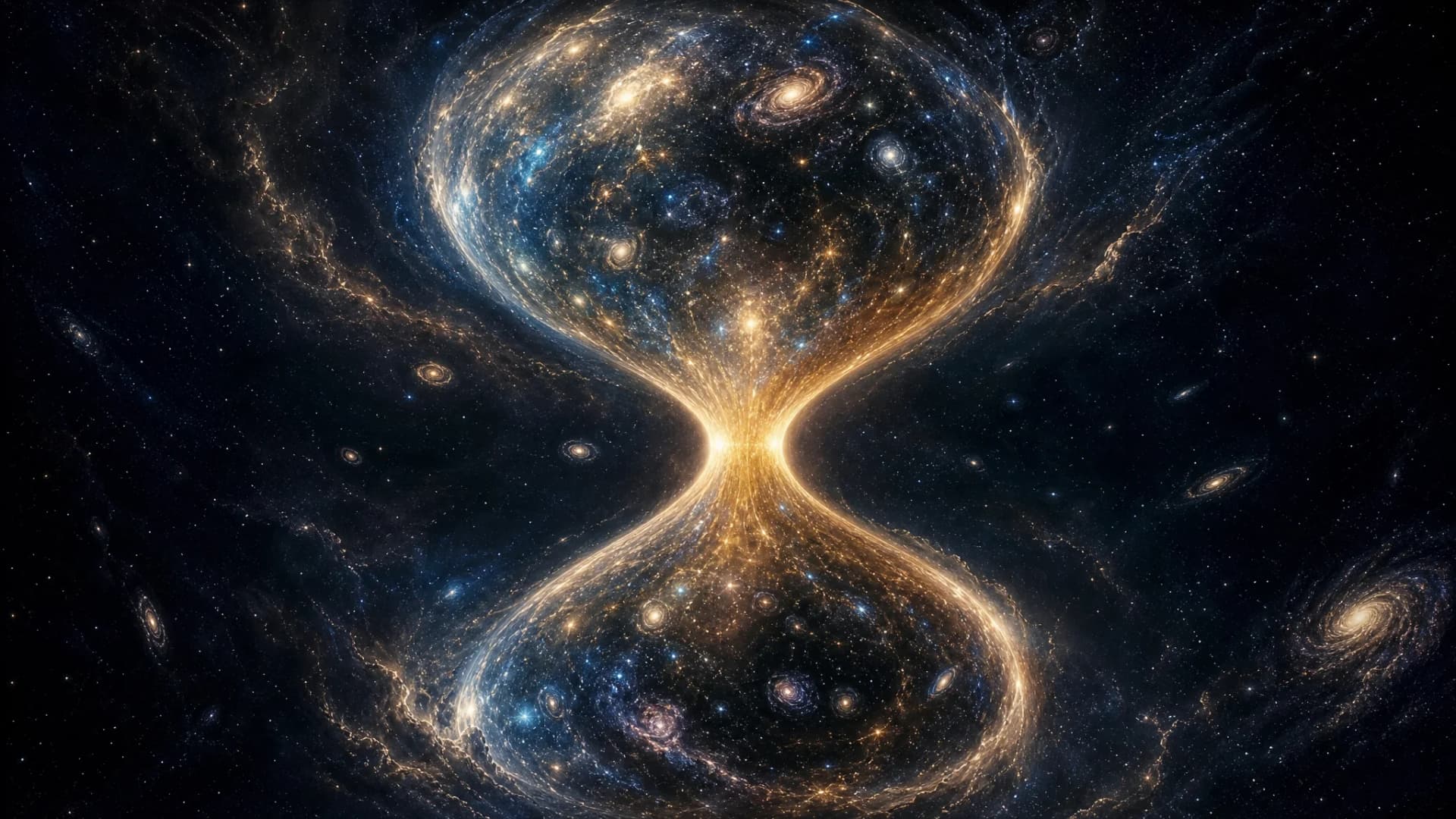
The Breathing Universe, Act Two: Dark Energy Begins to Weaken
The Runaway Particles: The Record and the Physics of a Collapsing Star
The Newsletter
Get the research behind each piece
Free. New Urantia Book explorations, the sources behind the videos, and early looks. No spam, unsubscribe anytime.
Prefer video? Follow on YouTube and Facebook.
Delivered through Substack. You can also read past issues.