
The Runaway Particles: The Record and the Physics of a Collapsing Star
The Urantia Book describes tiny particles with no electric charge escaping a dying sun and collapsing it within hours. Physics reached that picture in stages: 1941, 1966, and finally, watching it happen, 1987. Here is the full timeline, stated honestly in both directions.
One Paragraph, Weighed Carefully
Buried in a paper on the physics of the local universe, the record describes what happens when a giant sun runs out of fuel:
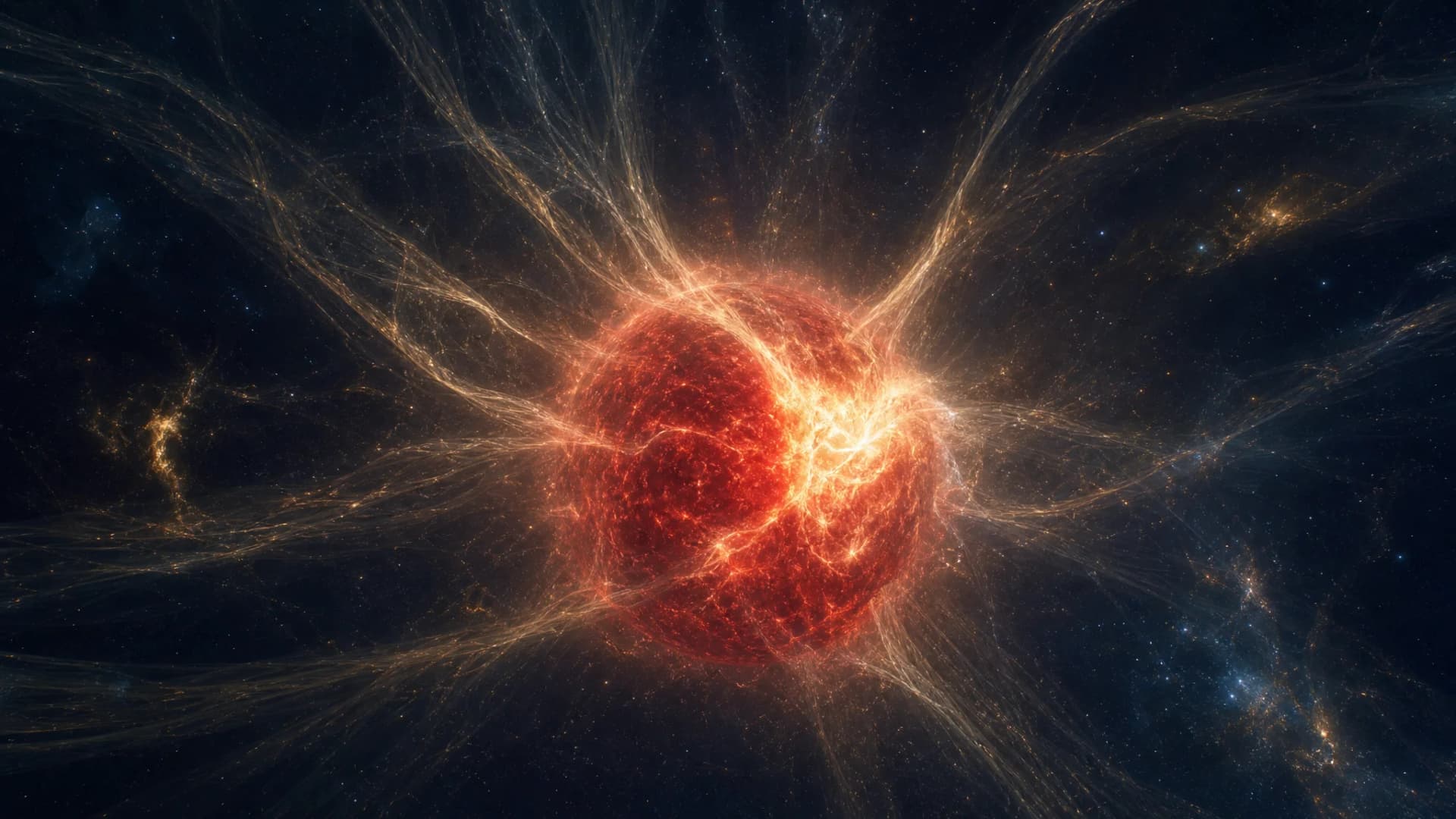
"In large suns—small circular nebulae—when hydrogen is exhausted and gravity contraction ensues, if such a body is not sufficiently opaque to retain the internal pressure of support for the outer gas regions, then a sudden collapse occurs. The gravity-electric changes give origin to vast quantities of tiny particles devoid of electric potential, and such particles readily escape from the solar interior, thus bringing about the collapse of a gigantic sun within a few days. It was such an emigration of these “runaway particles” that occasioned the collapse of the giant nova of the Andromeda nebula about fifty years ago. This vast stellar body collapsed in forty minutes of Urantia time." (41:8.3)
Read it slowly, because every clause is doing work. A massive star exhausts its hydrogen. Gravity contraction follows. A sudden collapse occurs. The collapse produces enormous quantities of tiny particles with no electric charge. Because they carry no charge, they escape the star's interior freely, and their departure is what brings the collapse to completion.
That is a working description of the role neutrinos play in the death of a massive star, which is one of the crown jewels of twentieth century astrophysics. The question worth asking is simple: when did physics know this, and when did the record say it?
At a Glance
| Key figure | The record | Modern science |
|---|---|---|
| The particles | "tiny particles devoid of electric potential" (41:8.3) | Neutrinos: proposed 1930, detected 1956 |
| Their role | Their escape collapses the giant sun (41:8.3) | About 99 percent of collapse energy leaves as neutrinos (SN 1987A, 1987) |
| First physics of that mechanism | Internal dating of the passage: about 1935 | Gamow and Schoenberg, Physical Review, 1941 |
| Collapse time | "within a few days"; S Andromedae "in forty minutes" (41:8.3) | Core collapse in seconds; the 1941 calculation said half an hour |
| Supernova remnant named | Crab nebula, origin "about nine hundred years ago" (41:8.4) | SN 1054; central star confirmed as the remnant in 1968 |
| Latest milestone | Record 220 PeV neutrino, KM3NeT (Nature, Feb 2025) |
Dating the Record's Words
The paragraph dates itself. "The giant nova of the Andromeda nebula about fifty years ago" is S Andromedae, the supernova that flared in the Andromeda galaxy in August 1885, the first ever observed beyond our Milky Way. Fifty years after 1885 is 1935, which matches the period when the Urantia papers are said to have reached completion. The record elsewhere anchors its own chronology the same way, dating events "from the year A.D. 1934" (74:0.1). The book was published in 1955; the movement's records and this kind of internal evidence place the writing about two decades earlier. We state both dates and let the reader weigh them, because the two dates give the claim two different strengths.
The next paragraph adds a second self-check:
"As a rule, the vast extrusion of matter continues to exist about the residual cooling sun as extensive clouds of nebular gases. And all this explains the origin of many types of irregular nebulae, such as the Crab nebula, which had its origin about nine hundred years ago, and which still exhibits the mother sphere as a lone star near the center of this irregular nebular mass." (41:8.4)
The Crab nebula is the remnant of the supernova of the year 1054, and "about nine hundred years ago" fits the writing window again. The identification of the Crab with the 1054 event was still fresh scholarship in the 1930s, and the "lone star near the center" was only confirmed to be the collapsed remnant itself, the Crab pulsar, in 1968.
What Physics Knew, Year by Year
Here is the honest timeline, with nothing smoothed over.
In 1930, Wolfgang Pauli postulated a neutral, nearly undetectable particle to balance the books of radioactive decay. Enrico Fermi built it into real physics in 1934 and gave it the name neutrino. Nobody connected it to dying stars.
In December 1933, Walter Baade and Fritz Zwicky proposed that supernovae represent the collapse of an ordinary star into a neutron star, releasing gravitational energy on a scale nobody had imagined. They identified the energy source of stellar collapse. They did not identify what carries the energy away.
In 1941, George Gamow and Mario Schoenberg published "Neutrino Theory of Stellar Collapse" in the Physical Review. This is the first quantitative physics of neutral particles streaming out of a collapsing star. Their mechanism, which they named the Urca process, poured neutrinos out of the stellar core as an invisible energy leak, and in their calculation this leak could drive the collapse of an evolved star "within as little as half an hour."
In 1956, Cowan and Reines finally detected the neutrino in a reactor experiment. In 1966, Stirling Colgate and Richard White founded the modern theory of neutrino-driven supernova collapse, calculating that the overwhelming share of a collapsing star's energy departs as neutrinos. And on February 23, 1987, the theory became observation: hours before supernova 1987A brightened in the sky, detectors in Japan, Ohio, and the Caucasus caught a burst of two dozen neutrinos. Roughly 99 percent of the collapse energy had left the star as particles devoid of electric potential, exactly as the paradigm predicted. The burst lasted about 13 seconds.
Where the Record Stands in That Timeline
Now place 41:8.3 against those dates, and be exact about it.
If the paragraph was written about 1935, as its own internal dating suggests, then it describes neutral particles escaping a collapsing sun six years before Gamow and Schoenberg gave physics its first version of that idea, twenty-one years before anyone detected a neutrino from anywhere, and fifty-two years before instruments watched it happen in a real star. In 1935, astronomy had the Baade and Zwicky proposal that collapse releases energy, but the notion that uncharged particles carry the energy out existed nowhere in the literature.
If a skeptic prefers the 1955 publication date, the picture changes and we say so plainly: Gamow and Schoenberg came first by fourteen years, and the priority claim inverts. What remains, even on the skeptic's dating, is a religious text committing itself in print to a specific, correct, and then obscure mechanism of stellar death, a decade before that mechanism had textbooks behind it.
There is a detail that quietly favors the earlier dating. The record says the star collapsed "within a few days" and, in the S Andromedae case, "in forty minutes." The modern picture puts the core collapse itself at under a second, with the neutrino burst lasting seconds. Forty minutes does not match 2026 physics. It is remarkably close to the 1941 calculation, which had collapse driven by neutrino escape "within as little as half an hour." The paragraph reads like physics frozen at the moment the idea was young, which is what the record claims to be, and it is a miss against the modern numbers, which we log in the ledger below.
One more supporting passage deserves its place. Describing dense dying stars, the record says:
"Not all stars are solid, but many of the older ones are. Some of the reddish, faintly glimmering stars have acquired a density at the center of their enormous masses which would be expressed by saying that one cubic inch of such a star, if on Urantia, would weigh six thousand pounds. The enormous pressure, accompanied by loss of heat and circulating energy, has resulted in bringing the orbits of the basic material units closer and closer together until they now closely approach the status of electronic condensation. This process of cooling and contraction may continue to the limiting and critical explosion point of ultimatonic condensation." (41:3.6)
Dense degenerate stars were era science; Eddington's famous popularizations of a ton of star-stuff in a matchbox date to the 1920s. What is notable is the last sentence: contraction continuing past electronic condensation to a "limiting and critical explosion point." Subrahmanyan Chandrasekhar published the limiting mass of such stars in 1931 and was ridiculed for it by Eddington in 1935; the idea that collapse proceeds past the white dwarf stage to a catastrophic end took decades to win. The record, at minimum, described contraction proceeding to a critical and catastrophic end point, which was the direction Chandrasekhar was defending.
The Ledger
The record's collapse timescales (days, forty minutes) match 1941 physics, not the seconds of the modern picture. The fusion chemistry in the same section (41:8.1) describes the carbon catalyzed cycle that Bethe and von Weizsacker published in 1938 and 1939, before the 1955 publication, so no priority is claimed there. And the record itself instructs us to expect exactly this aging:
"...within a few short years many of our statements regarding the physical sciences will stand in need of revision in consequence of additional scientific developments and new discoveries." (101:4.2)
The Field That Grew Around One Idea
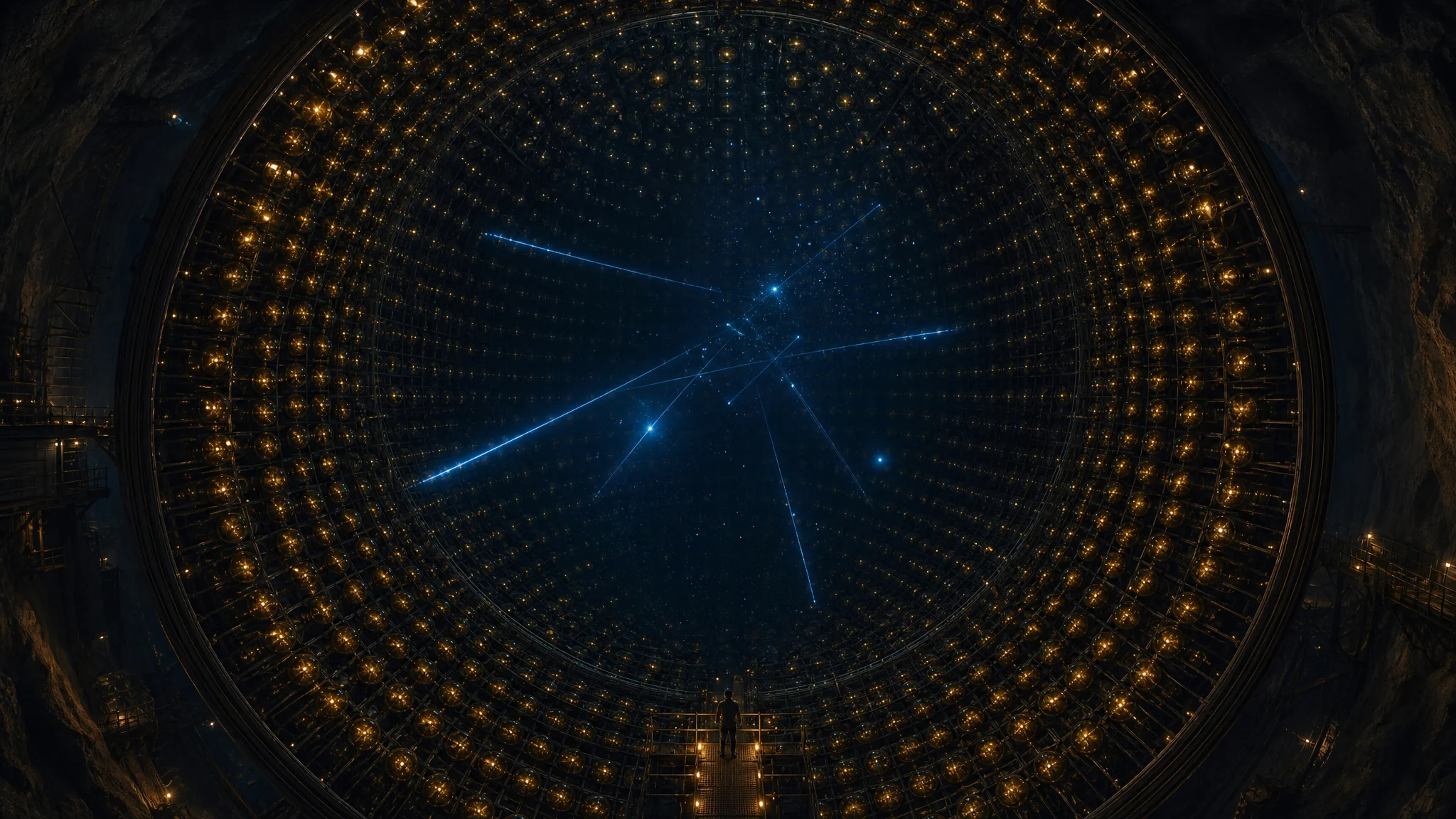
The mechanism in that paragraph is now an entire branch of astronomy. IceCube, a cubic kilometer of instrumented ice at the South Pole, published the first neutrino image of our own galaxy in Science in 2023. In February 2025, the KM3NeT detector in the Mediterranean announced in Nature the most energetic neutrino ever recorded, an event implying a particle of roughly 220 million billion electron volts arriving from deep space. Next generation detectors are standing watch for the next collapse in our galaxy, ready to catch the runaway particles in the act again.
Tiny particles devoid of electric potential, escaping a dying sun. Physics needed most of a century, and some of the largest instruments ever built, to watch it happen. The record gave it one paragraph, and dated itself doing so.
Keep Reading
The companion piece Dark Islands of Space follows what remains after such collapses, and how astronomers learned to find masses that emit nothing at all. The Universe Might Be Spinning examines the record's boldest structural claim in the light of 2025's rotation debate. And The Record and the Science lays out the original five convergences, with the honest differences included.
Connecting Articles
Dark Islands of Space: How Astronomers Learned to Find What Cannot Be Seen
The Universe Might Be Spinning: The Record's Strangest Claim Just Got Interesting
The Record and the Science: Five Places Where the Urantia Book Meets Modern Astronomy
The Breathing Universe, Act Two: Dark Energy Begins to Weaken
The Newsletter
Get the research behind each piece
Free. New Urantia Book explorations, the sources behind the videos, and early looks. No spam, unsubscribe anytime.
Prefer video? Follow on YouTube and Facebook.
Delivered through Substack. You can also read past issues.