
The Record and the Science: Five Places Where the Urantia Book Meets Modern Astronomy
The Urantia Book placed the center of our creation in the star cloud of Sagittarius. Modern astronomy put a supermassive black hole there. Five convergences between the 1955 record and the astronomy of today, plus one place where the numbers honestly differ.
What This Article Is, and Is Not
The Urantia Book describes a cosmos of nested rotations: our world circling its sun, our sun swinging around a center in Sagittarius, our galaxy turning inside something far larger. Some of what it says lines up strikingly with the astronomy of the decades that followed. Some of it matches the astronomy of the decades that came before. And in at least one place, its numbers reflect the science of the 1930s rather than the measurements of today.
This article lays out all of it, the impressive and the dated alike, with every quotation given verbatim and cited. The book itself sets the expectation that its physical science is tied to its era, so honest comparison is the only comparison worth making, and elsewhere the book records Jesus mapping the limits of measurement for a Greek scholar in Athens. Here are five convergences, and one candid difference.
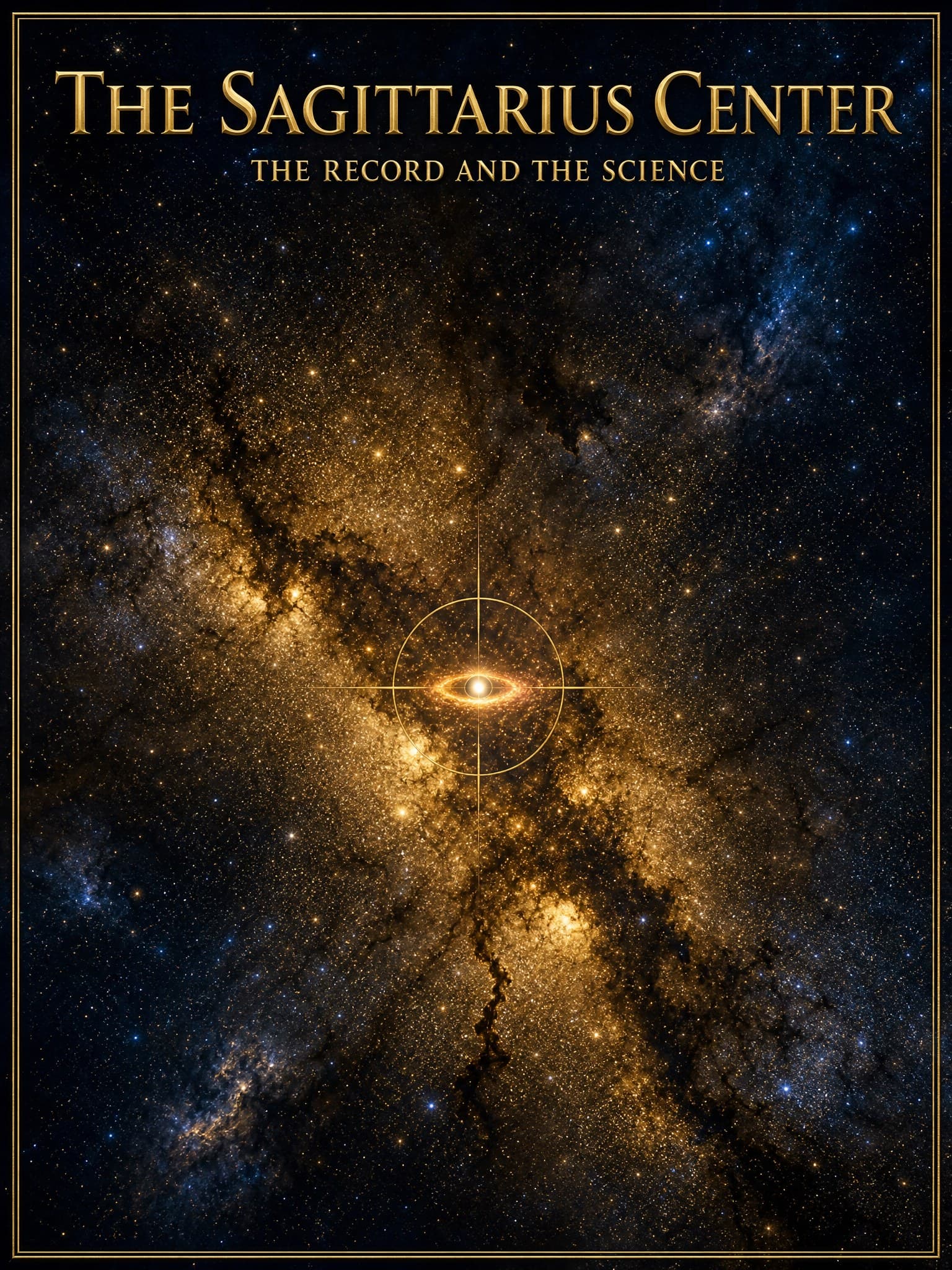
1. The Sagittarius Center
Here is the record on where our local creation is headed:
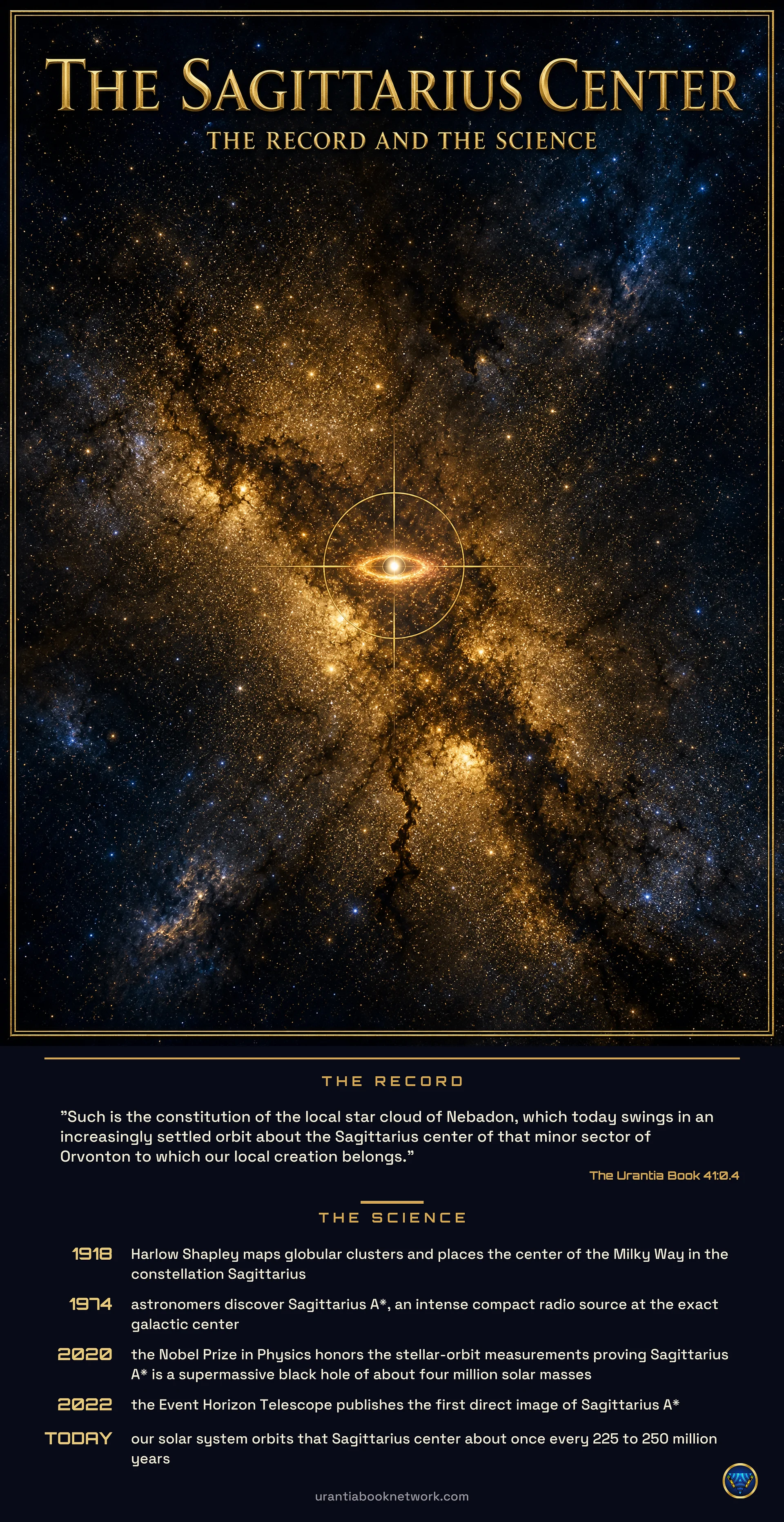
"Such is the constitution of the local star cloud of Nebadon, which today swings in an increasingly settled orbit about the Sagittarius center of that minor sector of Orvonton to which our local creation belongs." (41:0.4)
And again, in the papers on the superuniverses:
"The rotational center of your minor sector is situated far away in the enormous and dense star cloud of Sagittarius, around which your local universe and its associated creations all move, and from opposite sides of the vast Sagittarius subgalactic system you may observe two great streams of star clouds emerging in stupendous stellar coils." (15:3.5)
Now the science. In 1918 Harlow Shapley mapped the globular clusters and concluded the center of the Milky Way lies in the constellation Sagittarius. In 1974 radio astronomers found Sagittarius A*, an intense compact source sitting at that exact center. Decades of stellar orbit measurements, honored with the 2020 Nobel Prize in Physics, proved it is a supermassive black hole of about four million solar masses. In 2022 the Event Horizon Telescope published its first direct image. Our solar system orbits that Sagittarius center about once every 225 to 250 million years.
The chronology matters and we state it plainly: Shapley's work predates the Urantia papers. The book did not scoop astronomy here. What it did was commit, in plain language and in print, to Sagittarius as the gravitational heart of our stellar neighborhood, a claim that every subsequent decade of astronomy has only deepened, from a statistical inference about cluster positions to a photographed black hole.
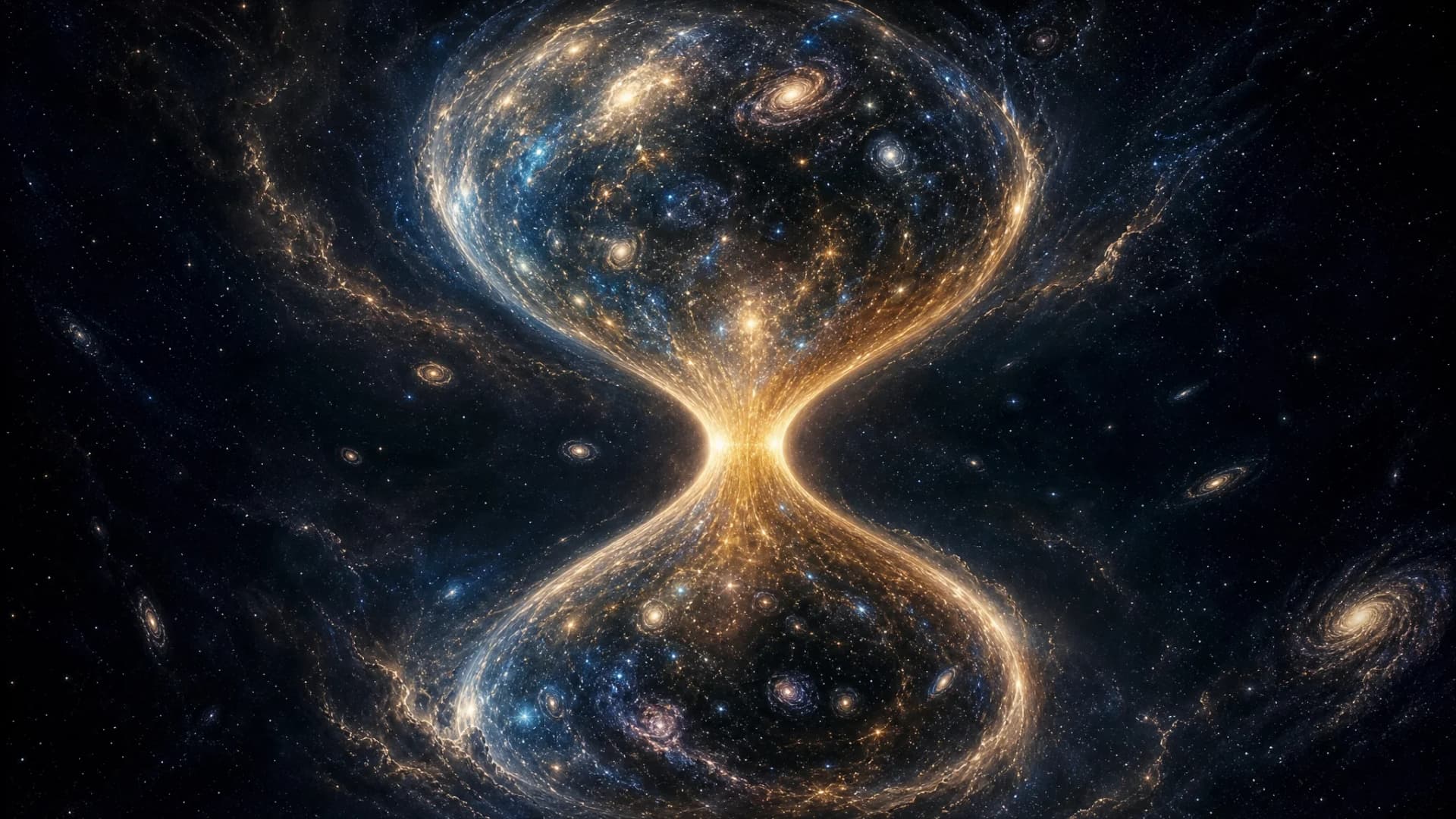
2. The Breathing Universe
"We do not know the actual mechanism of space respiration; we merely observe that all space alternately contracts and expands." (11:6.1)
"The cycles of space respiration extend in each phase for a little more than one billion Urantia years. During one phase the universes expand; during the next they contract." (11:6.4)
Edwin Hubble published the redshift distance relation in 1929: the universe is expanding. In 1998, supernova surveys revealed that the expansion is accelerating, a discovery attributed to dark energy. Whether that expansion continues forever or one day reverses is a genuinely open question in cosmology, and cyclic and bouncing models remain an active field of research.
The record's claim is bolder than the current consensus: it describes the expansion we observe as one phase of a breathing cycle, and it says we are near the midpoint of the expanding phase. Science cannot confirm that today. It also cannot rule it out. What is notable is that a book completed before the Second World War talks about universal expansion as casually as a weather report, and frames it inside a larger rhythm that modern cyclic cosmologies would find familiar.
3. The Milky Way, Nucleus of Something Larger
"The vast Milky Way starry system represents the central nucleus of Orvonton, being largely beyond the borders of your local universe." (15:3.1)
"From the astronomical position of Urantia, as you look through the cross section of near-by systems to the great Milky Way, you observe that the spheres of Orvonton are traveling in a vast elongated plane, the breadth being far greater than the thickness and the length far greater than the breadth." (15:3.2)
Modern measurement agrees with the geometry: the Milky Way's disk spans more than 100,000 light-years while running only about 1,000 light-years thick. Breadth far greater than thickness, exactly as described. Spitzer Space Telescope observations confirmed in 2005 that we live in a barred spiral of somewhere between 100 and 400 billion stars.
The record's larger claim, that the Milky Way is the nucleus of a vaster inhabited structure called Orvonton, is not something astronomy can test yet. But the local geometry it describes is the geometry we measure.
4. Wheels Within Wheels
The record lists seven distinct motions that carry you through space at this moment:
"1. The revolution of Urantia around its sun." (15:3.8)
"4. The swing of the local star cloud of Nebadon and its associated creations around the Sagittarius center of their minor sector." (15:3.11)
"7. The movement of Orvonton and six associated superuniverses around Paradise and Havona, the counterclockwise processional of the superuniverse space level." (15:3.14)
Modern astronomy stacks the motions the same way. Earth orbits the Sun at 30 kilometers per second. The Sun orbits the galactic center at roughly 230 kilometers per second. The Local Group of galaxies moves at more than 600 kilometers per second, falling toward the region astronomers call the Great Attractor. And in 2014, astronomers mapped Laniakea, a supercluster of a hundred thousand galaxies whose flows carry the Milky Way itself. Wheels within wheels, at every scale we have learned to measure.
5. A Trillion Worlds
"Only the Universal Father knows the location and actual number of inhabited worlds in space; he calls them all by name and number." (15:2.1)
The record goes on to describe a grand universe of approximately seven trillion inhabitable worlds (15:2.9). Hold that number against the timeline of discovery. In 1955, when the book was published, not one planet beyond our solar system had ever been observed. The first confirmed planet around a Sun-like star, 51 Pegasi b, arrived in 1995 and earned the 2019 Nobel Prize in Physics. Today more than 5,000 exoplanets are confirmed, and Kepler mission statistics imply billions of rocky, habitable-zone worlds in our galaxy alone.
A cosmos crowded with worlds was a fringe position in 1955. It is the mainstream expectation now.
Where the Numbers Differ: A Note on Andromeda
Honesty cuts both ways, so here is the other side of the ledger:
"This far-distant nebula is visible to the naked eye, and when you view it, pause to consider that the light you behold left those distant suns almost one million years ago." (15:4.7)
The modern measured distance to the Andromeda galaxy is about 2.5 million light-years. The book's figure of almost one million years matches the astronomy of the early 1930s, when Hubble's original distance estimates were in use; the calibration was famously revised upward in the early 1950s, after the papers were written but before they were published. The book itself tells the reader to expect exactly this, stating that its physical cosmology will stand in need of revision as science advances.
We publish that difference as plainly as the convergences. A record that invites you to check it against the sky is worth taking seriously on both counts.
The Posters
Each of the five convergences above is now a museum-grade educational poster in the UBN shop, pairing the verbatim passage with the modern science timeline: The Sagittarius Center, The Breathing Universe, Nucleus of Orvonton, Wheels Within Wheels, and A Trillion Worlds. They are high-resolution digital downloads that print crisp at any size, sold singly or as the complete Record and Science set. Every quote on every poster is verbatim and cited, the same standard as everything else on this site.
Connecting Articles
The Universe Might Be Spinning: The Record's Strangest Claim Just Got Interesting
Dark Islands of Space: How Astronomers Learned to Find What Cannot Be Seen
The Breathing Universe, Act Two: Dark Energy Begins to Weaken
The Runaway Particles: The Record and the Physics of a Collapsing Star
The Newsletter
Get the research behind each piece
Free. New Urantia Book explorations, the sources behind the videos, and early looks. No spam, unsubscribe anytime.
Prefer video? Follow on YouTube and Facebook.
Delivered through Substack. You can also read past issues.