
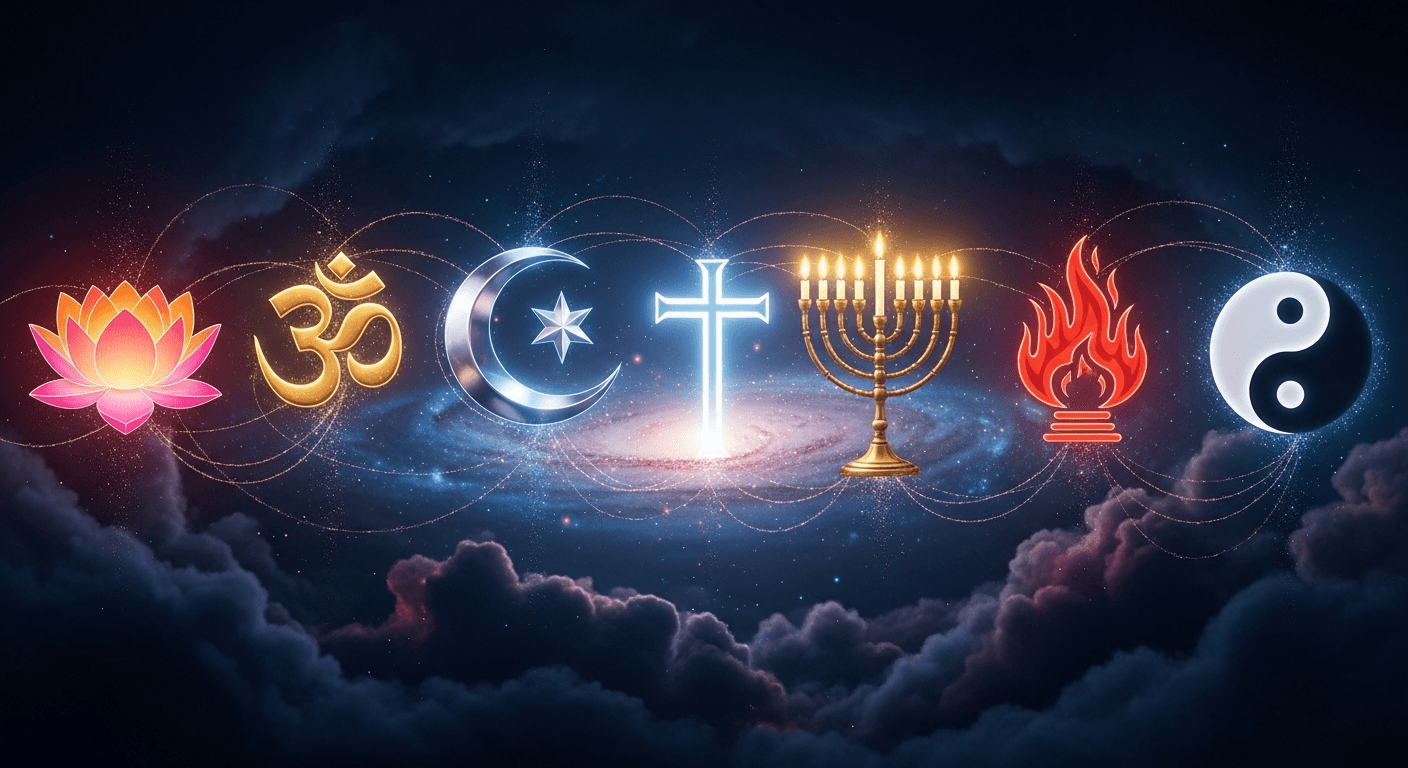
Convergence Chart
Buddhism, Islam, Hinduism, the teachings of Jesus, and the religion Christianity built in his name, mapped against The Urantia Book. Every thread traced to its Melchizedek source. What the world calls “independent invention” is actually one teaching, adapted by many cultures, from one emergency bestowal 4,000 years ago.
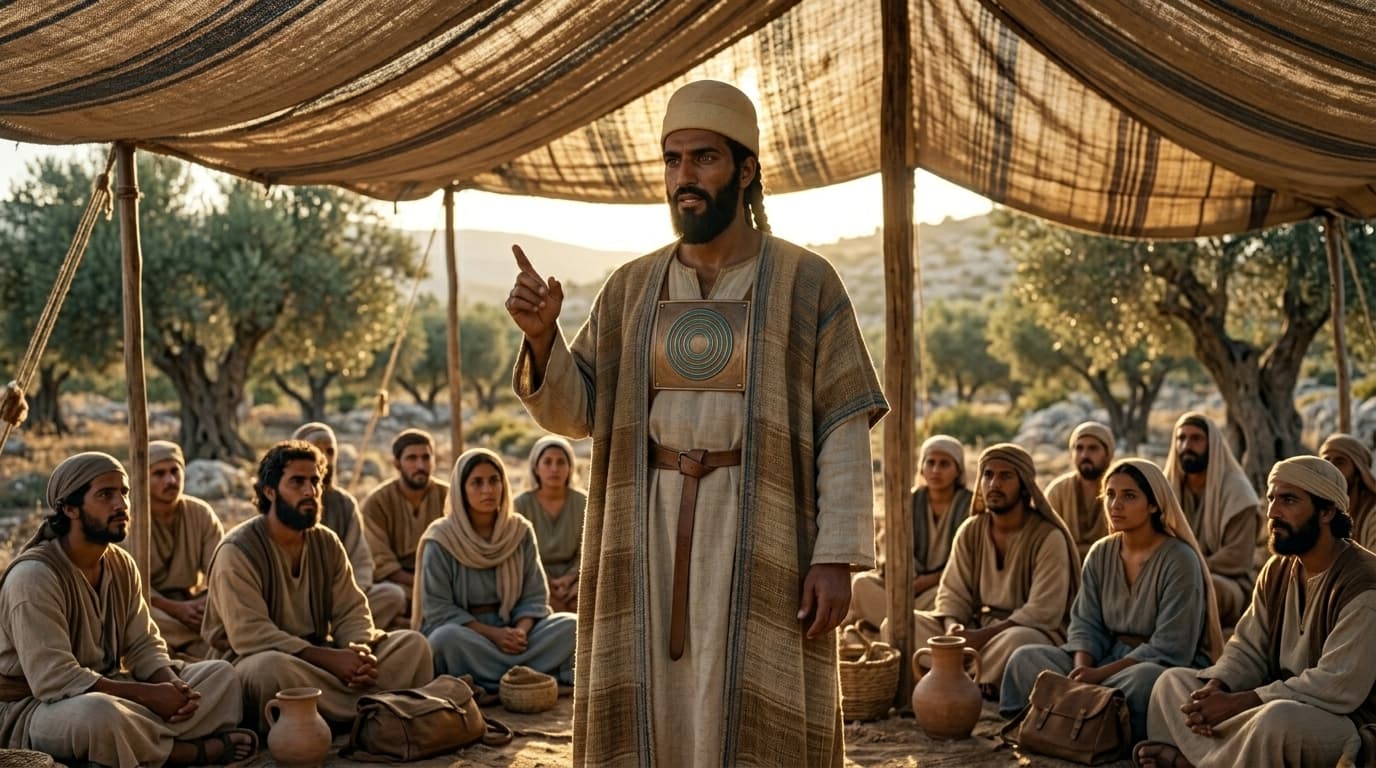
Machiventa Melchizedek
The Sage of Salem · ~1973 BC · the single source every thread traces back to
Chart Key
Buddhism
PARTIALThe Buddha remained silent on a creator God, focusing instead on the unconditioned (Nibbana). Later Mahayana developed the Dharmakaya, a single ultimate reality behind all Buddhas, echoing monotheistic structure without the label.
Hinduism
ALIGNEDThe Vedas begin polytheistic but the Upanishads converge on Brahman, the single, infinite, formless source of all reality. "Ekam sat vipra bahudha vadanti": Truth is One, the wise call it by many names (Rig Veda 1.164.46).
Islam
ALIGNEDTawhid, absolute, uncompromising monotheism, is the central pillar of Islam. "Say: He is Allah, the One" (Quran 112:1). No partners, no images, no divisions. This is the purest surviving echo of Melchizedek's original teaching.
Jesus' Teachings
ALIGNED"The Lord our God is one Lord" (Mark 12:29). Jesus taught a personal, loving Father, not a distant lawgiver. The Fatherhood of God was the core of his gospel, restoring the intimate relationship Melchizedek originally established.
Christianity (Post-Paul)
DIVERGEDThe Trinity doctrine (formalized at Nicaea, 325 AD) complicated Jesus' simple monotheism. God became a theological puzzle (three persons in one substance) requiring creeds and councils to define. The intimate Father became an abstract Godhead. Paul's writings shifted focus from the Father to the risen Christ, and the institutional church became the mediator between God and man.
Melchizedek / UB
BaselineMachiventa Melchizedek incarnated at Salem (~1973 BC) and taught "El Elyon," God Most High, strict monotheism to a world sliding into polytheism. His missionaries carried this One-God concept to every continent. All later monotheistic traditions trace back to this single source. (UB 93:2.1, 93:3.2)
Buddhism
ALIGNED"Hurt not others in ways that you yourself would find hurtful." (Udanavarga 5:18). The Buddha placed compassion (karuna) at the center of ethical conduct, not as a commandment from God, but as wisdom arising from understanding that all beings share suffering.
Hinduism
ALIGNED"This is the sum of duty: do not do to others what would cause pain if done to you." (Mahabharata 5:15.17). The concept appears in the Vedas, Upanishads, and epics, woven through thousands of years of moral teaching.
Islam
ALIGNED"None of you truly believes until he wishes for his brother what he wishes for himself." (Hadith, Sahih al-Bukhari). Islam frames the golden rule within ummah (community): service to God expressed as service to fellow believers and all of humanity.
Jesus' Teachings
ALIGNED"Do unto others as you would have them do unto you." (Matthew 7:12). Jesus elevated the golden rule from a negative prohibition ("do not harm") to a positive mandate ("actively do good"). This was a deliberate advancement of Melchizedek's teaching.
Christianity (Post-Paul)
DIVERGEDChristianity preserved the golden rule in doctrine but overlaid it with conditions. Love became tied to evangelism; "love your neighbor" meant converting them. The Crusades, Inquisition, and forced conversions show how the institutional church weaponized ethics. The golden rule survived in Christian practice largely through individuals who followed Jesus despite the institution.
Melchizedek / UB
BaselineMelchizedek's Salem missionaries taught the concept of God's goodness requiring reciprocal goodness to fellow humans. As the One-God concept spread through every culture, the ethical corollary traveled with it, producing independent-seeming golden rules that all trace back to the same Salem source. (UB 93:4.6, 131:2-10)
Buddhism
PARTIALRebirth through samsara until Nibbana is attained. No permanent soul, but a continuity of consciousness, a "flame passed from candle to candle." The Tibetan Book of the Dead maps detailed afterlife stages (bardos) remarkably similar to UB mansion world transitions.
Hinduism
PARTIALAtman (the eternal self) transmigrates through births until achieving moksha, liberation and merger with Brahman. The Katha Upanishad describes the soul's journey after death. The Bhagavad Gita: "The soul is neither born, nor does it die" (2:20).
Islam
PARTIALAkhirah, the afterlife, is a core doctrine. The soul (ruh) continues after death through Barzakh (intermediate state) until resurrection and judgment. Paradise (Jannah) is described in vivid physical terms, preserving a distorted memory of the mansion world concept.
Jesus' Teachings
ALIGNED"In my Father's house are many mansions" (John 14:2). Jesus directly taught survival after death and progressive ascension through multiple stages. He described heaven not as a static reward but as a Father's house with many dwelling places, the mansion worlds.
Christianity (Post-Paul)
DIVERGEDChristianity collapsed Jesus' "many mansions" into a binary: heaven or hell. Purgatory was added by the medieval church as an intermediate state, then rejected by Protestants. The rich progressive afterlife Jesus described, a Father's house with many dwelling places, was flattened into a single reward/punishment verdict at death. Dante's Divine Comedy preserved more cosmological structure than official theology.
Melchizedek / UB
BaselineThe Urantia Book reveals the morontia career: after physical death, surviving mortals are repersonalized on mansion world #1, then progress through seven mansion worlds, then through the constellation, local universe, superuniverse, and Havona to Paradise. Every tradition's afterlife concept is a cultural distortion of this actual architecture. (UB 47:0-3, 112:5-7)
Buddhism
PARTIALMeditation (bhavana) and mindfulness (sati) replace petitionary prayer. The goal is direct experiential contact with reality, not requesting favors from a deity. Zen's "just sitting" (shikantaza) is perhaps the purest form of contentless worship known.
Hinduism
PARTIALMultiple paths: bhakti (devotional worship), dhyana (meditation), puja (ritual offering), mantra (sacred sound). The Upanishads teach that the worshipper and the worshipped are ultimately one: "Tat tvam asi" (Thou art that). Worship is remembering your own divine nature.
Islam
ALIGNEDSalat, five daily prayers at prescribed times facing Mecca, structures the entire day around communion with God. Du'a (personal supplication) adds spontaneous prayer. Dhikr (remembrance of God) is continuous mindfulness. The discipline preserves Melchizedek's emphasis on regularity.
Jesus' Teachings
ALIGNEDJesus taught prayer as intimate conversation with a loving Father, not ritual performance. "When you pray, go into your room, close the door, and pray to your Father who is unseen" (Matthew 6:6). He modeled worship as a personal relationship, not an obligation.
Christianity (Post-Paul)
DIVERGEDThe church re-institutionalized prayer. Liturgical schedules, priestly intercession, confession to clergy, and saints as intermediaries replaced Jesus' direct Father-child communion. The Catholic mass became a prescribed ritual; Protestant worship added hymnal structure. Jesus said "go into your room"; the church built cathedrals and required attendance.
Melchizedek / UB
BaselineMelchizedek established the Salem covenant: "trust God, have faith, and God accepts you." He taught that sincere faith, not sacrifice or ritual, was the basis for relating to God. Prayer was communion, not transaction. All subsequent traditions elaborated on this core, adding layers of ritual that often obscured the original simplicity. (UB 93:4.1-6, 91:1-4)
Buddhism
PARTIALAnatta (non-self): no permanent, unchanging soul exists. Yet Buddhism acknowledges something continues between lives. The Tathagatagarbha ("Buddha-nature") doctrine in Mahayana comes remarkably close to the UB concept: an innate spiritual potential within every being that can awaken.
Hinduism
ALIGNEDAtman, the eternal, indestructible self identical with Brahman. "The Self is smaller than the smallest, greater than the greatest" (Katha Upanishad 1.2.20). This is the closest any religion comes to the UB's Thought Adjuster concept, a divine fragment dwelling within.
Islam
ALIGNEDThe ruh (spirit) is breathed into the body by Allah. The nafs (soul/self) has three states: commanding evil, self-reproaching, and at peace (Quran 12:53, 75:2, 89:27). The Islamic model of the soul progressing through moral stages closely mirrors morontia progression.
Jesus' Teachings
ALIGNED"What does it profit a man to gain the whole world and forfeit his soul?" (Mark 8:36). Jesus spoke of the soul as something real, precious, and at stake, not metaphorical. He taught that the soul grows through relationship with the indwelling Father spirit.
Christianity (Post-Paul)
DIVERGEDChristianity adopted the Greek concept of an immortal soul given at birth, rather than Jesus' teaching of a soul that grows through moral decisions. The church taught that baptism was necessary to save the soul, and that unbaptized infants were in peril, a doctrine Jesus never taught. The soul became a possession to protect through sacraments rather than a living reality to grow through experience.
Melchizedek / UB
BaselineThe Urantia Book reveals the soul as a morontia reality, neither purely material nor purely spiritual, co-created by the human mind and the indwelling Thought Adjuster. It is the embryonic form of your future morontia self. The soul is not born with you; it is created through every moral decision you make. This is what every tradition dimly remembers. (UB 111:2-3, 0:5.10)
Buddhism
PARTIALNo concept of "sin" against God; instead, unskillful actions (akusala) generate karma. Redemption is not needed from a deity but achieved through right understanding and right practice. The Eightfold Path IS the redemption mechanism, a practical method, not a doctrinal belief.
Hinduism
PARTIALKarma accumulates through dharmic or adharmic action across lifetimes. Redemption comes through jnana (knowledge), bhakti (devotion), or karma yoga (selfless action). Grace (prasada) from the divine can also dissolve karma, the Gita's ultimate teaching.
Islam
ALIGNEDSin (dhanb) is disobedience to Allah's will. Tawbah (repentance), sincere turning back to God, brings immediate forgiveness. No mediator required. "Allah loves those who are constantly repentant" (Quran 2:222). This directness preserves Melchizedek's original simplicity.
Jesus' Teachings
ALIGNEDJesus taught that sin is knowingly choosing against the Father's will, not inherited guilt. Forgiveness comes through sincere repentance and faith. He never taught blood atonement theology; that was Paul's later addition. Jesus said: "Your sins are forgiven; go and sin no more."
Christianity (Post-Paul)
DIVERGEDPaul transformed sin from a personal spiritual choice into an inherited cosmic debt. Original sin ("in Adam all have sinned") meant every human was born guilty. Redemption required the blood sacrifice of God's own Son. This atonement doctrine was "partially Mithraic in origin, having little in common with Hebrew theology, Philo's philosophy, or Jesus' teachings" (UB 121:6.5). Jesus forgave sins directly; Paul said only the cross could.
Melchizedek / UB
BaselineThe UB clarifies: sin is deliberate disloyalty to Deity; evil is the unconscious violation of divine law; iniquity is persistent, willful rebellion. Redemption is not transactional; God does not need to be "paid." Forgiveness is freely available to all who sincerely seek it. The atonement doctrine distorted Jesus' gospel of divine mercy into a primitive sacrifice concept. (UB 67:1.4, 89:10.1, 188:4-5)
Buddhism
ALIGNEDMetta (loving-kindness) extended to all sentient beings without exception. The Bodhisattva vow: "I will not enter Nirvana until all beings are liberated." This radical universalism, beyond race, caste, and gender, was revolutionary in its time and mirrors the UB's cosmic citizenship.
Hinduism
ALIGNED"Vasudhaiva Kutumbakam," the world is one family (Maha Upanishad 6.72). Despite the caste system's historical distortions, the Upanishadic teaching is clear: the same Brahman dwells in all beings. Seeing the divine in every person is the highest realization.
Islam
ALIGNED"O mankind, We have created you from male and female and made you peoples and tribes that you may know one another" (Quran 49:13). The Hajj, where millions from every nation stand equal before God, is the most powerful living symbol of human unity on Earth.
Jesus' Teachings
ALIGNED"The Fatherhood of God and the Brotherhood of Man": this was the double gospel. If God is the Father of all, then all humans are siblings. Jesus ate with sinners, healed Gentiles, and spoke to Samaritans. He demolished every human barrier to brotherhood.
Christianity (Post-Paul)
DIVERGEDThe institutional church replaced universal brotherhood with the "saved vs. unsaved" divide. Membership in the church, not common divine sonship, became the basis of community. "Outside the church there is no salvation" (extra ecclesiam nulla salus) directly contradicted Jesus' teaching that all humans are children of the same Father. Denominations fragmented even believers into competing factions.
Melchizedek / UB
BaselineThe Urantia Book teaches that the Fatherhood of God logically necessitates the brotherhood of all humanity. This is not sentiment; it is cosmic fact. Every mortal is indwelt by a fragment of the same Universal Father. Racial, national, and religious divisions are evolutionary artifacts that must be transcended. Melchizedek's missionaries seeded this truth in every culture. (UB 12:7.8, 134:4.1-2, 52:6.1)
Historical Pipeline
How one emergency bestowal at Salem became every religion’s highest truth
Machiventa Melchizedek incarnates at Salem
Emergency bestowal. Teaches monotheism, faith-based covenant, and the coming of a future bestowal Son. Establishes Salem as a global teaching center.
Salem missionaries spread to every continent
Teachers travel to Mesopotamia, Egypt, India, China, the Mediterranean, and beyond. Each adapts the core message to local culture, planting seeds of monotheism worldwide.
Vedic period through Upanishads
Salem teachings merge with Aryan traditions. Polytheism gradually yields to Brahman-consciousness. The Upanishads recover the One-God idea, though wrapped in philosophical complexity.
Siddhartha Gautama (The Buddha)
Born into a culture shaped by Salem-influenced Hinduism. Strips away ritual and caste, recovers ethical core. Buddhism carries the golden rule and afterlife concepts eastward.
Jesus of Nazareth, the Fourth Bestowal Son
Restores Melchizedek's gospel in its fullest form: Fatherhood of God, brotherhood of man, survival by faith. His message is later overlaid with atonement theology by Paul.
Muhammad receives the Quran
Reasserts strict monotheism in a polytheistic Arabia. Islam's Tawhid is the purest surviving echo of Melchizedek's original One-God teaching, transmitted through Abrahamic tradition.
The Urantia Papers received and published
The Fifth Epochal Revelation arrives, providing the complete picture: all threads traced back to their source, the distortions identified, the original truth restored.
“The many religions of Urantia are all good to the extent that they bring man to God and bring the realization of the Father to man. It is a fallacy for any group of religionists to conceive of their creed as The Truth.”
The Urantia Book, Paper 92:7.3WATCH
Jesus on true religion: how all faiths connect
Explore more connections between ancient texts and the Urantia Book.