Paper 131
The Alexandria Collection
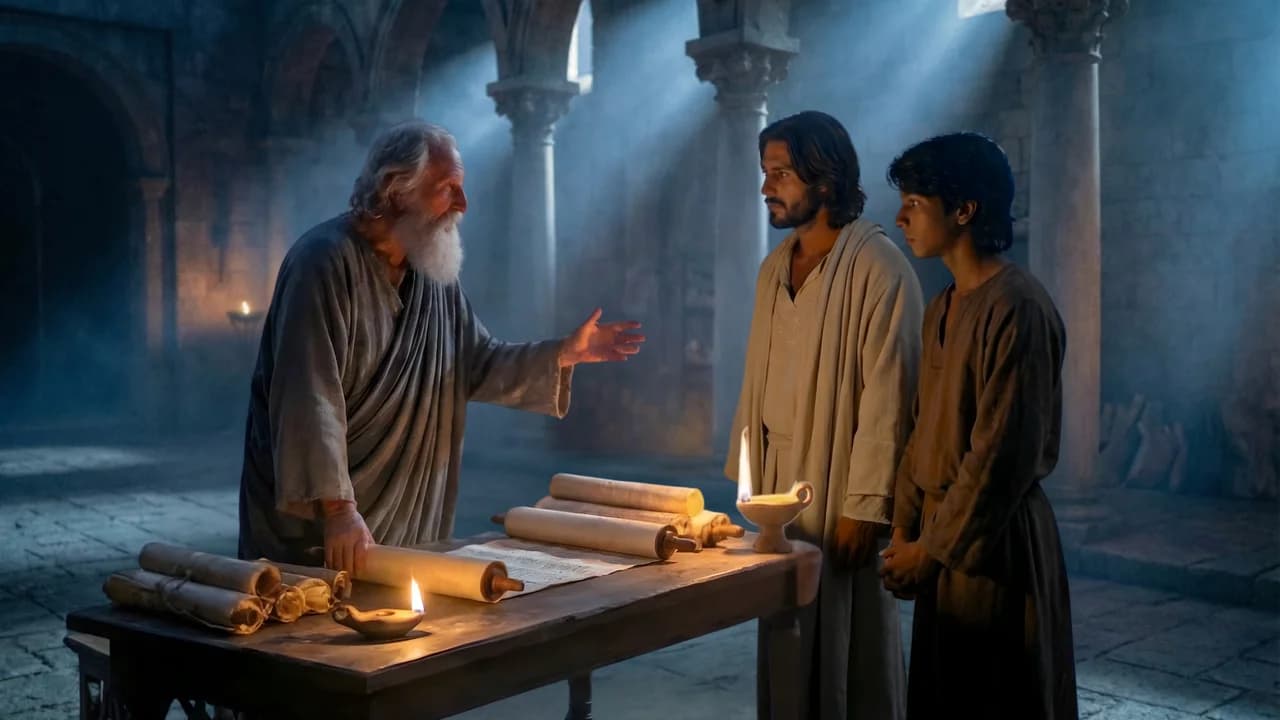
During their visit to the Great Library of Alexandria, young Ganid employed over 60 translators to collect the world's religious writings. What he discovered changed his understanding of God forever.
Every tradition they studied contained echoes of the same truth, planted centuries earlier by the Salem missionaries of Machiventa Melchizedek.
One Source, Ten Streams
Machiventa Melchizedek incarnated at Salem around 1973 BC and sent missionaries across the ancient world. Each world religion preserves a fragment of that original teaching.
The Ten Traditions
Cynicism
131:1Salem Connection
Greek Cynics inherited the tradition of radical simplicity and devotion to truth that traces back to Salem missionaries who reached the Mediterranean world.
โThe soul of man cannot be restrained by, or confined to, the bounds of any creed or the limitations of any institution.โ
UB 131:1
Golden Rule
Do not do to others what you would not want done to you.
Cicero (De Natura Deorum I.32) records Antisthenes taught "there are many gods of popular belief, but only one God in nature" -- explicit monotheism anomalous in Greek philosophy. F.G. Downing (Cynics and Christian Origins, 1992) documents how Cynic street preachers were virtually indistinguishable from early Jewish missionaries. John Moles argues Cynic universalism has no adequate Greek precedent and may reflect external influence.
Judaism
131:2Salem Connection
The most direct line. Machiventa Melchizedek incarnated at Salem and personally trained Abraham, who carried the one-God teaching into Hebrew culture.
โThe Lord our God is one Lord, and you shall love the Lord your God with all your heart and with all your soul.โ
UB 131:2
Golden Rule
What you hate, do not do to anyone.
Frank Moore Cross (Canaanite Myth and Hebrew Epic, 1973): "El Elyon" (God Most High) predates Yahwism. Dead Sea Scrolls 11Q13 (c. 100 BCE) portrays Melchizedek as "an enormously exalted divine being, to whom are applied names generally reserved for God alone." The Amarna Letters (c. 1350 BC) reference Urusalim as an established sacred city. Margaret Barker (1992): the Melchizedek tradition represents an older, suppressed strand of Israelite religion.
Buddhism
131:3Salem Connection
Salem missionaries reached India and planted seeds of monotheism that influenced Gautama Siddhartha. Buddhist compassion echoes Salem teachings on mercy.
โAll mourning, lamentation, and pain shall be done away with. Where there is truth, righteousness, and an ever-living hope, there is joy.โ
UB 131:3
Golden Rule
Hurt not others in ways that you yourself would find hurtful.
Mesopotamia-Indus Valley trade (3rd-2nd millennium BC) is archaeologically indisputable: Indus seals found at Ur; Mesopotamian imports at Mohenjo-daro. The BMAC (Bactria-Margiana) corridor served as a religious-cultural crossroads. Johannes Bronkhorst (Greater Magadha, 2007) argues the sramana movement was non-Vedic and culturally distinct -- representing a separate religious substrate consistent with external missionary influence.
Hinduism
131:4Salem Connection
Salem missionaries penetrated India long before the Vedic period, planting the concept of one supreme deity. Brahman as the universal ground of being echoes Salem monotheism.
โGod is our sure refuge. In him who is the great Source of all creation, let men find shelter.โ
UB 131:4
Golden Rule
Do nothing to others which would cause you pain if done to you.
The Vedic-to-Upanishadic transition remains genuinely unexplained by purely internal factors. Rig Veda 10.129 (Nasadiya Sukta) posits a single creative principle before the gods themselves -- proto-monotheism within the Vedic corpus. Thomas McEvilley (The Shape of Ancient Thought, 2002) argues for bidirectional philosophical exchange between Greece and India via shared intermediary sources. The BMAC transmission corridor is archaeologically proven.
Zoroastrianism
131:5Salem Connection
Zoroaster was directly influenced by the Salem tradition. His concept of Ahura Mazda, one supreme God of truth and light, is a recognizable descendant of Melchizedek's teaching.
โGod is most wise and is the creator of all things. He is the righteous judge of all mankind.โ
UB 131:5
Golden Rule
Do only that which you would have done to you.
Zoroaster's monotheism has no adequate purely Iranian explanation. W.F. Albright (From the Stone Age to Christianity, 1957) noted it "cannot be fully explained by purely Iranian developments." In the Gathas, Zoroaster speaks as a reformer reviving an older truth, not as an innovator. Mary Boyce documents extensive Zoroastrian-Jewish parallels (angels/demons, resurrection, final judgment) best explained by a common earlier source. UB dating (~1000 BC) falls within the mainstream linguistic dating range.
Suduanism (Jainism)
131:6Salem Connection
The Jainist emphasis on non-violence and truthfulness preserves fragments of the Salem teaching of respect for all life and the supremacy of truth.
โHe who is free from sloth, who is wise, who helps others: such a one may hope to achieve the supreme liberation.โ
UB 131:6
Golden Rule
In happiness and suffering, in joy and grief, regard all creatures as you regard your own self.
Jainism's anti-Brahmanical character and sramana roots are consistent with the Salem thesis. Bronkhorst (Greater Magadha, 2007) argues the sramana tradition had non-Vedic, possibly external roots. Archaeological evidence of Parshvanatha (23rd Tirthankara) confirms Jain roots older than Buddhism. Jain caves and inscriptions cluster in regions historically connected to Persian Gulf maritime trade routes.
Shinto
131:7Salem Connection
Salem missionaries reached Japan through China and Korea. Shinto reverence for the divine in nature echoes the Salem concept of God as present in all creation.
โIf the people will not feel ashamed of that which is unworthy, there shall come upon them a great iniquity.โ
UB 131:7
Golden Rule
The injury of a neighbor is our injury; the good done to him is our good.
Joseph Kitagawa (On Understanding Japanese Religion, 1987) showed continental Asian religious ideas fundamentally shaped early Japanese religion. The concept of Ame-no-Minakanushi ("Lord of the Center of Heaven") in the Kojiki (712 AD) is a proto-monotheistic element. Roman glass beads in Japanese Kofun-period tombs prove goods -- and presumably ideas -- traveled the full Mesopotamia-to-Japan distance. The transmission chain is physically possible but very long.
Taoism
131:8Salem Connection
Lao-tse received the Salem concept of God as the uncaused First Cause. The Tao as the "Way" echoes Melchizedek's teaching of one universal divine path.
โGod is the all-supreme treasure of man. This divine One is generous and beneficent; he freely gives to all who will seek him.โ
UB 131:8
Golden Rule
The good man treats as good those who are good and also treats as good those who are not good.
The Tao Te Ching presents the Tao as unnameable, uncreated, and prior to heaven and earth -- remarkably close to Semitic monotheism stripped of personality. Tarim Basin mummies (c. 1800 BC) prove people from the west were physically present in China at the right time period. Victor Mair (1990) notes possible Indo-European connections to Taoism. Shang Di ("Lord on High") may be the older personal supreme God that the Tao concept depersonalized.
Confucianism
131:9Salem Connection
Confucius built his ethical framework on foundations laid by earlier Salem missionaries in China. His emphasis on right relationships reflects the brotherhood of man under one Father.
โThe will of Heaven is all-inclusive. It makes no distinction of rich and poor; it is always with the good man.โ
UB 131:9
Golden Rule
Do not do to others what you do not want them to do to you.
Shang Di (Lord on High) appears fully formed in Shang Dynasty oracle bone inscriptions (c. 1600 BC) as the supreme deity -- with no developmental sequence showing gradual emergence. David Keightley (Sources of Shang History, 1978): Shang Di is categorically supreme, not "one god among many." Confucius explicitly said "I transmit but do not innovate; I am devoted to antiquity" (Analects 7.1) -- self-identifying as a restorer, not an innovator.
"Our Religion": Ganid's Synthesis
131:10Salem Connection
Ganid, guided by Jesus himself, compiled all the traditions and synthesized them into a personal religion of one universal Father. This was the culmination of Melchizedek's original teaching.
โOur religion is simply the living of a life of worshipful recognition of God, wholehearted service to man, and a hopeful trust in the survival of the mortal soul.โ
UB 131:10
The universality and near-identical phrasing of the Golden Rule across all these traditions is a genuine scholarly puzzle. Jeffrey Wattles (The Golden Rule, 1996) traces it across all major traditions. C.S. Lewis (The Abolition of Man, 1943) compiled parallel moral teachings he called "the Tao." Karl Jaspers' "Axial Age" (800-200 BC) simultaneity problem has no accepted solution -- the Salem thesis provides one. Every link in the Salem-to-Japan trade route chain is archaeologically proven for the 2nd millennium BC.
The Golden Rule: 9 Voices, One Truth
Every tradition Ganid studied contained a version of the same ethical core. Here they are, side by side.
โDo not do to others what you would not want done to you.โ
โWhat you hate, do not do to anyone.โ
โHurt not others in ways that you yourself would find hurtful.โ
โDo nothing to others which would cause you pain if done to you.โ
โDo only that which you would have done to you.โ
โIn happiness and suffering, in joy and grief, regard all creatures as you regard your own self.โ
โThe injury of a neighbor is our injury; the good done to him is our good.โ
โThe good man treats as good those who are good and also treats as good those who are not good.โ
โDo not do to others what you do not want them to do to you.โ
Ganid's Breakthrough
โI will no longer be satisfied to believe that God is the Father of all my people; I will henceforth believe that he is also MY Father.โ
UB 131:10.6
Research Library
Curated external resources for independent study. Visual aids, primary documents, and scholarly analysis from trusted authors.
Archaeology & Astronomy
Architecture of the Universe and the UB
Frederick L. Beckner
Stars, Galaxies, Superuniverses and the UB
Frederick L. Beckner
Earth-Moon Evolution
Dr. Phil Calabrese
Monmatia Revisited
Bill Laurune
A Tale of Two Orvontons
Dick Bain
Urantia, 606 of Satania
Israel Dix
Jesus the Boatbuilder and the Ancient Boat
Saskia Praamsma
Atlantis/UB Eden Parallels
Robert Sarmast
First Eden/Atlantis Analysis
Commodore Robert Bates
Ancient Cyprus
Stefan Tallqvist
Cosmic View of the Universe Architecture
A.A. Zachow
Visual Study Aids
The Family Tree of Humanity
Saskia Praamsma
Life Establishment on Urantia (Paper 58)
Saskia Praamsma
Marine Life Era (Paper 59)
Saskia Praamsma
Papers 61-62: Primates to Man Pictorial
Saskia Praamsma
The Human Race: Papers 62-80
Saskia Praamsma
The Living Universe: Our Journey to Paradise
Chick Montgomery & Saskia Praamsma
Evolution Charts (1983 + 2019)
Saskia Praamsma
Urantia Study Aids Collection
Hara Davis
Rob Mastroianni UB Concepts
Rob Mastroianni
Topical Index of the Urantia Book
David Kantor
Movement History: Primary Documents
"I Remember the Forum"
Ticky Harries
The 1942 Forum Petition
Primary Document
Sherman's Suggestions to Sadler re: Book Publishing
Harold Sherman (1942)
Sherman's Suggestions re: Organizations
Harold Sherman (1942)
The Plan for the Urantia Book Revelation
Carolyn B. Kendall
The Forumites (Full Roster)
Saskia Praamsma
533 Diversey Parkway
Saskia Praamsma
The Contact Commission
Community
The Split: A Blessing in Disguise
Saskia Praamsma
The Urantia Diaries
Harold & Martha Sherman
Forum Data and Apocrypha
Urantia Diaries Vol. 2
Webster Stafford's 1952 Urantia Report
Primary Document
Evolution of the Soul (Sadler Lecture, 1941)
Dr. William S. Sadler
Sir Hubert Wilkins and the Urantia Book
Saskia Praamsma
A.A. Zachow: Revelation Worker
Saskia Raevouri
Harold Sherman and Urantia
Historical
Harry Loose
Harold Sherman
Value of an Accurate History
Saskia Praamsma
1915: The Sadlers and Chautauqua
Univ. of Iowa Libraries
Published Books
Exploring the Urantia Revelation: Bridging Science and Spirit with the Truth of Reality
JJ Johnson
Skyhorse Publishing, 2025 -- 408 pages documenting where the UB anticipated science by decades
Rocking the Boat: Is It Time to Update Christianity?
Lowel Pierce
2023 -- Uses the Bible and UB to examine atonement theology, the Gospels, and Jesus's actual message
Read the full text of Paper 131, all 10 traditions in Ganid's own compilation.