
Sudden Animals: The Cambrian Explosion and the Record's Date for the Dawn of Life
The Urantia Book says the first multicellular animals appeared suddenly and without gradation ancestry, and dates the planting of marine life at 550 million years ago. Modern paleontology calls that suddenness the Cambrian explosion, and dates the first skeletal animals at 550 million years. The convergences, and the honest contradictions, side by side.
The Sentence Paleontology Recognizes
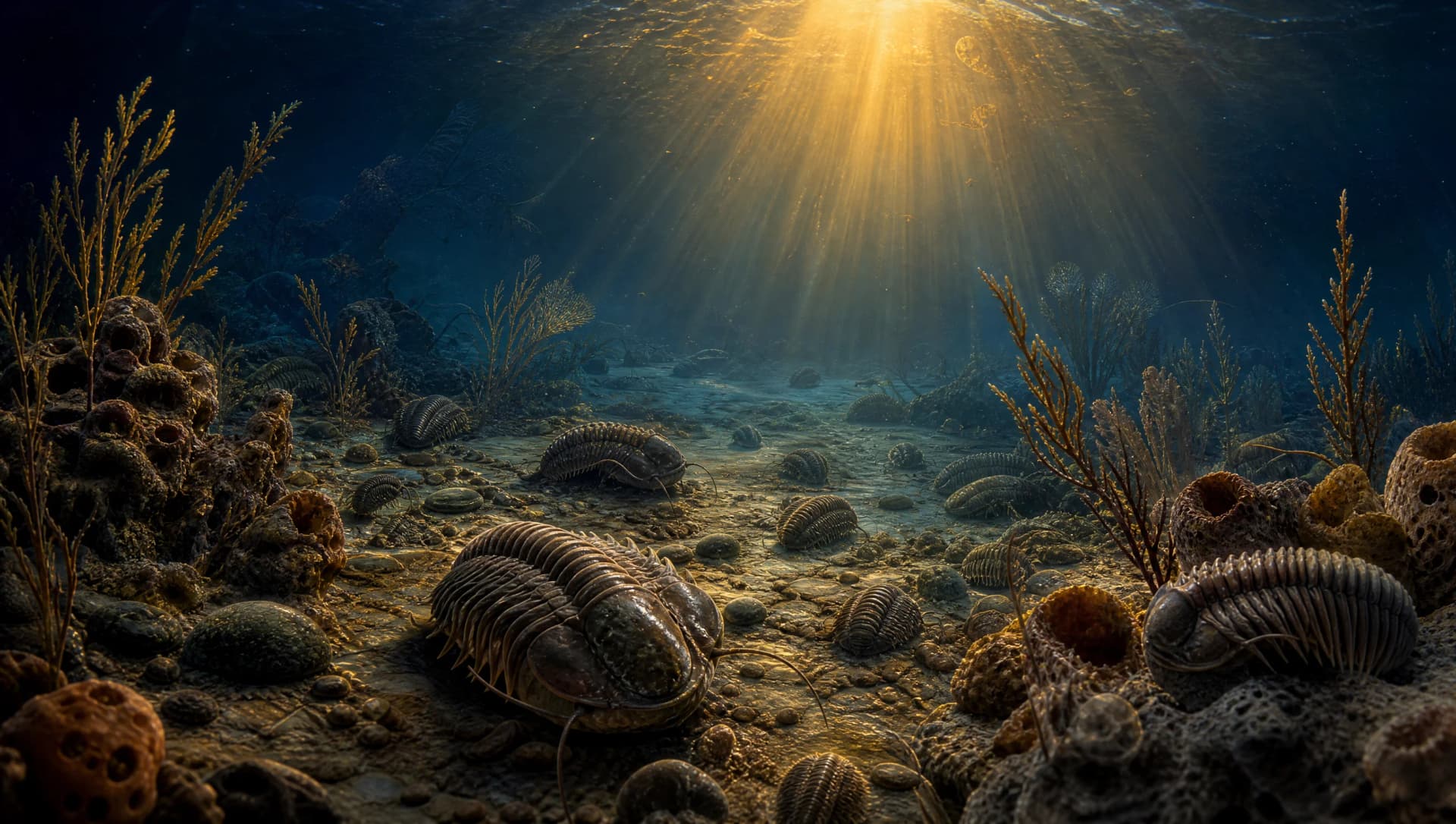
Charles Darwin considered the base of the Cambrian rocks the gravest objection to his theory. Complex animals, trilobites with jointed legs and compound eyes, appear in the fossil record abruptly, fully formed, with no visible chain of simpler ancestors beneath them. He hoped future collecting would fill the gap. A century and a half later, the gap has sharpened into one of paleontology's defining events, with a name every textbook uses: the Cambrian explosion.
Here is the Urantia Book's account of the same moment, published in 1955:
"Suddenly and without gradation ancestry the first multicellular animals make their appearance. The trilobites have evolved, and for ages they dominate the seas. From the standpoint of marine life this is the trilobite age." (59:1.4)
Suddenly, and without gradation ancestry. The record does not soften the abruptness that troubled Darwin; it italicizes it. And it describes the trilobite age with a naturalist's affection for detail:
"But the trilobites were the dominant living creatures. They were sexed animals and existed in many forms; being poor swimmers, they sluggishly floated in the water or crawled along the sea bottoms, curling up in self-protection when attacked by their later appearing enemies. They grew in length from two inches to one foot and developed into four distinct groups: carnivorous, herbivorous, omnivorous, and “mud eaters.”" (59:1.19)
"The trilobites were still prominent. These little animals existed in tens of thousands of patterns and were the predecessors of modern crustaceans. Some of the trilobites had from twenty-five to four thousand tiny eyelets; others had aborted eyes." (59:2.10)
The record has its own explanation for the suddenness, and it is candid about being an explanation science cannot supply: the life was planted.
At a Glance
| Key figure | The record | Modern science |
|---|---|---|
| How animals appear | "Suddenly and without gradation ancestry" (59:1.4) | The Cambrian explosion, paleontology's named discontinuity |
| Life-dawn date | 550 million years ago (58:4.2) | First skeletal animals (Cloudina): about 551 to 550 million years ago |
| The era's own estimate | Base of Cambrian near 500 million on the 1930s-40s Holmes timescale | |
| Cambrian begins | 538.8 million years ago, plus or minus 200 thousand (ICS) | |
| Oldest animal fossils | Ediacaran macrofossils from 576 million years; Dickinsonia confirmed at 558 million | |
| Oldest life of any kind | The implantations of 58:4.2 | Microbial life at 3.48 billion years. A logged contradiction, see the ledger |
The Date: 550 Million Years
The record's Life Carriers, the beings it describes as responsible for establishing life on evolutionary worlds, are said to have surveyed this planet and then acted:
"600,000,000 years ago the commission of Life Carriers sent out from Jerusem arrived on Urantia and began the study of physical conditions preparatory to launching life on world number 606 of the Satania system." (58:1.1)
"It should be made clear that Life Carriers cannot initiate life until a sphere is ripe for the inauguration of the evolutionary cycle. Neither can we provide for a more rapid life development than can be supported and accommodated by the physical progress of the planet." (58:1.2)
"550,000,000 years ago the Life Carrier corps returned to Urantia. In co-operation with spiritual powers and superphysical forces we organized and initiated the original life patterns of this world and planted them in the hospitable waters of the realm. All planetary life (aside from extraplanetary personalities) down to the days of Caligastia, the Planetary Prince, had its origin in our three original, identical, and simultaneous marine-life implantations." (58:4.2)
550 million years ago, in shallow, sheltered marine waters, the record had already described the stage being set: "long fingerlike seas providing those shallow waters and sheltered bays which are so suitable as a habitat for marine life" (57:8.24).
Now line that date up against two rulers: the science of the era in which the papers were written, and the science of today.
When the papers are said to have reached completion, in the mid-1930s, the geological timescale was young. Arthur Holmes, its principal architect, placed the base of the Cambrian, which era science treated as the effective dawn of visible life, near 500 million years in his 1930s and 1947 scales; only by 1959 had the estimate stretched toward 600 million. A writer borrowing the era's number for the dawn of animal life would have written 500 million.
Today's ruler, refined by decades of radiometric calibration, reads as follows. The Cambrian period begins at 538.8 million years ago, defined to a precision of 200 thousand years at a golden spike in Newfoundland. Trilobites appear about 521 million years ago, and a 2019 study in the Proceedings of the National Academy of Sciences concludes the explosive phase of diversification had ended by about 519 million. Before the Cambrian, the large soft-bodied Ediacaran organisms appear from about 576 million years ago, with the oldest chemically confirmed animal, Dickinsonia, at about 558 million. And the first animals that built hard skeletons, the tube-forming Cloudina and its kin, appear in terminal Ediacaran rocks at approximately 551 to 550 million years ago.
The record's date for the planting of the life that would become the animal kingdom is 550 million years. The modern date for the first skeletal marine animals is 550 million years. The era's own best number missed by fifty million; the record's number lands inside the window that twenty-first century geochronology finally drew.

The Sea Inside You
One more passage belongs here. Explaining why the implantations required a salty ocean, the record writes:
"The Urantia type of protoplasm can function only in a suitable salt solution. All ancestral life—vegetable and animal—evolved in a salt-solution habitat. And even the more highly organized land animals could not continue to live did not this same essential salt solution circulate throughout their bodies in the blood stream which freely bathes, literally submerses, every tiny living cell in this “briny deep.”" (58:1.3)
Your bloodstream as a private ocean, carrying the ancient sea to every cell. The observation that blood plasma chemically echoes seawater was live science in the early twentieth century and remains a beloved physiological observation today. The record uses it the way it uses the trilobite eyelets: not as proof, but as texture, the voice of authors who claim to have watched.
The Ledger, and It Is a Serious One
This article's honesty section carries more weight than most, and we do not shrink it.
First, and largest: modern science holds that life on Earth is far older than 550 million years. Fossil stromatolites in Australia's Dresser Formation, generally accepted as microbial, are 3.48 billion years old. Contested evidence reaches back to 3.7 billion, and a 2024 genomic clock study in Nature Ecology and Evolution places the last universal common ancestor near 4.2 billion years. A straightforward reading of the record, in which the oceans held no life before the implantations of 550 million years ago, contradicts that evidence flatly. Readers of the record have proposed reconciliations; the plain scientific position is that microbial life long predates the record's date, and we state it without decoration.
Second, the record's internal dates for the trilobite age run young. Paper 59 distributes trilobite events around its 400 million year markers (59:1.2), where modern dating puts the first trilobites at 521 million. This is the compressed timescale of the era, visible elsewhere in the book, and the record's own disclaimer anticipates such aging: "...within a few short years many of our statements regarding the physical sciences will stand in need of revision in consequence of additional scientific developments and new discoveries." (101:4.2)
Third, the suddenness itself is no longer quite as absolute as it looked from 1859, or from 1955. Modern paleontology has found the fuse of the explosion: Ediacaran fronds by 576 million years, trace fossils, small shelly faunas. The appearance of complex animals now looks like a rapid crescendo rather than a single leap from silence to noise. The record's own sequence, plants first, then a distinct and sudden animal debut, fits that crescendo better than a literal single-day reading, but we do not pretend the fit is perfect.
What Stands
Three things survive the ledger intact. The record committed to the suddenness of animal origins in the exact place paleontology still marks its greatest discontinuity, and did so approvingly, without embarrassment, because its account predicted discontinuity. It set the stage in shallow, sheltered coastal waters, which is where the Ediacaran and Cambrian faunas actually lived. And it wrote 550 million years when the science of its own day would have told it 500, a number that now sits on the modern date for the first animals with skeletons.
A skeptic may fairly call the microbial contradiction disqualifying, and a believer may fairly call the 550 million figure extraordinary. We publish both readings. The record asks to be checked against the rocks; on the suddenness and the date it checks out better than it has any era-bound right to, and on the age of the deepest life it does not check out at all.
Keep Reading
The First Crack follows the continental breakup that made the shallow seas of this story. The Record and the Science holds the astronomy ledger. And Paper 58 and Paper 59 of the record itself remain, whatever a reader concludes, one of the strangest and most detailed accounts of deep time ever put inside a religious book: era by era, sea by sea, with the trilobites counted eyelet by eyelet.
Connecting Articles

The First Crack: Continental Drift and the Date of 750 Million Years

Other Inhabited Worlds: What the Urantia Book Says About Life Across the Cosmos

The Submerged Peninsula: A Geophysical and Textual Case for the Levantine Location of the First Eden

The Adjudication of Urantia: What Happens When the Lucifer Era Ends
The Newsletter
Get the research behind each piece
Free. New Urantia Book explorations, the sources behind the videos, and early looks. No spam, unsubscribe anytime.
Prefer video? Follow on YouTube and Facebook.
Delivered through Substack. You can also read past issues.