
From Andon to the Blue Man: Neanderthal, Cro-Magnon and the Adamites in One Story
Four names readers keep mixing up, one line of descent. The Urantia Book gives the Neanderthals an Andonic root, sends the blue man into Europe to lift them, and says the Adamites blended with the blue men to produce groups "one of which you have denominated the Cro-Magnons" (80:1.7).
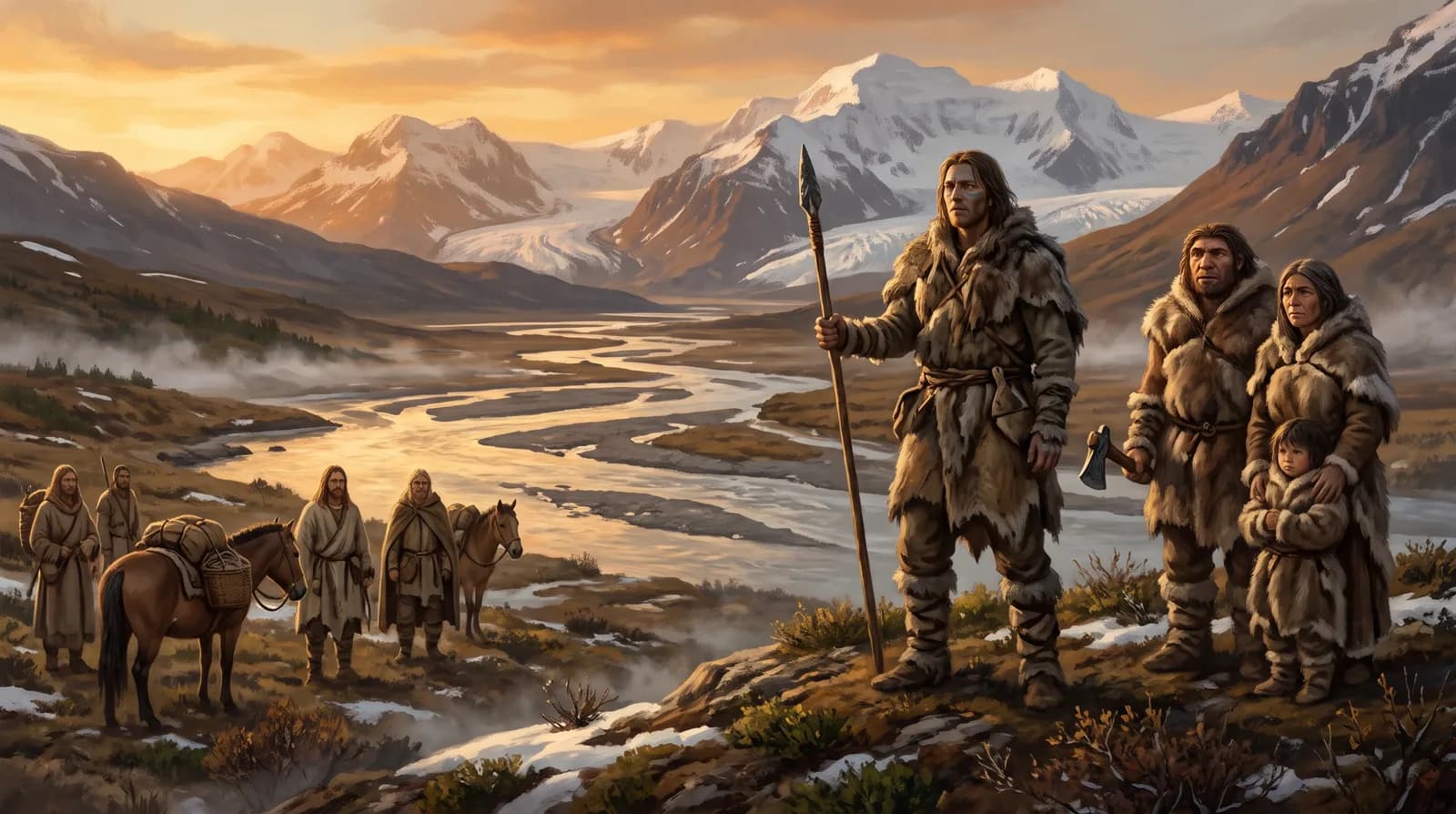
From Andon to the Blue Man
Four names readers keep mixing up, one line of descent
Derek Samaras | Urantia Book Network | November 2026
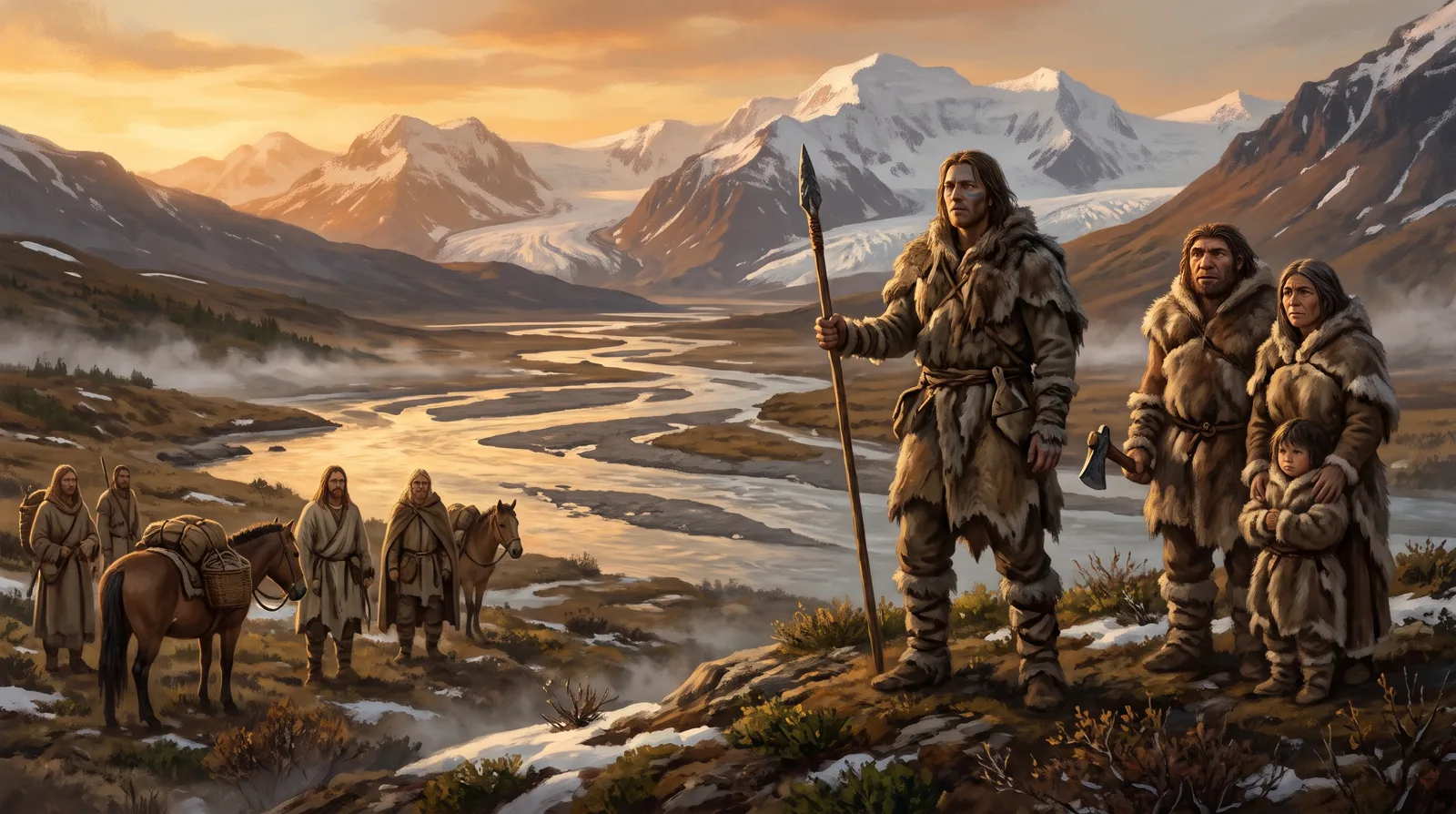
A reader, John Kimball, wrote in with a request: "I would like to see some clarity regarding the Adamic race, Neanderthals, Cro-Magnon and the blue race into a coherent narrative."
It is a fair ask. The four names show up in different papers, written by different authors, across hundreds of thousands of years. Are the Neanderthals and the blue men rivals? Are the Cro-Magnons a separate race, or the same people under another name? Where do Adam's children fit?
Here is the short answer, and then the long one.
In one sentence: the book gives the Neanderthals an Andonic root (64:3.5), has the blue man of the Sangik line arrive in Europe and lift them (64:7.9 to 64:7.10), has Adamite blood then refine the best of the blue men into the Cro-Magnons (80:1.7), and has the later white wave from the east absorb the Cro-Magnons (80:3.9, 80:5.3).
That is one family story, told in five steps. Every step below is cited so you can check it yourself.
A few terms first
- Andonites (Andonic): the descendants of Andon and Fonta, the first human pair (Paper 63).
- Sangik: the six colored races, red, orange, yellow, green, blue and indigo, born in one family (64:5.3).
- Adamites (Adamic): the violet race of Adam and Eve and their children (Papers 73 to 76).
- Andites: Adamites blended with Nodite and Sangik peoples (78:0.1).
One note for John. "Adamic" and "Andonic" look alike, but they point to opposite ends of the story. Andonic means the first humans, nearly a million years back. Adamic means the violet race that arrived only about 38,000 years ago. Most of the confusion around this subject starts with those two words.
Step One: Andon and Fonta, the First Human Family
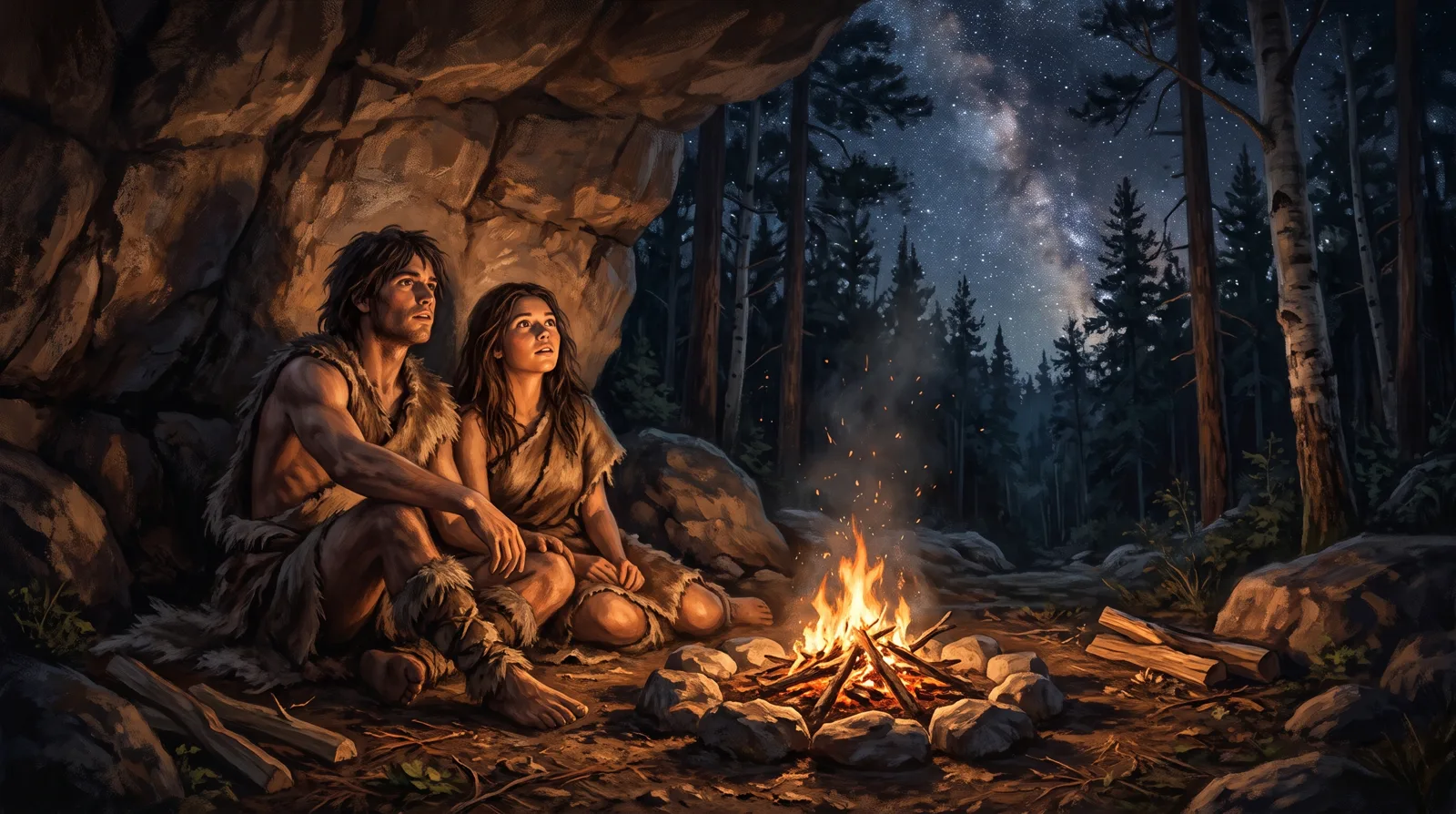
The story starts with two people. The book calls them "the actual parents of all mankind" (63:1.1), and the archangels gave them their names: "these parents of the new race shall be called Andon and Fonta." (63:0.2)
Their children spread out. The book says "the geography of those times pointed them north" (63:5.1). Over time their culture slipped. "As the Andonic dispersion extended, the cultural and spiritual status of the clans retrogressed for nearly ten thousand years until the days of Onagar" (63:6.1). (We tell Onagar's story in Onagar, the First Truth Teacher.)
Hold on to Andon's name. It comes back in every step that follows.
Step Two: The Neanderthals Come From Andon's Line
Here is the first point of clarity, and it may surprise readers who think of Neanderthals as a separate species or a dead branch. In the Urantia Book, the Neanderthals are Andon's own descendants.
Their story begins with the Badonan hill tribes of northwest India, a branch of the Andonites. "850,000 years ago the superior Badonan tribes began a warfare of extermination directed against their inferior and animalistic neighbors." (64:3.5) That harsh campaign "brought about a slight improvement in the hill tribes of that age. And the mixed descendants of this improved Badonite stock appeared on the stage of action as an apparently new people" (64:3.5): the Neanderthals.
Note the word "apparently." They looked new. They were not new. When the blue man later meets them in Europe, the book calls them "the Neanderthal descendants of their early and common ancestor, Andon." (64:7.9)
How they lived
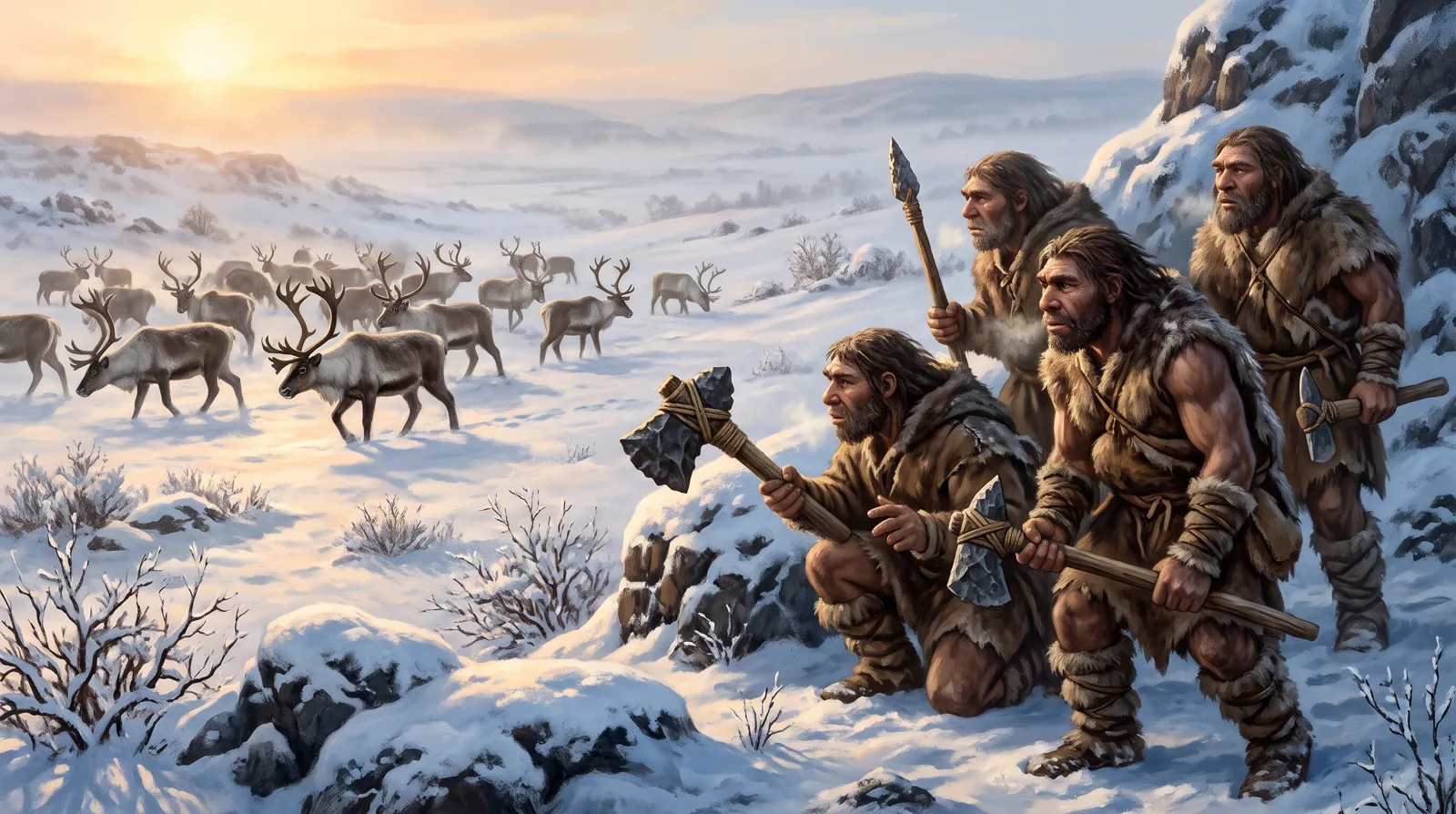
The Neanderthals were tough and they traveled. "The Neanderthalers were excellent fighters, and they traveled extensively. They gradually spread from the highland centers in northwest India to France on the west, China on the east, and even down into northern Africa. They dominated the world for almost half a million years until the times of the migration of the evolutionary races of color." (64:4.1)
They were hunters in a rich land. "The Neanderthalers were great hunters, and the tribes in France were the first to adopt the practice of giving the most successful hunters the choice of women for wives." (64:4.2) The reindeer was central to their lives. "They had little culture, but they greatly improved the work in flint until it almost reached the levels of the days of Andon." (64:4.3)
The slow decline
Yet over the long haul they slid backward. "For almost a quarter of a million years these primitive peoples drifted on, hunting and fighting, by spells improving in certain directions, but, on the whole, steadily retrogressing as compared with their superior Andonic ancestors." (64:4.11)
The book adds a detail about the eastern part of their range. "While the early Neanderthalers were spread out over the entire breadth of Eurasia, the eastern wing was the more contaminated with debased animal strains." (79:5.2) Those eastern types, it says, "were destroyed or driven off the mainland by the later migrating yellow tribes." (79:5.2) Keep that phrase "off the mainland" in mind. We come back to it in the science section.
Step Three: The Sangik Races and the Blue Man Arrive
The same Badonan stock produced a second surprise. "500,000 years ago the Badonan tribes of the northwestern highlands of India became involved in another great racial struggle." (64:5.1) When it ended, a small remnant survived: "But these survivors were the most intelligent and desirable of all the then living descendants of Andon and Fonta." (64:5.1)
In one of those families something new happened. "These Sangik children, nineteen in number, were not only intelligent above their fellows, but their skins manifested a unique tendency to turn various colors upon exposure to sunlight. Among these nineteen children were five red, two orange, four yellow, two green, four blue, and two indigo." (64:5.3)
So the blue man and the Neanderthal share an ancestor. Both come from Andon through the Badonan tribes. In our reading, that is the key to John's question: these are cousins, not strangers.
Who the blue man was
The book speaks warmly of him. "The blue man. The blue men were a great people. They early invented the spear and subsequently worked out the rudiments of many of the arts of modern civilization. The blue man had the brain power of the red man associated with the soul and sentiment of the yellow man. The Adamic descendants preferred them to all of the later persisting colored races." (64:6.21)
That last line is a hint of what comes later.
Into Europe
The primary Sangik races avoided the tropics, "the red man going northeast to Asia, closely followed by the yellow man, while the blue race moved northwest into Europe." (64:7.3)
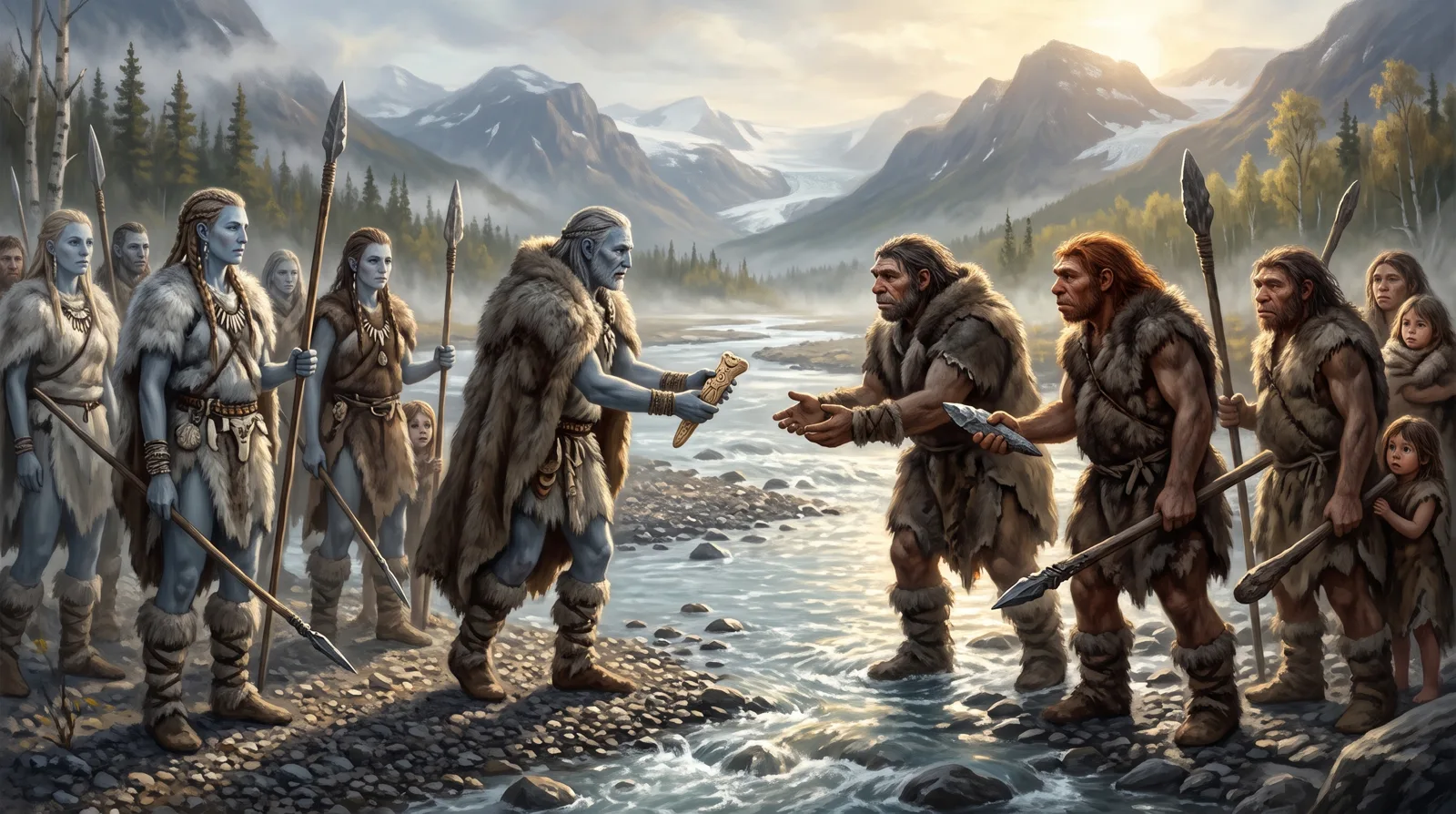
There they met their long-lost relatives. "In Europe they soon encountered the Neanderthal descendants of their early and common ancestor, Andon. These older European Neanderthalers had been driven south and east by the glacier and thus were in position quickly to encounter and absorb their invading cousins of the Sangik tribes." (64:7.9)
The meeting lifted the older race. "It was this infusion of Sangik blood, more especially that of the blue man, which produced that marked improvement in the Neanderthal peoples exhibited by the successive waves of increasingly intelligent tribes that swept over Europe from the east." (64:7.10)
The result spread far. "During the following interglacial period this new Neanderthal race extended from England to India." (64:7.11)
The mixing cut both ways. The book later says "Neanderthal absorption had greatly retarded the culture of the blue man, but he was otherwise the most aggressive, adventurous, and exploratory of all the evolutionary peoples of Eurasia." (78:1.8) The red and yellow men, by contrast, "largely escaped that admixture with the debased Neanderthal strain which so greatly retarded the blue man in Europe" (79:5.1).
A side note on the blue line. Not all the blue men went to Europe. "The remnant of the blue race left in the old Persian peninsula later amalgamated with certain others, primarily the yellow; and the resultant blend, subsequently somewhat upstepped by the violet race of Adam, has persisted as the swarthy nomadic tribes of modern Arabs." (64:7.11) The blue race also had its own leader honored on high: "Orlandof, a prince of the blue men and their leader in the recognition of the divinity of “The Supreme Chief.”" (45:4.6) And Serapatatia, who played a part in the default of Eve, descended from a Dalamatia leader "mated with one of the master female minds of the blue race of those distant days." (75:3.1)
Step Four: The Adamites Meet the Blue Man, and Cro-Magnon Is Born
Now the violet race enters. "ADAM AND EVE arrived on Urantia, from the year A.D. 1934, 37,848 years ago." (74:0.1) Even after the default, the book says "Adam’s contribution to the biologic status of the races, notwithstanding the partial failure of the undertaking, enormously upstepped the people of Urantia." (78:1.1)
The Adamites, and later the Andites, carried that gift outward. By about 15,000 B.C., the book says, Adam's descendants were thick in Europe and central Asia, and "the European blue races had been largely infiltrated." (78:3.5) (For the full routes, see The Andite Migrations.)
Who was waiting in Europe
The blue men of Europe were no longer one simple people. "While we speak of the blue man as pervading the European continent, there were scores of racial types. Even thirty-five thousand years ago the European blue races were already a highly blended people carrying strains of both red and yellow, while on the Atlantic coastlands and in the regions of present-day Russia they had absorbed a considerable amount of Andonite blood" (80:3.2).
The meeting
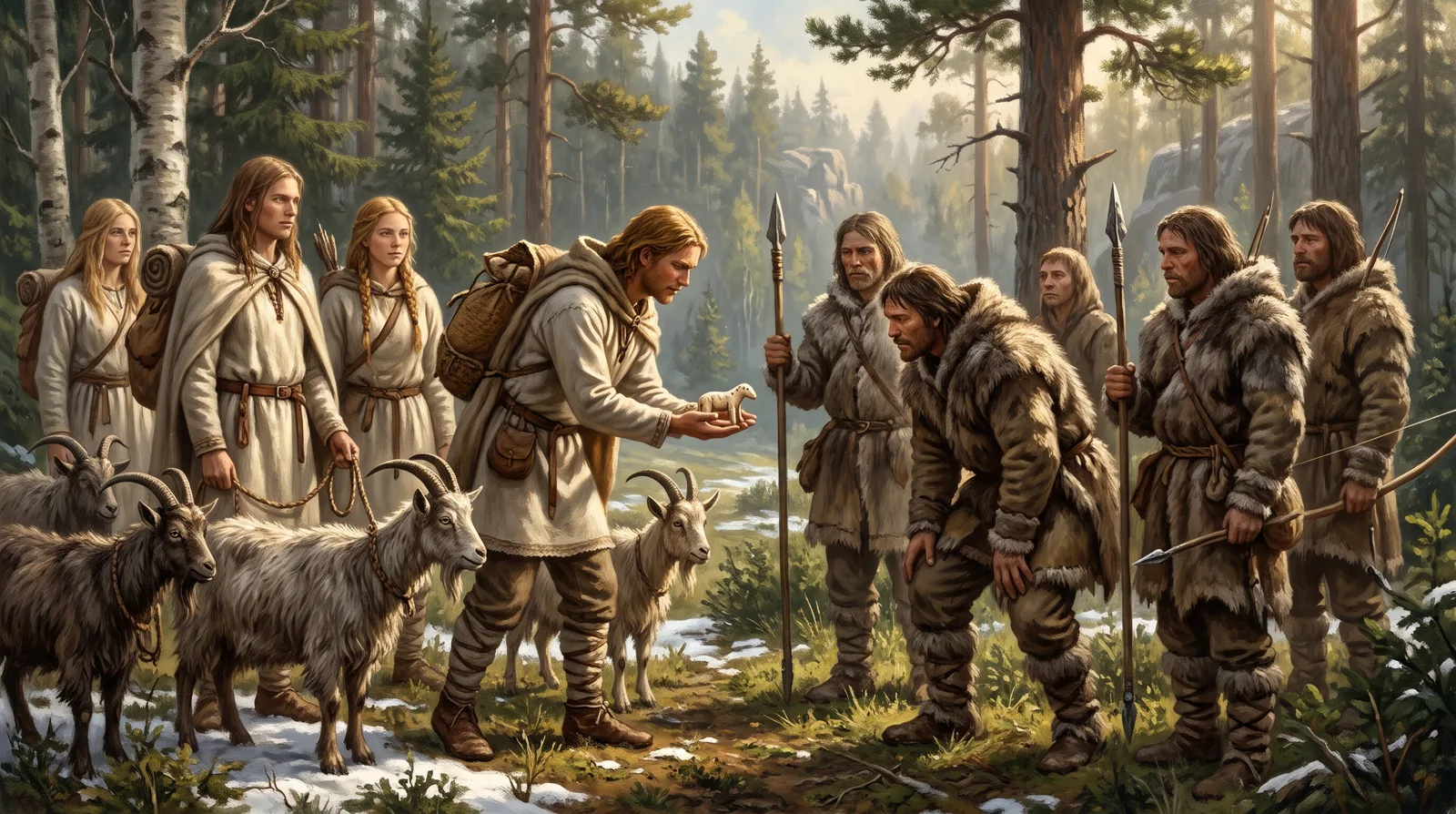
The book describes a real attraction. "The blue men, then dominant in Europe, had no religious practices which were repulsive to the earlier migrating Adamites, and there was great sex attraction between the violet and the blue races." (80:1.6)
Then comes the one sentence that ties the Cro-Magnon name to this story. "Slowly these migrating sons of Eden united with the higher types of the blue race, invigorating their cultural practices while ruthlessly exterminating the lingering strains of Neanderthal stock. This technique of race blending, combined with the elimination of inferior strains, produced a dozen or more virile and progressive groups of superior blue men, one of which you have denominated the Cro-Magnons." (80:1.7)
Read it slowly. Three things happen at once. Adamite blood blends with the best of the blue men. The last distinct Neanderthal strains are wiped out. And out of this come a dozen or more improved groups. The Cro-Magnons are one of them.
So the Cro-Magnons are not the whole blue race, and they are not a separate creation. In the book's words they are blue men, upstepped by Adam's children. This is the only place the book links the name to that blend, and we do not want to claim more for it than it says.
Cro-Magnon life
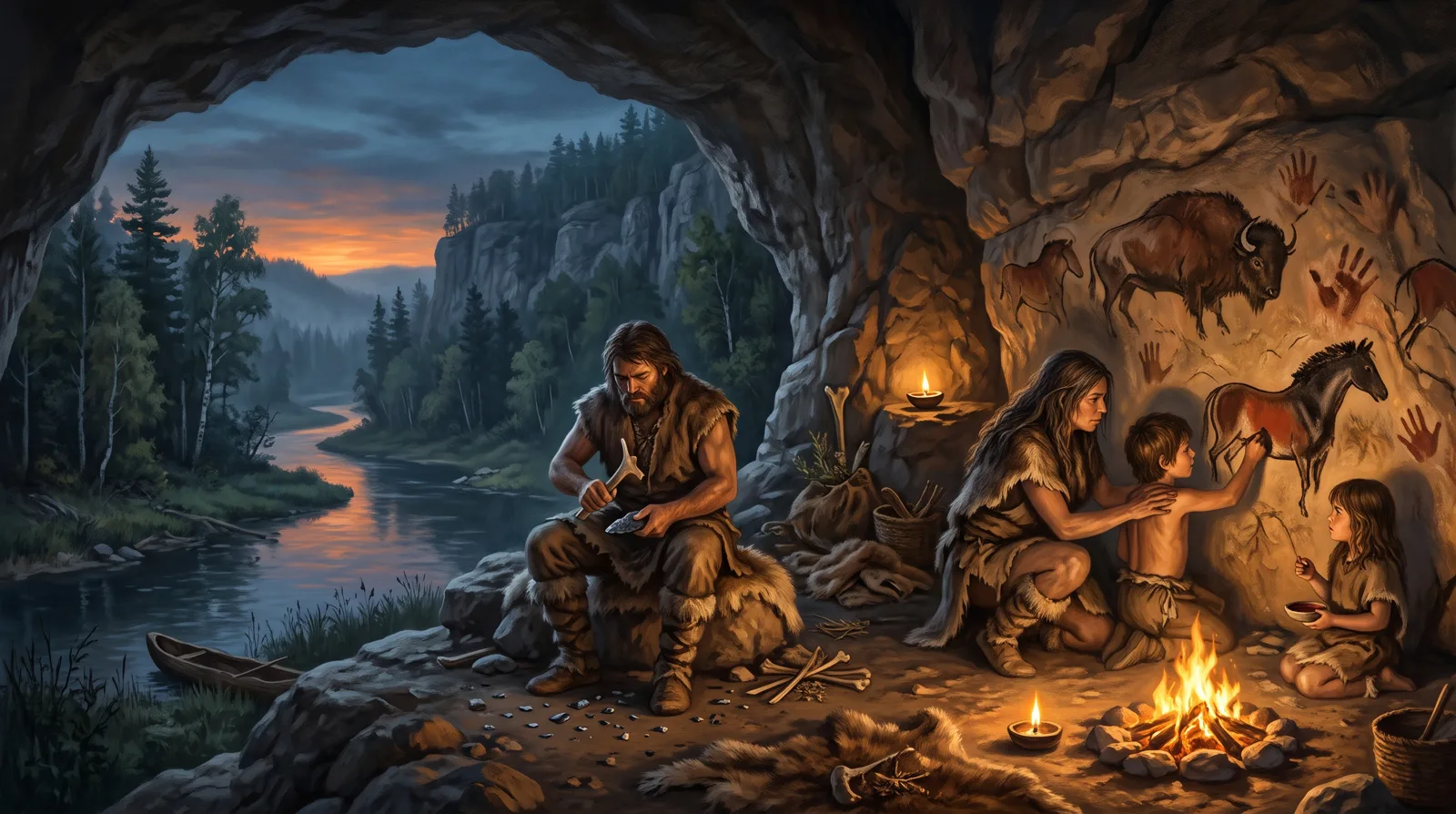
The book's portrait is a fond one. "These Cro-Magnon peoples were a brave and farseeing race. They maintained an efficient system of child culture. Both parents participated in these labors, and the services of the older children were fully utilized. Each child was carefully trained in the care of the caves, in art, and in flint making." (80:3.5)
"The blue men were hunters, fishers, and food gatherers; they were expert boatbuilders." (80:3.6) And "the southern Cro-Magnons generally lived in caves and grottoes." (80:3.6)
Step Five: The Long Decline and Absorption
Climate changed everything. "About fifteen thousand years ago the Alpine forests were spreading extensively." (80:3.8) The hunters had to become herders and farmers.
Settled life brought a hidden cost. The tribes "began to save many of the mediocre captives as slaves. And it was the progeny of these slaves that subsequently so greatly deteriorated the whole Cro-Magnon type." (80:3.9) The decline ran "until it received a fresh impetus from the east when the final and en masse invasion of the Mesopotamians swept over Europe, quickly absorbing the Cro-Magnon type and culture and initiating the civilization of the white races." (80:3.9)
Not everyone went quietly. "The advancing tribes of the mixed white race met with stubborn and protracted resistance from the Cro-Magnons, but superior intelligence and ever-augmenting biologic reserves enabled them to wipe the older race out of existence." (80:5.3)
Yet the Cro-Magnon line did not simply vanish. "The Cro-Magnoid blue man constituted the biologic foundation for the modern European races, but they have survived only as absorbed by the later and virile conquerors of their homelands." (80:5.7) In the south, more survived: "The Basques and the Berbers represent the survival of two branches of this race" (80:9.11).
Why the caves remember them
The book even explains a puzzle in the record. The early white Nordics cremated their dead and "never lived in caves. And again this explains why there are so few evidences of the white man’s early culture, although the preceding Cro-Magnon type is well preserved where it has been securely sealed up in caves and grottoes." (80:9.4)
From there the blends of Europe "became generalized into the three white races" (80:9.1), which is a story for another article.
The Whole Line in One Table
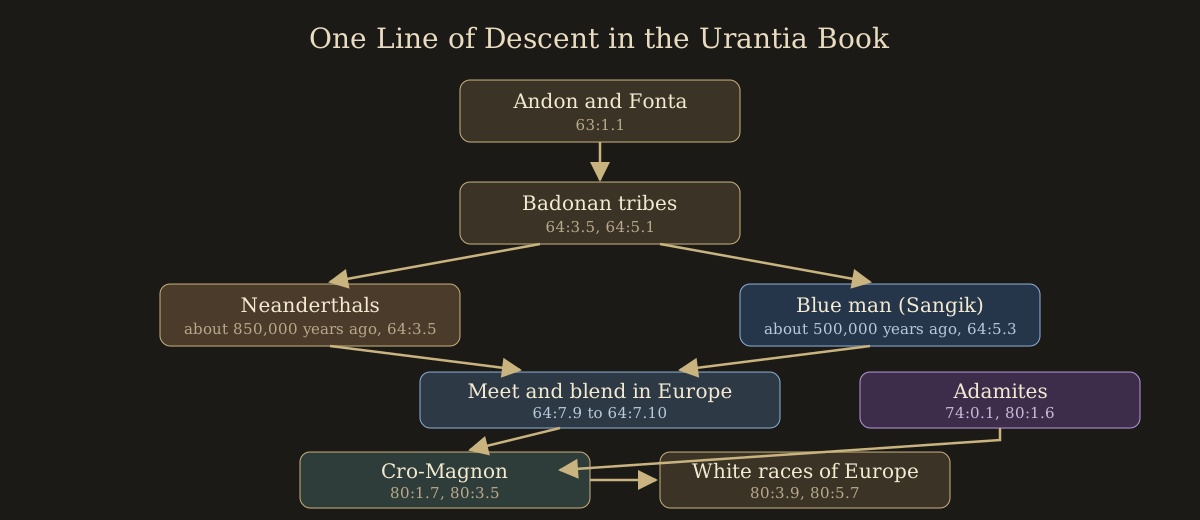
| Step | People | Where the line comes from | What became of them | Key refs |
|---|---|---|---|---|
| 1 | Andonites | Andon and Fonta | Spread north, culture declined | 63:1.1, 63:6.1 |
| 2 | Neanderthals | Badonan Andonites | Lifted by the blue man, last strains destroyed in the Adamite blending | 64:3.5, 64:4.1, 64:7.10, 80:1.7 |
| 3 | Blue man | Sangik, born in one Badonan family | Into Europe, blends with Neanderthal, red, yellow and Andonite strains | 64:5.3, 64:6.21, 64:7.3, 80:3.2 |
| 4 | Cro-Magnon | Blue men plus Adamites | Slow decline, absorbed by the later wave from the east | 80:1.7, 80:3.9, 80:5.3 |
| 5 | White races | Andite plus blue blends | The base of modern Europe | 80:5.7, 80:9.1 |
What Science Says
Here we step outside the book. We want to be fair in both directions: where the book and mainstream science line up, where they pull apart, and what is still open. None of this proves the book. Science changes, and the book was not written to match a textbook.
Supported: modern humans and Neanderthals interbred. The first draft Neanderthal genome showed that Neanderthals share more genetic variants with people outside Africa than with sub-Saharan Africans, pointing to gene flow into our ancestors (Green et al. 2010, Science 328:710). In the 1930s and 1950s, the textbook picture drew separate branches. The book's picture, two cousin peoples who "absorb" each other (64:7.9), fits the genetic finding.
Supported: mixing came in waves from the east. The book says the blended tribes "swept over Europe from the east" (64:7.10). The oldest modern human genomes yet found in Europe come from Bacho Kiro Cave in Bulgaria, dated 45,930 to 42,580 years ago, and all three individuals had Neanderthal ancestors only a few generations back (Hajdinjak et al. 2021, Nature). A jaw from Peştera cu Oase in Romania, 37,000 to 42,000 years old, had a Neanderthal ancestor four to six generations back (Fu et al. 2015, Nature 524:216). In our reading, this is one of the strongest fits in the whole subject.
Supported: an eastern archaic line pushed offshore. The book says the eastern Neanderthal strains were "driven off the mainland" (79:5.2). Today the highest Denisovan ancestry in the world is found off the Asian mainland, in the Ayta Magbukon of the Philippines (Larena et al. 2021, Current Biology). Science treats Denisovans as a sister line to Neanderthals. The book never uses the word Denisovan. Reading its eastern Neanderthal wing as including them is our reading, not the book's claim.
Supported in part: Cro-Magnon culture. The book's Cro-Magnons are cave dwellers, artists and flint makers (80:3.5). The real Cro-Magnon shelter at Les Eyzies in the Dordogne gave a radiocarbon date of 27,680 ± 270 years BP on a pierced shell, which points to the early Gravettian (Henry-Gambier 2002, BMSAP 14:89). By our calibration that is roughly 32,000 calendar years ago.
In tension: the order of events. The Neanderthal toolmaking culture across Europe ends by 41,030 to 39,260 calibrated years ago (Higham et al. 2014, Nature 512:306). The book has Adam arriving 37,848 years before 1934 (74:0.1), and Adamite groups still "exterminating the lingering strains of Neanderthal stock" (80:1.7) in Europe after that. On science's dates the Neanderthals were gone before Adam's descendants could reach Europe. The Cro-Magnon culture fits. The timing does not. We name that plainly.
In tension: how long ago. The book puts the Neanderthal start near 850,000 years ago (64:3.5) and has them dominant "for almost half a million years" (64:4.1). Mainstream science places the Neanderthals much later, in roughly the last few hundred thousand years. This is a real gap. We do not smooth it over.
Not supported: a gene for Adam's blood. Some readers have pointed to the brain-related gene variant Microcephalin haplogroup D, which arose about 37,000 years ago (Evans et al. 2005, Science 309:1717), as a marker for the violet race. The data do not support that reading. Its frequency pattern across living peoples does not fit that idea. We do not claim any genetic marker for Adamic blood.
This subject still needs to be worked out, and we would rather say so than pretend otherwise.
What the Book Does Not Say
- It makes no DNA claims. Genes and genomes are our comparison, not its words.
- It never names Denisovans.
- It names the Cro-Magnons as one group among a dozen or more blue-Adamite blends (80:1.7), not as the whole blue race.
- It does not say the Neanderthals were a separate creation. It says they were Andon's descendants (64:7.9).
Where we say "in our reading," that part is ours. Everything inside quotation marks is the book.
One Human Story
So here is the line again: Andon and Fonta, then the Neanderthals of the Badonan stock, then the blue man of the same stock coming home to his cousins in Europe, then the Adamite blend that produced the Cro-Magnons, then the white races who absorbed them.
These are not rival peoples. In the book's telling they are one family, lifted and set back and lifted again, across a very long road. That is worth sitting with.
If this helped, subscribe on Substack. A sermon on this line of descent is coming, and so is more of our 3D globe work tracing these routes.
Related reading: The Andite Migrations, Thor, the Andite Commander, The Rh-Negative Blood Claim, Veles and the Underworld of Nod, The Forbidden Fruit Redeemed.
Sources outside the book
- Green, R. E., et al. (2010). A draft sequence of the Neandertal genome. Science 328:710-722. doi:10.1126/science.1188021
- Fu, Q., et al. (2015). An early modern human from Romania with a recent Neanderthal ancestor. Nature 524:216-219.
- Hajdinjak, M., et al. (2021). Initial Upper Palaeolithic humans in Europe had recent Neanderthal ancestry. Nature.
- Larena, M., et al. (2021). Philippine Ayta possess the highest level of Denisovan ancestry in the world. Current Biology. doi:10.1016/j.cub.2021.07.022
- Higham, T., et al. (2014). The timing and spatiotemporal patterning of Neanderthal disappearance. Nature 512:306-309. doi:10.1038/nature13621
- Henry-Gambier, D. (2002). Les fossiles de Cro-Magnon (Les Eyzies-de-Tayac, Dordogne). Bulletins et Mémoires de la Société d'Anthropologie de Paris 14(1-2):89-112.
- Evans, P. D., et al. (2005). Microcephalin, a gene regulating brain size, continues to evolve adaptively in humans. Science 309:1717. doi:10.1126/science.1113722
Connecting Articles

The Andite Migrations Out of Mesopotamia

The Forbidden Fruit Redeemed: The Apple, the Andites, and the Long Road to the Basque Cider House

Who Were the Olmec? A Urantia Book Reading
The Woven World: Carpet, Thread, and the Loom of Eternity
The Newsletter
Get the research behind each piece
Free. New Urantia Book explorations, the sources behind the videos, and early looks. No spam, unsubscribe anytime.
Prefer video? Follow on YouTube and Facebook.
Delivered through Substack. You can also read past issues.