
The Woven World: Carpet, Thread, and the Loom of Eternity
From the council halls of Dalamatia to a hillside outside Jerusalem, one craft threads through the entire planetary record. This is not a minor detail. It is the pattern of civilization itself.
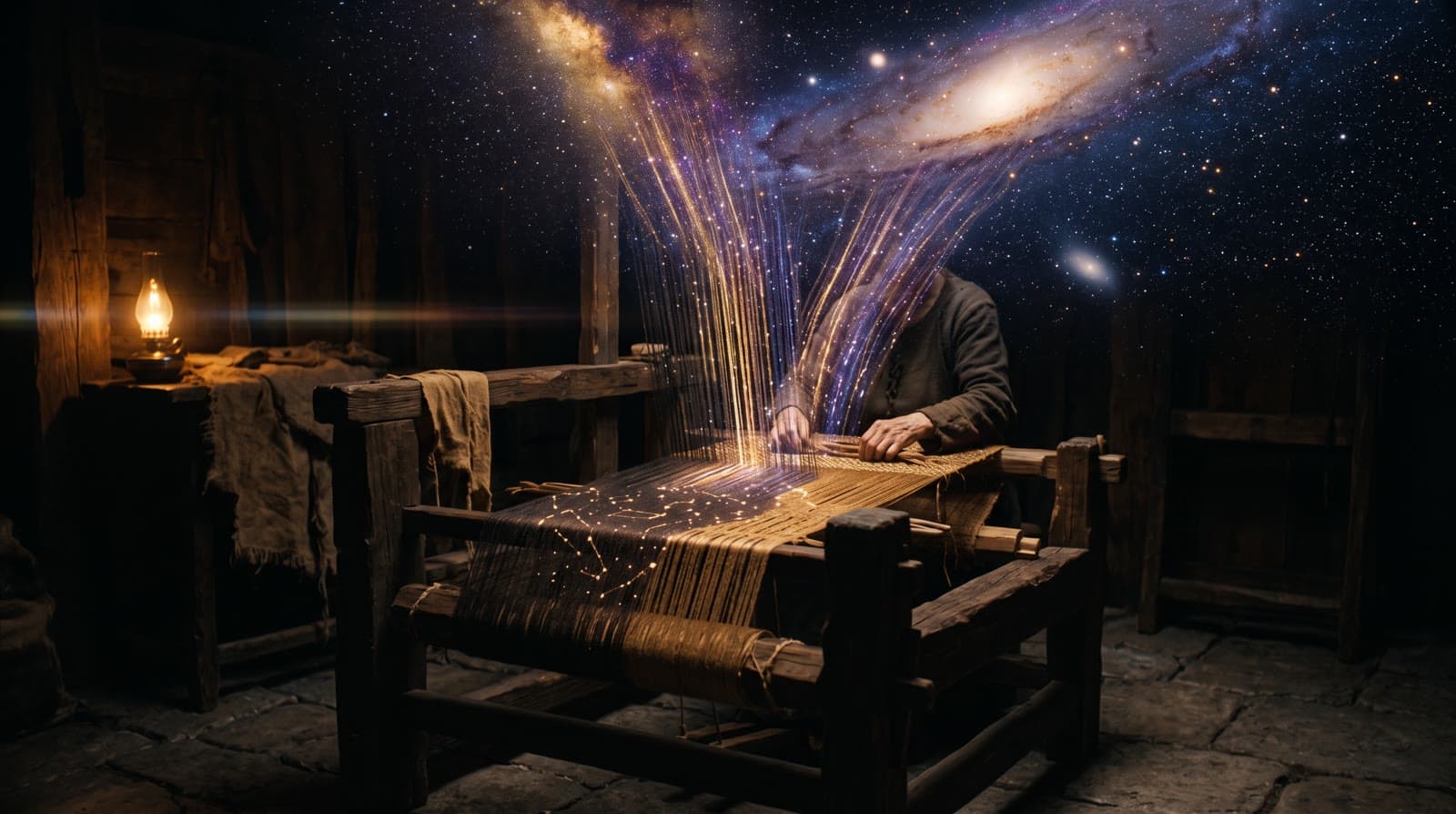
The Woven World
Carpet, Thread, and the Loom of Eternity
Derek Samaras | Urantia Book Network | June 2026
There is an old legend, stitched into the mythology of a dozen cultures, about a carpet that flies. The story surfaces in Persia, in Jewish tradition, in the Arabian Nights, in the folklore of ancient India. A king sits upon a magnificent woven rug and is carried through the air across the world. Scholars treat this as pure fantasy, a product of the same dreaming mind that gave us winged horses and talking fish.
But what if the flying carpet is a memory? Not of magic, but of something real, distorted across millennia into legend?
The Urantia Book does not describe flying carpets. What it does describe is something far more extraordinary: a continuous thread of weaving culture stretching from the teaching councils of Dalamatia through the coronation of Adam and Eve, through the Andite migrations that seeded every great civilization of the ancient world, into the home of Mary in Nazareth where a loom sat among the household furniture, into the hands of the boy Jesus who mastered that loom by age ten, through the textile workshops of Antioch where he worked as a tentmaker, to the hill outside Jerusalem where a crowd threw their garments on the ground to form a carpet of honor beneath the feet of a donkey, and finally to a hillside called Golgotha, where the last garment of the Creator Son of a universe was unusual enough that Roman soldiers stopped to gamble for it rather than cut it apart.
Once you see this thread, it does not break.
I. Dalamatia: The First Loom
Five hundred thousand years ago, a city was built in the region corresponding to what we now call Mesopotamia. Its name was Dalamatia, the headquarters of the Planetary Prince of Urantia. Within its forty-foot walls, the one hundred members of the Prince's staff were organized into ten autonomous councils (66:5.1), each dedicated to a domain of human advancement.
The first council, led by a staff member named Ang, oversaw food, water, and clothing. They taught well digging and irrigation. They improved the treatment of animal skins for warmth. But clothing from skins was only the beginning:
"Food, water, clothes, and the material advancement of the human species were fostered by this able corps. They taught well digging, spring control, and irrigation. They taught those from the higher altitudes and from the north improved methods of treating skins for use as clothing, and weaving was later introduced by the teachers of art and science." (66:5.2)
Weaving did not come from Ang's council. It came specifically from the teachers of art and science, the eighth council, led by a staff member named Mek (66:5.23). This is the first appearance of weaving in the planetary record. Not discovered by accident around a fire. Not evolved through chance observation. Introduced. Deliberately taught to early humanity as part of the first epochal revelation on Urantia.
And then the rebellion came. The text is stark about what followed:
"Great progress was made in the home arts, most of which were lost in the long and dark ages of rebellion, never to be rediscovered until modern times." (66:5.27)
Arts taught by superhuman beings half a million years ago, lost, and only rediscovered in what the text calls "modern times." Weaving was among them. The city eventually sank beneath the waters in a tidal wave (67:5.4), its remnants resting to this day under the Persian Gulf (78:7.7), taking most of its cultural legacy with it. But not all. The transmission of craft knowledge through living hands is more durable than stone.
This is where the legend of the flying carpet may take its first root. Every great Near Eastern mythology remembers a pre-flood civilization of beings who descended from above and taught mortals the arts of refined life. The carpet, in those traditions, belongs to a sovereign of supernatural wisdom. In Dalamatia, such figures walked the earth for three hundred thousand years (67:1.1).
II. Eden: Weaving at the Coronation
Nearly thirty-eight thousand years ago, the Material Son and Daughter descended to Urantia (74:0.1). Adam and Eve were formally installed as world rulers in a ceremony the text describes with precision. They received kingly robes. And the text pauses to note exactly where those robes came from:
"And Adam and Eve were invested with kingly robes on this occasion, the time of their formal induction into world rulership. Not all of the arts of Dalamatia had been lost to the world; weaving was still practiced in the days of Eden." (74:2.7)
That sentence is doing two things at once. It is reporting a specific fact about a specific ceremony. And it is explicitly connecting the weaving at Eden to the weaving of Dalamatia, nearly half a million years earlier (66:0.2, 74:0.1). The authors want you to see the thread. They draw it for you.
The second garden, established after the Adamic default, extended this legacy into the historical period. In the lands between the Tigris and Euphrates, the violet peoples preserved a civilization the text names in specific terms:
"The Adamites greatly excelled the surrounding peoples in cultural achievement and intellectual development. They produced the third alphabet and otherwise laid the foundations for much that was the forerunner of modern art, science, and literature. Here in the lands between the Tigris and Euphrates they maintained the arts of writing, metalworking, pottery making, and weaving and produced a type of architecture that was not excelled in thousands of years." (76:3.8)
Four arts. Writing, metalworking, pottery, weaving. This is the cultural spine of what became Western civilization, and weaving stands among the others as a foundational achievement of the violet race, named in one breath with the written word.
III. Van's Lake: The Name on the Water
North and west of the second garden, in a region we now call eastern Anatolia, the followers of Van left a mark that endures to this day. Van, who had served on Urantia through the three hundred thousand years of the Prince's administration before the rebellion (67:1.1) and then remained for more than one hundred and fifty thousand years afterward, sustained by the technique of the tree of life while a world in chaos was slowly rebuilt (67:6.4), inspired such devotion in his associates that even after his departure from the planet, the communities he had shaped continued to carry his name forward.
"Some of the early associates of Van subsequently settled about the shores of the lake which still bears his name, and their traditions grew up about this locality. Ararat became their sacred mountain, having much the same meaning to later-day Vanites that Sinai had to the Hebrews." (77:4.11)
A lake that still bears his name. Lake Van, in eastern Turkey, still called exactly that. The Vanites, northern Nodite descendants of those who had followed Van and Amadon rather than the rebel Nod (77:4.10), built their traditions around this place. They believed their seven commandments had been given to Van on Ararat. They firmly believed, the text says, that Van and Amadon were "taken alive from the planet while they were up on the mountain engaged in worship" (77:4.11).
What the Vanites knew about weaving the text does not say directly. But the cultural geography is striking. These were the people most directly descended from the civilization that introduced weaving to the world. Their craft traditions stretched through the Dalamatian inheritance, and the Andite descendants of these northern Nodite communities carried those traditions into what historians now call the Armenian plateau and the Caucasus, the heartland of the world's oldest surviving carpet traditions.
The lake keeps his name. The craft keeps his inheritance, even if history has forgotten the connection.
IV. The Andites: Weavers of the World
Between fifteen thousand and six thousand years before Christ, the Andites, blended descendants of the violet race and the older Nodite and Sangik peoples, poured out of Mesopotamia in great migrations. The text describes what they carried:
"And to every nation to which they journeyed, they contributed humor, art, adventure, music, and manufacture. They were skillful domesticators of animals and expert agriculturists." (78:5.8)
Manufacture. In the ancient world, the most portable and valuable manufactured goods were textiles. When a brilliant tribe of these Andites migrated to Crete around 12,000 BC, the text leads with a precise list of their skills:
"These emigrants to Crete were highly skilled in textiles, metals, pottery, plumbing, and the use of stone for building material." (80:7.2)
Textiles first. And these were not ordinary Andites. They had intermarried with the Vanite division of the northern Nodites (80:7.2). They were carrying the combined inheritance of Dalamatia, Eden, and the communities that had formed around Van's name into the Mediterranean world. The Minoan civilization they seeded passed its cultural legacy westward. When Egypt followed Mesopotamia into decline and cultured families fled to Crete, and when inferior groups later threatened Crete, those same cultured families moved on to Greece (80:7.12). One inheritance, passed hand to hand, generation to generation.
Meanwhile, a parallel thread was evolving among the river peoples. The text describes how basket weaving emerged independently:
"It was from these early huts that the subsequent idea of all sorts of basket weaving independently originated." (81:2.18)
Two streams, one taught from above and one evolved from below, eventually merged in the craft traditions of the ancient Near East. The more sophisticated textile arts, the ones capable of producing the intricate pile patterns we now associate with Persian and Armenian carpet weaving, trace their ancestry to the deliberate instruction of the Dalamatian councils and the Adamic culture of the second garden.
When the Sumerians appeared in history, they came already equipped. The text reaches for a word:
"Without a trace of origin elsewhere in the world, these ancient tribes suddenly loom upon the horizon of civilization with a full-grown and superior culture, embracing temples, metalwork, agriculture, animals, pottery, weaving, commercial law, civil codes, religious ceremonial, and an old system of writing." (77:4.7)
Loom. These ancient tribes "loom" upon the horizon of civilization, carrying weaving among their fully formed arts. Whether or not the authors intended the double meaning, it is there on the page.
V. The Bridal Carpet: A Forgotten Thread
Before we reach Nazareth, the text offers one more carpet reference, easy to miss, buried in a discussion of ancient wedding customs in Paper 83.
The account explains why brides wear veils, why their feet must not touch common ground before the ceremony, and then adds this:
"Even in the twentieth century it is still the custom under the Christian mores to stretch carpets from the carriage landing to the church altar." (83:4.7)
The text is noting the deep antiquity of the carpet as a symbol of sacred passage. The bride's feet must not touch ordinary earth. A carpet is laid between her and the common world, consecrating the path from one life to another.
It is the same gesture the crowd at Olivet would perform two thousand years before the text was written. Sacred feet. Sacred path. Woven cloth between the holy and the earth. The instinct is so old it survives into the present day without anyone quite knowing why they still do it.
VI. The Cosmic Loom
Before following the thread into Nazareth, we need to stop at what may be the most astonishing single sentence in the entire Urantia Book on this subject. In Paper 111, in a discussion of the relationship between the human mind, the Thought Adjuster, and the evolving soul, the authors reach for a metaphor. They could have chosen a seed, a river, a flame. They chose weaving:
"The material mind of mortal man is the cosmic loom that carries the morontia fabrics on which the indwelling Thought Adjuster threads the spirit patterns of a universe character of enduring values and divine meanings—a surviving soul of ultimate destiny and unending career, a potential finaliter." (111:2.2)
Every person alive is a loom. Every moral decision is a thread. The Thought Adjuster, the literal fragment of the Universal Father indwelling the human mind, is the weaver, threading spirit patterns through every choice. The result is the soul: the eternal garment being woven from the fabric of a mortal life.
This is not a passing illustration. It is the chosen metaphor for the most intimate transaction in the universe, the relationship between the human being and the presence of God within the mind. The craft that began in Dalamatia as a survival technique, that was deliberately introduced to humanity by Mek's council half a million years ago (66:0.2, 66:5.2), has here been elevated into the central image for what the cosmos does with a human life.
VII. The Home of Jesus: Mary's Loom
The revelation's account of Jesus's childhood home is precise enough to be architectural. The house of Joseph and Mary in Nazareth was a one-room stone structure with a flat roof. The text lists the furniture with the specificity of someone who was there:
"The furniture consisted of a low stone table, earthenware and stone dishes and pots, a loom, a lampstand, several small stools, and mats for sleeping on the stone floor." (122:6.2)
Six items. Among them: a loom. The revelation does not include decorative details. This is in the record because it was there.
Why was a loom there? Because Mary was a weaver:
"Mary was an expert weaver and more than averagely skilled in most of the household arts of that day; she was a good housekeeper and a superior homemaker." (122:5.7)
Not ordinary. An expert. The loom in that house was a professional tool in the hands of a skilled practitioner. And sleeping on the floor beneath that loom, on the woven mats the text also lists, was the child who would grow up to sit at it.
VIII. The Boy Who Mastered the Loom
When Jesus was seven years old, he entered formal school at the Nazareth synagogue. The classroom was a floor. Pupils sat on it in a semicircle while the chazan sat facing them (123:5.3). The earliest education happened at ground level, on the same kind of woven mats that furnished his home.
A year or two later, alongside learning to milk the family cow and care for the animals, Jesus learned two specific crafts. The text records them together:
"During this and the following year he also learned to make cheese and to weave. When he was ten years of age, he was an expert loom operator." (123:5.15)
Expert. The same word used for Mary. By ten years old, the Creator Son of a universe of approximately ten million inhabited worlds (35:4.2) had mastered the craft his mother practiced. He had sat at the loom and learned it from the inside: the warp, the weft, the rhythm of the shuttle, the pattern building thread by thread under hands that were learning what hands are for.
Later, his sister Martha would follow the same path. "Martha had become an expert weaver" (128:3.1). Three members of the same family, each named by the text with the same word: expert.
IX. Jesus Weaving Himself
Here is the passage that perhaps more than any other unlocks the full meaning of the weaving thread. It appears in his twentieth year, six years after he had taken over as head of the household following his father's death. From the outside, those six years look like patient waiting: a carpenter's work, a family protected, brothers and sisters educated, the shop managed, the bills paid. But the revelation marks something else happening in the interior life, quietly, year after year:
"This year he began anew the task of further weaving his mortal and divine natures into a simple and effective human individuality. And he continued to grow in moral status and spiritual understanding." (127:6.9)
The text uses the word "weaving" to describe what Jesus was doing to himself. Notice "anew": this was not a new task but a return to it with fresh purpose, a re-engagement with the internal work of integration that the incarnation required. Taking two distinct natures, mortal and divine, and weaving them into one coherent self.
Paper 111 told us the mind is a cosmic loom on which the Adjuster threads the patterns of the soul. Here, in Paper 127, we see the subject of the entire book actively engaged in that exact process. Jesus is both the loom and the weaver, both the fabric and the pattern being threaded. He is not merely an expert with thread. He is, in the precise language the text chooses, weaving his own being into coherence, year by year, in a carpenter's house in Galilee.
X. Jesus Teaching with Thread
The weaving connection does not stop at Jesus's hands. It enters his words.
When the leader of the Jerusalem spies, a Pharisee, asked why his disciples did not fast, Jesus answered with an image born from the workshop:
"Be reminded that a wise tailor does not sew a piece of new and unshrunk cloth upon an old garment, lest, when it is wet, it shrink and produce a worse rent." (147:7.2)
A man who had never sat at a loom does not reach for this image. A man who had spent his childhood weaving, who understood the difference between new cloth and preshrunk cloth, who knew in his hands what happens when incompatible materials are forced together under tension, does reach for it. The teaching is born from the craft.
And later, quoting Isaiah to his apostles (147:8.1), he chose these words among all the words available to him:
"Is it not to share my bread with the hungry and to bring those who are homeless and poor to my house? And when I see those who are naked, I will clothe them." (147:8.3)
Clothing is not abstract in this teaching. For the boy who had been an expert loom operator at ten, who had sat at his mother's loom learning how raw fiber becomes something that covers and protects, clothing the naked was the concrete act the symbol pointed to.
XI. Jesus the Tentmaker
The weaving connection extends beyond Nazareth. When Jesus spent time in Antioch during his thirty-first year (134:7.1), he worked in a textile trade:
"At Antioch the Son of Man lived for over two months, working, observing, studying, visiting, ministering, and all the while learning how man lives, how he thinks, feels, and reacts to the environment of human existence. For three weeks of this period he worked as a tentmaker." (134:7.3)
Tentmaking was serious textile work. First-century tents required strong, weather-resistant fabric, cut and sewn to precise specifications. The man who had been an expert loom operator at ten was, in his thirty-first year, working with fabric again in a professional capacity, in a city that would become one of the great centers of early Christianity.
Years later, Paul preached in Antioch. His converts spoke of a teacher who had preceded them, whose teachings had already prepared the soil. Paul eventually reached the conclusion that this earlier teacher, the "scribe of Damascus," and the "tentmaker of Antioch" were the same person (132:0.10). He never fully grasped what he was saying: that the craftsman who had sat at a tentmaker's bench in Antioch and the man whose gospel he was preaching were one.
XII. The Last Supper: Cloth at the Final Table
When Jesus and his apostles gathered in the upper room for the last Passover, the text describes the physical arrangement:
"Except for the end on which rested the bread and wine, this long table was surrounded by thirteen reclining couches, just such as would be provided for the celebration of the Passover in a well-to-do Jewish household." (179:1.1)
Thirteen reclining couches. The most solemn meal of the Jewish year. Jesus and his twelve apostles reclined for the last meal before his arrest, the meal at which he took bread and wine and established a new memorial.
At that same table, he rose, removed his outer garment, wrapped himself in a towel, and went to wash his apostles' feet (179:3.1). The garment removed. The towel taken up. Cloth moving between the roles of dignity and service, the teacher stripped of his robe to become, for a moment, the servant.
XIII. The Carpet of Honor
Four days before the Last Supper, Jesus entered Jerusalem for the final time on a donkey. The text explains the deliberate choice:
"A warrior king always entered a city riding upon a horse; a king on a mission of peace and friendship always entered riding upon an ass." (172:3.5)
The crowd responded with the oldest gesture of royal honor in the ancient Near East:
"The festive crowd threw their garments on the ground and brought branches from the near-by trees in order to make a carpet of honor for the donkey bearing the royal Son, the promised Messiah." (172:3.9)
A carpet of honor. The text uses the phrase directly, without elaboration, because none is needed. The garments of pilgrims and Galilean believers, woven cloth from ordinary households, were thrown across the dust of the road to form a living carpet for a king who had no palace, no throne, and no army.
The instinct behind the gesture is older than the kingdoms those crowds had known. The crowd at Olivet had no palace carpets. They had their cloaks. They threw them down anyway, enacting without knowing it a tradition rooted in something far older than the ceremony they were creating.
XIV. The Seamless Vestment: The Last Thread
The final weaving detail in the life of Jesus is the one the tradition has most sentimentalized and the one the revelation records most precisely.
At the crucifixion, the four soldiers divided the Master's clothing among themselves as was their right. They took the sandals, the turban, the girdle, the cloak. One item remained:
"This left the tunic, or seamless vestment reaching down to near the knees, to be cut up into four pieces, but when the soldiers saw what an unusual garment it was, they decided to cast lots for it." (187:2.8)
A seamless vestment. Unusual enough to stop four Roman soldiers from the routine practice of dividing spoils. Unusual enough that they chose to gamble for it whole rather than divide it.
The text calls it seamless and unusual. Nothing more. A seamless garment of this kind represented skilled work, the product of someone who knew what they were doing. The text does not say Mary wove it. It does not say Jesus wove it. What it says is that it was unusual, that it was seamless, and that soldiers who had seen many garments recognized in it something worth preserving whole.
The weaver of that garment, whoever they were, practiced a skill that had been introduced to humanity in Dalamatia, preserved through the Adamic default, carried by Andite migrants across the ancient world, passed from Mary of Nazareth to her son and daughter, and exercised by that son in the workshops of Antioch.
Thread by thread. Pattern by pattern. Generation by generation.
XV. The Flying Carpet: Decoded
The legend now looks different.
In the mythology surrounding Solomon, the archetype of wisdom in both Jewish and Islamic tradition, the king sits on a carpet and is carried wherever he wishes. He speaks the language of all things, commands the winds, achieves what ordinary rulers cannot. The carpet is his throne in the air.
The Urantia Book does not equate Solomon with any superhuman figure. But it does trace the tradition of a wise ruler with access to celestial knowledge directly back to the Prince's staff. Those one hundred members of Caligastia's council "were repersonalized on Urantia as supermen," and "much of your subsequent mythology grew out of the garbled legends of these early days" (66:4.1). The Nodite descendants of that staff became the "mighty men of old," the "men of renown" of the Genesis tradition (77:2.3). Van's associates settled a lake that still bears his name. The Vanite ancestors of the Assyrians, the text tells us, remembered Van as a figure taken alive from the planet while engaged in worship on the mountain (77:4.11). Their traditions lived on for ten thousand years after the fact.
A civilization that wove the coronation robes of Adam and Eve. Craft traditions carried by Andite migrants to every major civilization of the ancient world. These are the roots of the flying carpet legend. Not magic. Memory. The distorted remembrance of a time when woven cloth was produced by a civilization that stood so far above the surrounding peoples that the gap looked, from below, like flight.
The carpet flies not because it has wings. It flies because the civilization that made it had risen above the ordinary. Because when you sit at a loom and pass the thread through the warp, you are enacting one of the oldest deliberately taught behaviors in the planetary record, a behavior introduced to early humanity by beings who arrived on this world half a million years ago.
XVI. The Thread That Holds
From Dalamatia to Golgotha. Half a million years. One thread.
Mek's council introduces weaving to humanity as a deliberate gift. The arts of the home are developed, most of them lost in the rebellion, to be rediscovered only in what the text quietly calls "modern times."
Custom itself, the text reminds us, has been "the thread of continuity which has held civilization together" (68:4.6). That thread held. Even through the rebellion. Even through the default. Even through the long centuries when humanity stumbled forward without the guidance it had been given.
In Eden, Adam and Eve are crowned in woven robes. The text pauses to draw the explicit line: weaving survived Dalamatia and was still practiced when they arrived. The second garden preserves it alongside writing and metalworking as a pillar of Adamic culture.
Van's associates settle a lake that still carries his name in the heartland of the world's oldest carpet traditions. The Andites carry textile mastery with them to Crete, Egypt, Greece, and Persia, seeding every civilization that would eventually produce the culture we call Western.
The Sumerians appear with weaving already fully formed in their civilization, their origin traceable by the revelation to the city that sank beneath the Persian Gulf.
A bride's carpet is stretched to the church altar, the same ancient instinct the crowd at Olivet enacted without knowing why.
The cosmic loom stands at the center of Paper 111: the mind as loom, the Adjuster as weaver, the soul as the eternal fabric being threaded in every moment of moral choice.
In Nazareth, Mary is an expert weaver. Her home contains a loom. Her son masters that loom by age ten, grows up to reach for a weaver's image when he teaches, and works the textile trade as a tentmaker in his thirty-first year.
He weaves, the text tells us, his own mortal and divine natures into a single integrated self.
He is honored at Olivet by a carpet of human garments.
He dies in a seamless vestment unusual enough that soldiers stop to cast lots for it.
And in Paper 111, the revelation steps back and shows us that all of this, the physical thread and the historical continuity, points to something eternal. Every human being is a loom. Every moral choice is a thread. The Thought Adjuster, the fragment of the living God within the mind, is the master weaver, passing the shuttle of spirit pattern through the fabric of a mortal life, year by year, choice by choice, until what was scattered and parallel becomes something with integrity and beauty and purpose.
The flying carpet is a memory of a civilization that understood what cloth is for. Not merely warmth. Not merely beauty. Cloth is what the cosmos does with raw material: takes what is scattered, parallel, without coherence, and passes a single thread through all of it, back and forth, until what was loose becomes pattern, what was fragile becomes strong, what was nothing becomes something that endures.
Mary of Nazareth knew this with her hands.
Her son learned it from her.
And the Thought Adjuster has been practicing it on every human mind since the first ancestor chose to do good in the dark, alone, with no witness except the divine presence threading that choice into something that will last forever.
All Verified UB References
Every citation below was checked against the local Urantia Book source text, paper by paper, before publication. Every direct quote was compared word for word to the cited paragraph.
Dalamatia and the Introduction of Weaving
- 66:3.1 | The Prince's headquarters was situated in the Persian Gulf region, in the district corresponding to later Mesopotamia
- 66:3.3 | The city enclosed within a wall forty feet high; named Dalamatia
- 66:5.1 | The one hundred were organized for service in ten autonomous councils
- 66:5.2 | Ang's council oversaw clothing; weaving introduced by the teachers of art and science
- 66:5.23 | Mek led the eighth council: the planetary council on art and science
- 66:5.27 | Home arts including weaving lost in the rebellion, to be rediscovered only in modern times
- 66:4.1 | Staff repersonalized as supermen; subsequent mythology grew from these days
- 67:1.1 | Caligastia in charge three hundred thousand years before the rebellion
- 67:5.4 | A tidal wave swept over Dalamatia; the headquarters sank beneath the waters of the sea
- 78:7.7 | Vestiges of Dalamatia still rest under the waters of the Persian Gulf
Adam and Eve, Eden, and the Second Garden
- 74:0.1 | Adam and Eve arrived 37,848 years before AD 1934
- 74:2.7 | Invested with kingly robes; weaving still practiced in Eden, explicitly connecting to Dalamatia
- 76:3.8 | Second garden: writing, metalworking, pottery, and weaving as the four cultural pillars
- 76:3.9 | Children of the violet race trained in craftsmanship
Van, Lake Van, and the Vanites
- 67:6.4 | Van and Amadon sustained by the tree of life for over one hundred and fifty thousand years
- 77:4.10 | The Vanites: northern Nodites following Van and Amadon rather than Nod
- 77:4.11 | Early associates of Van settled around the lake that still bears his name; Ararat as sacred mountain; Vanite ancestors of the Assyrians
- 77:2.3 | Staff descendants became the "mighty men of old," the "men of renown"; origin of widespread mythology
The Andites and Textile Mastery
- 80:7.2 | Andites to Crete, 12,000 BC: first-named skill is textiles; the Vanite-Andite group
- 80:7.12 | Cultured Cretan families eventually moved west to Greece: the chain of transmission
- 78:5.8 | Andites contributed "humor, art, adventure, music, and manufacture" to every nation
The Sumerians
- 77:4.7 | Sumerians appear with weaving among the elements of their full-grown culture
Basket Weaving: Parallel Evolution
- 81:2.18 | Basket weaving evolved independently from interlaced-reed hut construction
- 81:6.8 | "Weaving, pottery, the domestication of animals, and metalworking" as tools of civilization
- 69:3.10 | Among some tribes weaving was done by women, in others by men
The Bridal Carpet
- 83:4.7 | The bride's feet must not touch common ground; carpets stretched from carriage to church altar
The Cosmic Loom
- 111:2.2 | "The material mind of mortal man is the cosmic loom that carries the morontia fabrics on which the indwelling Thought Adjuster threads the spirit patterns of a universe character of enduring values and divine meanings..."
- 68:4.6 | "Custom has been the thread of continuity which has held civilization together"
- 35:4.2 | A universe eventually embracing approximately ten million inhabited worlds
Mary and Jesus as Weavers
- 122:5.7 | "Mary was an expert weaver"
- 122:6.2 | Home of Jesus: a loom and mats for sleeping listed among the household furniture
- 123:5.3 | Pupils in synagogue school sat on the floor in a semicircle
- 123:5.15 | "When he was ten years of age, he was an expert loom operator"
- 128:3.1 | "Martha had become an expert weaver"
Jesus Weaving His Own Nature
- 126:2.1 to 126:2.2 | Joseph's death when Jesus was fourteen; Jesus assumed responsibility for the family
- 127:6.9 | In his twentieth year: "he began anew the task of further weaving his mortal and divine natures into a simple and effective human individuality"
Jesus Teaching with Textile Metaphor
- 147:7.2 | "A wise tailor does not sew a piece of new and unshrunk cloth upon an old garment"
- 147:8.1 | Jesus introducing the following passage as a quotation from the Prophet Isaiah
- 147:8.3 | Isaiah quoted by Jesus: "And when I see those who are naked, I will clothe them"
Jesus as Tentmaker
- 134:7.1 | Jesus's journey to Antioch
- 134:7.3 | "For three weeks of this period he worked as a tentmaker" in Antioch
- 132:0.10 | Paul later concluded the "tentmaker of Antioch" and the "scribe of Damascus" were the same person
The Last Supper
- 179:1.1 | Thirteen reclining couches surrounding the Passover table in the upper room
- 179:3.1 | Jesus removes his outer garment, girds himself with a towel, washes the apostles' feet
The Carpet of Honor at Olivet
- 172:3.5 | A king on a mission of peace enters on a donkey, not a horse
- 172:3.9 | "The festive crowd threw their garments on the ground... in order to make a carpet of honor for the donkey bearing the royal Son, the promised Messiah"
The Seamless Vestment
- 187:2.8 | "The tunic, or seamless vestment reaching down to near the knees... when the soldiers saw what an unusual garment it was, they decided to cast lots for it"
- 187:2.9 | The Master desired that his followers have nothing material to associate with his life on earth
A note on quotation. Every direct quotation in this article was verified word for word against the local Urantia Book source text on the date of publication, and every Paper:Section.Paragraph citation was checked against the cited paragraph. One small note: in the source of 111:2.2, the clause beginning "a surviving soul" is joined to the preceding clause by an em dash. To honor both the verbatim standard and the no-dash house style, that single mark is rendered here as a colon. No words were changed. No em dashes appear in this article.
Derek Samaras | Urantia Book Network | June 2026
Connecting Articles

The Prince Who Fell: Caligastia and the Truth About the Devil

The Forbidden Fruit Redeemed: The Apple, the Andites, and the Long Road to the Basque Cider House

Why the Adamic Mission Defaulted (and What Was Salvaged)

The Andite Migrations Out of Mesopotamia
The Newsletter
Get the research behind each piece
Free. New Urantia Book explorations, the sources behind the videos, and early looks. No spam, unsubscribe anytime.
Prefer video? Follow on YouTube and Facebook.
Delivered through Substack. You can also read past issues.