
Be of Good Cheer: How Jesus Frees the Downhearted
His constant words were 'Fear not' and 'Be of good cheer.' Here is how Jesus found the fearful and the downcast and lifted them into the confident freedom of God's children, and why it still answers a weary world.

Derek Samaras | Urantia Book Network | June 2026
Something is weighing on the modern world, and it is heavier than anything the body can carry. People are anxious about their work, their families, their countries, and a future none of us can quite see. Many of us wake already braced, carrying a low hum of dread through the day like a second heartbeat. And underneath most of it sits one old, quiet lie, repeated so often we have stopped hearing it: that we are alone, that we are small, and that the universe does not care whether we rise or fall.
Into a world exactly like that, two thousand years ago, a carpenter from Galilee kept saying the same two things over and over. The record tells us his constant word of exhortation was, "Be of good cheer" (100:7.9), and that his watchword was, "Fear not" (100:7.15). He was not whistling past the graveyard. He was the most fearless, confident, and joyful person who ever lived on this world, and the astonishing thing about him is that he wanted to give all of it away. He spent his life handing courage to cowards, confidence to the defeated, and a sense of belonging to people who had been told their whole lives that they did not matter.
This is the story of how he gave that away, one frightened person at a time: how he found the downhearted, broke the chains of the fear that bound them, set their consciences free, and lifted them into the one identity that changes everything, a loved and confident child of God. Every word he speaks below is quoted exactly, so you can sit with it yourself.
He Found the Downhearted, One Soul at a Time
Before Jesus ever preached to a crowd, he was already a master of the single discouraged heart. One of the most tender scenes in the entire record happens on a mountainside, where Jesus comes across a young man who has climbed up alone to get away from people. The text tells us plainly that this youth "was fearful and downcast," that he "had grown up with a feeling of helplessness and inferiority," and that he had lost his father at the age of twelve (130:6.1). He is not a villain. He is a good kid who has been quietly crushed by life, and he has decided he would rather be alone with his disappointment than risk one more letdown from another human being.
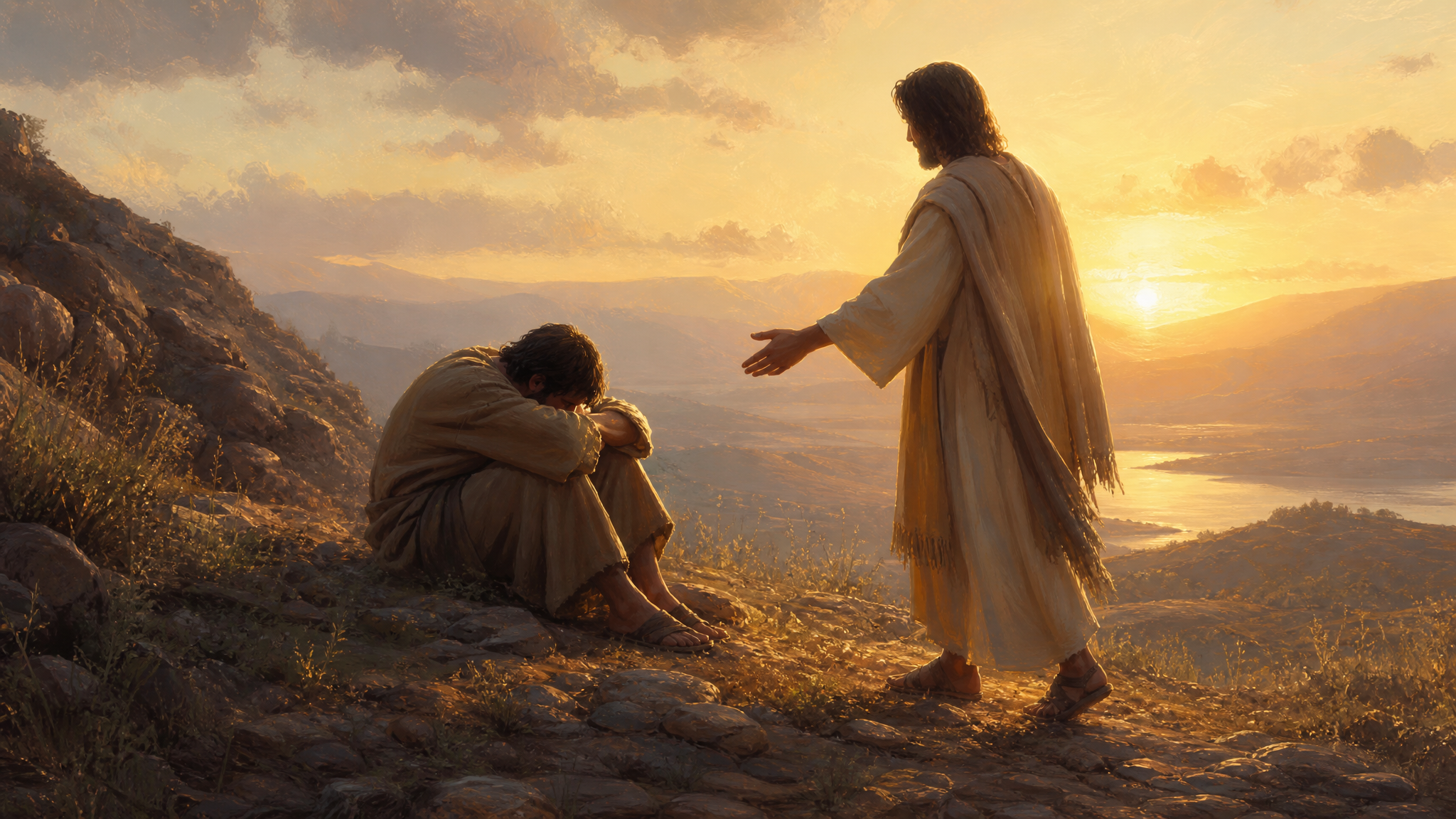
Watch what Jesus does, because it is almost the opposite of what anyone else would do. He does not lecture the boy. He does not quote scripture at him. He does not even ask what is wrong. He asks the discouraged young man for directions, draws him into explaining the mountain trails he knows by heart, and lets him feel useful and capable for the first time in a very long while. Only then, having quietly earned the right to be heard, does Jesus say the thing the young man had been waiting his whole life to hear:
"My friend, arise! Stand up like a man! You may be surrounded with small enemies and be retarded by many obstacles, but the big things and the real things of this world and the universe are on your side. The sun rises every morning to salute you just as it does the most powerful and prosperous man on earth." (130:6.3)
That single image is worth a hundred pep talks. The same sun that rises over kings and millionaires rises over you. The cosmos is not rationing its light to the worthy. Jesus tells the young man to stop letting his mind be dominated "by fear like an unthinking animal" (130:6.3), and he locates the boy's real power exactly where every person's real power lives: in the spirit within, which can flood the soul with a love of others once a person realizes "that you are a child of God" (130:6.3). Then comes the charge:
"Trouble will invigorate you; disappointment will spur you on; difficulties will challenge you; and obstacles will stimulate you." (130:6.4)
This is the whole reversal in a single sentence. The very things that had been crushing this young man, the trouble and the disappointment and the difficulty, become the fuel that drives him forward, the instant his identity changes. And then comes one quiet detail: the trembling boy on the mountainside was named Fortune, and he went on to become the leader of the Christians in Crete (130:6.5). A frightened kid on a hill became a builder of people, because one stranger took the time to tell him who he really was.
That was not a one-time event. It was how he moved through the world. During the months he spent in Rome, long before his public ministry, he sought out hundreds of ordinary people simply to make their lives richer. The account is specific about who responded most:
"Those who derived most benefit from his personal ministry were overburdened, anxious, and dejected mortals who gained much relief because of the opportunity to unburden their souls to a sympathetic and understanding listener, and he was all that and more." (132:4.2)
And to each of them, by one method or another, he offered "practical and immediately helpful suggestions" and then told them "that they were the children of this loving Father in heaven" (132:4.2). To a Roman soldier walking with him along the Tiber, he said:
"Be brave of heart as well as of hand. Dare to do justice and be big enough to show mercy." (132:4.6)
Notice what kind of courage Jesus prescribes. It is not bravado. It is the courage to be just, the strength to be merciful, the boldness to do the right thing in a hard world. He was building confident, upright, free human beings one conversation at a time.
He Broke the Chains of a Frightened Religion
To set people free, Jesus first had to dismantle the thing that was holding so many of them captive: a religion of fear. The people he grew up among had inherited a picture of God as a mighty and dangerous King who had to be appeased, obeyed, and dreaded. When the apostle Philip asked him how to square the old scriptural command to "fear the Lord" (149:6.1) with Jesus's invitation to approach the Father with no fear at all, Jesus answered with one of the clearest statements of his entire mission:
"I would deliver you from the bondage of driving yourselves through slavish fear to the irksome service of a jealous and wrathful King-God." (149:6.2)
He was not interested in adjusting the old fear. He was interested in replacing it entirely:
"I have come into the world to put love in the place of fear, joy in the place of sorrow, confidence in the place of dread, loving service and appreciative worship in the place of slavish bondage and meaningless ceremonies." (149:6.5)
Read that list again slowly, because it is essentially a prescription for a frightened generation. Love instead of fear. Joy instead of sorrow. Confidence instead of dread. That is the exchange Jesus is offering, and the price has already been paid. He goes on to give a new and higher commandment, one that turns the old duty inside out. He would teach them, he says, to "love God and learn to do his will, for that is the highest privilege of the liberated sons of God" (149:6.7). The word he chooses is privilege, and the people he is describing are liberated. The entire relationship changes from a slave cowering before a master to a confident son delighting to do the will of a Father he adores.
This matters for anyone who has ever felt that faith was mostly a long list of ways to fall short. Recovering this, the love underneath the fear, is much of what Jesus actually taught. Jesus's God does not torment his children with uncertainty about whether they are loved. That is the heart of the next thing he set free.
He Set the Conscience Free
If there is one passage worth reading slowly anywhere a person longs to think for themselves, it is the discourse Jesus gave one afternoon on the road to Phoenicia, when he laid out the difference between a religion of mere authority and the living religion of the spirit. He had twenty-four of his closest followers walking beside him, and on this stretch of road he turned and looked at them, one by one, calling each of them by name, and asked the hardest question any of them had ever been asked:
"Are you fearful, soft, and ease-seeking? Are you afraid to trust your future in the hands of the God of truth, whose sons you are?" (155:5.13)
What happened next is one of the most human moments in the whole record. All twenty-four of them leaped to their feet at once, ready right there on the road to shout their loyalty back at him. And Jesus raised his hand and stopped them. He would not accept a vow made on a rush of feeling. He sent them off alone, each one apart with the Father, to find the answer in silence rather than in the heat of the moment, and only then to speak it (155:5.14). They walked on afterward, silent at first and then talking it over among themselves, until by midafternoon they could go no farther. They came to a halt in the road, and Peter went up to Jesus and said simply, "Master, you have spoken to us the words of life and truth. We would hear more" (155:5.16).
So while the group rested in the shade of the hillside, Jesus kept going. He told them exactly what they had chosen by walking away from the religion of their fathers:
"You have dared to protest against the grueling bondage of institutional religion and to reject the authority of the traditions of record which are now regarded as the word of God." (155:6.2)
He calls the old way what it is, a bondage, and he honors them for daring to walk out of it. Then he names the cost of the comfortable alternative, a cost that every thoughtful person would do well to weigh carefully:
"While the religion of authority may impart a present feeling of settled security, you pay for such a transient satisfaction the price of the loss of your spiritual freedom and religious liberty." (155:6.5)
There it is in plain language. The settled certainty that an authority hands you always costs you something, and what it costs is your freedom. Jesus refuses to charge that price. In the same breath he describes the alternative as the most liberating thing imaginable:
"The religion of the spirit leaves you forever free to follow the truth wherever the leadings of the spirit may take you." (155:6.5)
Forever free. Free to follow truth wherever it goes. This is not the language of a man building a cage. It is the language of a man tearing one open. He draws the contrast as sharply as it can be drawn:
"The religions of authority crystallize into lifeless creeds; the religion of the spirit grows into the increasing joy and liberty of ennobling deeds of loving service and merciful ministration." (155:6.9)
Jesus was not promising any of them a soft life on that road. He was promising a free one, and a confident one, lived in the open hand of a God who can be trusted. For a person raised to believe that faith means surrendering your conscience to whoever holds the megaphone, this is the great liberation. The dignity of the individual, the right to seek truth for yourself, the refusal to let your spiritual life be dictated by anyone: these are not modern political slogans laid on top of Jesus's message. They flow straight out of it. Jesus prized the sovereignty of the single human soul long before any nation thought to write it into law.
He Gave the Assurance the Heart Craves
Freedom without assurance can be a lonely thing. A person can be free and still lie awake at night wondering if they truly belong to anyone. So Jesus did not stop at cutting people loose from fear. He filled the empty space where the fear had been with an unshakable confidence about exactly where they stood with God. During Passover week in Jerusalem, a man from Damascus pushed Jesus on this very point in the discourse on assurance. He was the kind of careful, anxious person who needed to know, not just hope, and he asked how anyone could be sure they were truly accepted into the kingdom. Jesus did not answer with theology. He answered with the plainest, most disarming logic imaginable, the kind any parent in the crowd could understand in their own home. What loving father, he asked, keeps his own child in anxiety about whether he belongs in the family?
"Neither does your Father in heaven leave his faith children of the spirit in doubtful uncertainty as to their position in the kingdom." (142:5.2)
And then the assurance itself, stated as flatly as a fact:
"If you receive God as your Father, then indeed and in truth are you the sons of God." (142:5.2)
There is no probation here, no waiting period, no anxious checking of the ledger. Receive God as your Father, and you are, in truth, his child. Jesus even names the thing that conquers the chronic uncertainty so many people live with. The one who is born of the spirit, he says, has the power to overcome all doubt, "and this is the victory that overcomes all uncertainty, even your faith" (142:5.3). Faith is the victory: not perfection, not certainty about every question, not the approval of an institution, just faith. He seals the discourse with a promise quoted from the prophet Isaiah:
"When the spirit is poured upon us from on high, then shall the work of righteousness become peace, quietness, and assurance forever." (142:5.4)
Peace, quietness, and assurance forever. That is the inheritance Jesus is describing, and he says it is meant for ordinary people who simply believe the good news. He went out of his way to make the picture of God human enough to trust, teaching that God relates to us the way the best kind of father relates to his children:
"A compassionate father is freely forgiving; fathers do not hold vengeful memories against their children. Fathers are not like judges, enemies, or creditors." (142:7.11)
Not a judge. Not an enemy. Not a creditor keeping score. A Father who forgives freely and holds no grudge. If you have spent years half-expecting God to be disappointed in you, sit with that sentence for a while. It is one of the most freeing things ever said about the character of God.
He Sent Us Out to Live Boldly
Here is something people often miss about Jesus. The religion he taught was not passive, soft, or resigned. It was aggressive in the best sense of the word, a religion of doing, of initiative, of meeting life head-on. During a teaching tour through the Decapolis, the record says he "required his followers to react positively and aggressively to every life situation" (159:5.9), and he handed them a principle for every discouraged person to hold close:
"Forget not, the truly good is invariably more powerful than the most malignant evil." (159:5.10)
Good is not merely a match for evil; it is stronger. That is not naive optimism; it is the strategic confidence of a man who had measured both. He gave his followers a picture of faith that reframes the struggle:
"Faith is to religion what sails are to a ship; it is an addition of power, not an added burden of life." (159:3.8)
Faith is not one more weight to carry. It is the sail that catches the wind and pulls you forward. And Jesus was scrupulously honest about what faith does and does not promise. He never told anyone that belief would shield them from hardship:
"Believing the gospel will not prevent getting into trouble, but it will insure that you shall be unafraid when trouble does overtake you." (159:3.13)
That is the realistic, durable kind of courage. Not a magic charm against pain, but a settled fearlessness in the middle of it. And then the promise that holds it all together: "I do not promise to deliver you from the waters of adversity, but I do promise to go with you through all of them" (159:3.13). You are not promised a life without storms. You are promised company through every one of them, which is a different promise than the one we usually want, and it sits close to the deeper question of why a good world holds so much adversity in the first place.
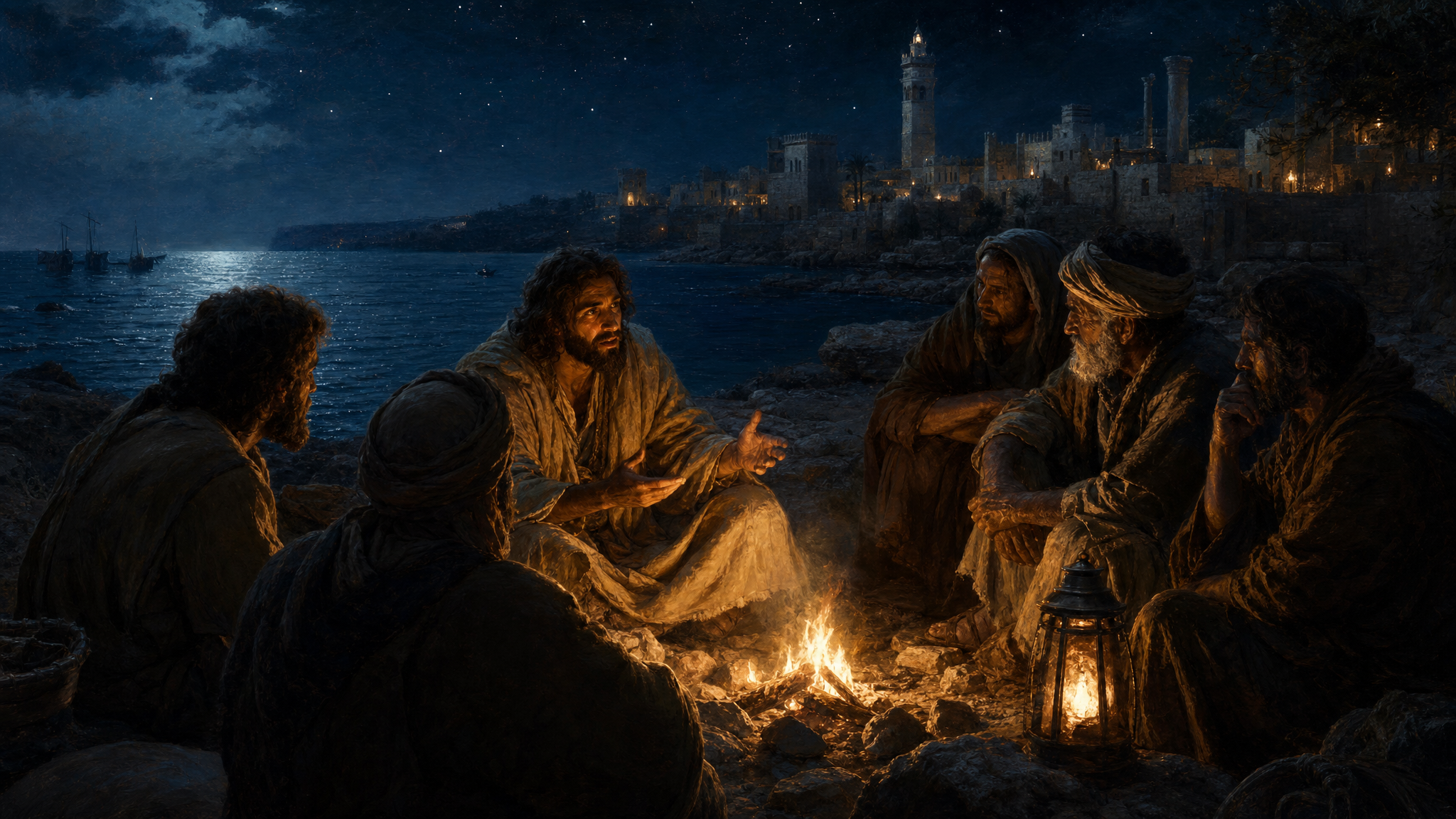
Picture the scene for a moment, because this next stretch of counsel comes from a different night altogether, earlier that same summer on the Phoenician coast. Jesus and his closest followers are camped at Tyre, and the day's teaching has long since ended, but the apostles and evangelists will not let him stop. The record says simply that they kept asking him questions "long into the night" (156:5.6), as if they could feel they were close to something they did not want to lose by falling asleep. It is out of that late-night fireside conversation that some of the most bracing, unsentimental counsel in the whole record comes pouring out. When his followers pressed him about how to handle their own failures and discouragement, Jesus gave them counsel that reads like medicine for the modern soul:
"Do not become discouraged by the discovery that you are human." (156:5.8)
And the line a person can hold onto when their own past will not let go of them:
"The mistakes which you fail to forget in time will be forgotten in eternity." (156:5.8)
He describes the mature believer as someone weather-sealed against the ups and downs of circumstance:
"God-knowing individuals are not discouraged by misfortune or downcast by disappointment." (156:5.13)
"The God-conscious mortal is certain of salvation; he is unafraid of life; he is honest and consistent." (156:5.20)
Unafraid of life. Hold onto that one. And he insists that the obstacles themselves are not the enemy of the confident soul but its training ground:
"Difficulty whets the ardor of the truth lover, while obstacles only challenge the exertions of the undaunted kingdom builder." (156:5.21)
This is the opposite of a fragile faith. It is a faith that gets sharper the harder life pushes, because its confidence is anchored somewhere the storm cannot reach.
Built to Feast on Uncertainty
It is worth pausing to ask where this kind of fearlessness ultimately comes from, because the answer turns out to be older and deeper than this one planet. The same revelation teaches that the fearlessness Jesus lived was never meant to be rare or superhuman. It is the deep design built into every soul on the long journey home to God, forged across countless lives that climb, step by step, toward his presence. Here is how that climb is described, written of pilgrims still far from Havona, the revelation's name for the threshold of God's own central dwelling:
"But long before reaching Havona, these ascendant children of time have learned to feast upon uncertainty, to fatten upon disappointment, to enthuse over apparent defeat, to invigorate in the presence of difficulties, to exhibit indomitable courage in the face of immensity, and to exercise unconquerable faith when confronted with the challenge of the inexplicable." (26:5.3)
Let that lift the ceiling off your idea of what a human being is for. We were never built merely to survive uncertainty. We were built to feast on it. Disappointment is not supposed to starve us; it is supposed to fatten us. Apparent defeat is not meant to crush us; it is meant to fire us up. This is the design written into every soul, long before it ever touched a human life.
And here is where the wonder of the gospel comes in. That description was written about beings traveling through realms beyond imagining, ages removed from a dusty road in Galilee. And then Jesus took that vast, faraway confidence and packed it into a single human lifetime in a fishing village. He showed, in one mortal body, with people watching, the very fearlessness the universe spends an eternity teaching its children. What is forged across an unimaginably long journey, he simply lived on the spot, in front of witnesses, and then offered to anyone willing to trust the Father as he trusted him.
He Lived It First
Everything in this article would be just beautiful advice if Jesus had only talked about it. What gives it unbreakable authority is that he lived it, completely, all the way to the end. The closing summary of his life on earth describes a faith that had burned away every trace of fear:
"Even in the face of apparent defeat or in the throes of disappointment and threatening despair, he calmly stood in the divine presence free from fear and fully conscious of spiritual invincibility." (196:0.5)
Free from fear. Conscious of spiritual invincibility. Not because he was spared difficulty, but because his trust in the Father was total. It is stated about as plainly as language allows:
"His faith grew to such heights of trust that it was devoid of fear." (196:0.11)
And it pairs that steady trust with a grown man's strength, refusing to let anyone reduce his confidence to childish naivety:
"He combined the stalwart and intelligent courage of a full-grown man with the sincere and trusting optimism of a believing child." (196:0.11)
This was not a soft man floating above the realities of life. This was the most robust person who ever lived:
"He made robust and manly decisions, courageously faced manifold disappointments, resolutely surmounted extraordinary difficulties, and unflinchingly confronted the stern requirements of duty." (196:0.14)
That is the model. And the most generous thing about him is what he asks of us. He does not ask to be worshiped from a safe distance. He asks us to share the very faith he lived. He draws the distinction with precision:
"Jesus does not require his disciples to believe in him but rather to believe with him, believe in the reality of the love of God and in full confidence accept the security of the assurance of sonship with the heavenly Father." (196:0.13)
Believe with him, not merely about him. The whole invitation comes down to a single line: to "trust God as he trusted God and to believe in men as he believed in men" (196:1.5). That confidence is not reserved for saints or geniuses. It is the natural birthright of anyone who will receive God as Father. The portrait of the Master himself shows where the steadiness came from. He was, the record says, "immune to disappointment and impervious to persecution," and "untouched by apparent failure" (100:7.7). And his most repeated word to the people around him, the one he said again and again, was simply this:
"Be of good cheer." (100:7.9)
He could keep saying it, the text explains, "because of his unswerving trust in God and his unshakable confidence in man" (100:7.9). His cheer was not a personality quirk. It was the overflow of a man who knew the universe was friendly and the Father was good. He was, in the words of the record, not "a man of sorrows" but "a soul of gladness" (100:7.13).
A Word to a Weary World
So here is what the gospel offers, to every single person carrying a low hum of dread through their day, and to every people that has ever feared for its future. It offers a confidence that is not arrogance and a courage that is not pretending. It offers the dignity of a soul that no authority has the right to crush, because that soul belongs to God himself. It offers the assurance that you are not a worm, not a number, not a disappointment, but a loved and free child of a Father who does not keep score and does not let his children languish in doubt about whether they belong.
This is not a call to abandon your conscience to anyone. It is the opposite. It is a call to stand up like a man, or a woman, fully free, and to trust your future to the God of truth, the same words Jesus once spoke to a frightened boy named Fortune on a mountainside, words that boy carried with him the rest of his life. It is permission to feast on uncertainty instead of being eaten by it, to let your disappointments fatten you and your difficulties sharpen you, to walk through the waters of adversity unafraid because you are not walking through them alone.
The carpenter from Galilee already lived all of this. He proved it was possible in a human life, and then he made it the most generous offer ever extended to our world: not believe in me from a distance, but believe with me, share my faith, trust the Father as I trust him, and become what you already are, a confident child of God.
The world is tired and afraid. The answer is older than all of our fears, and it is still being offered, freely, to anyone who will take it.
Be of good cheer.
Every quotation in this article is taken verbatim from The Urantia Book and cited by Paper:Section.Paragraph. The personal ministry accounts are drawn from Papers 130 and 132, the teachings on fear and assurance from Papers 142, 149, 155, 156, and 159, the cosmic ascension testimony from Paper 26, and the closing portrait of the Master from Papers 100 and 196.
Connecting Articles


The Newsletter
Get the research behind each piece
Free. New Urantia Book explorations, the sources behind the videos, and early looks. No spam, unsubscribe anytime.
Prefer video? Follow on YouTube and Facebook.
Delivered through Substack. You can also read past issues.