
Rebellion Tested: What the Lucifer Rebellion Knows About Narcissistic Abuse
A recovery coach says the goal is not forgiving the narcissist, it is acceptance. He is right, and The Urantia Book got there first, describing a being who did exactly what clinicians describe at the scale of a solar system, and then adding what the survivor becomes.

Rebellion Tested: What the Lucifer Rebellion Knows About Narcissistic Abuse
Derek Samaras | Urantia Book Network | August 2026
Part one of the Rebellion Tested series.
There is a mural on Jerusem, the capital world of our local system, that tells the history of Satania in a continuous circular panorama. Somewhere along it, where the reign of our own Planetary Prince should be, there is nothing.
"At present there is an erasure of over two standard miles in this circular story. This sector will be restored upon the readmission of Satania into the constellation family." (46:8.1)
Two miles of blank wall. Not a warning. Not a villain's gallery with a plaque explaining what he did. The administration did not preserve the record as a caution to others. It took the record down.
"The Caligastia panoramic reign-records on Jerusem were obliterated, and the probationary era of planetary rehabilitation was inaugurated." (67:3.10)

And in the same archive system, in the records of Salvington, there is a portrait. It is not of the Prince. It is of a man from the highland tribes who had no universe experience of any kind, who stood beside a deposed judge through seven years of unbroken argument while the world went the other way, and who then held the line with him for more than a hundred and fifty thousand years afterward.
"the records of Salvington portray Amadon as the outstanding character of the entire system in his glorious rejection of the flood tides of sedition and in his unswerving devotion to Van" (67:8.1)
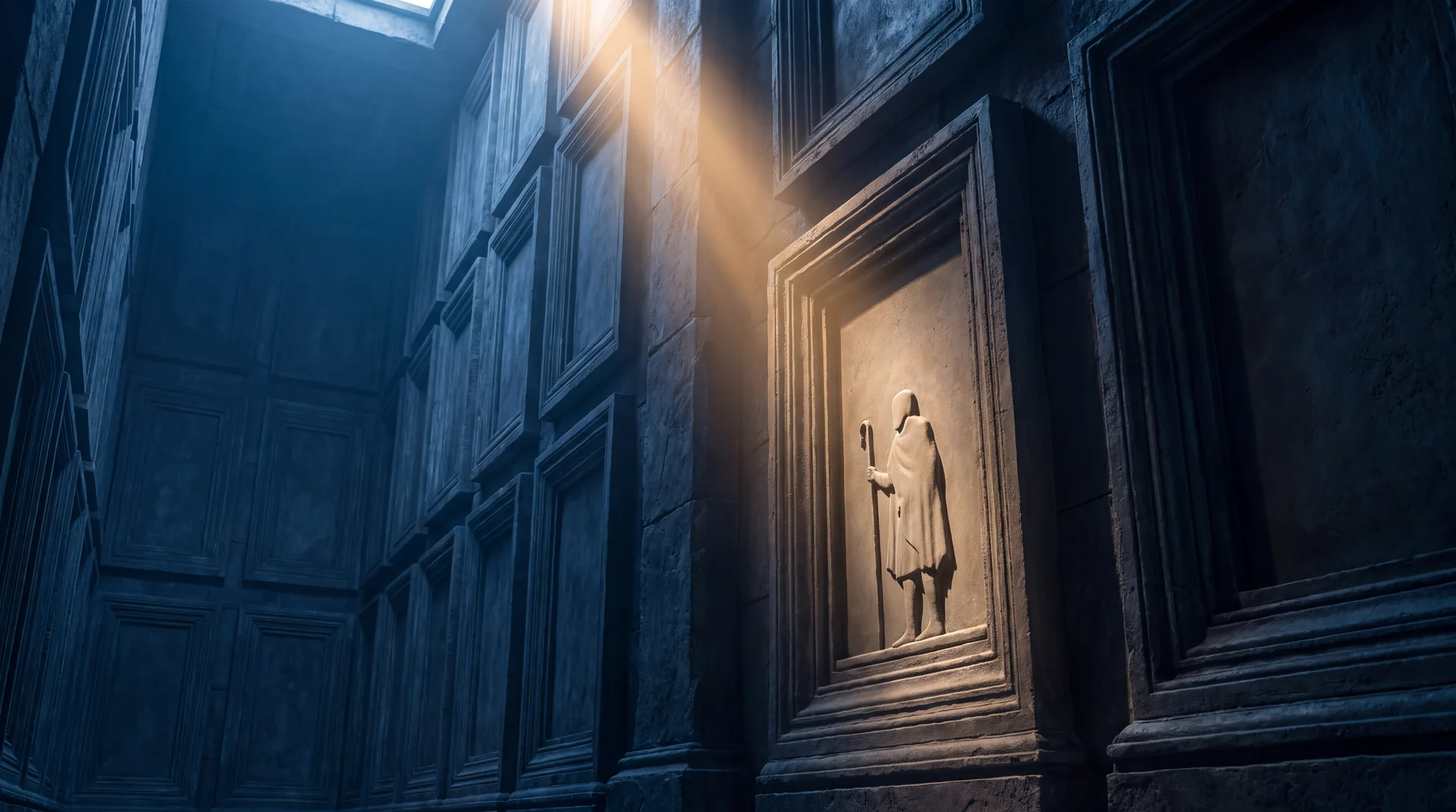
The universe deleted the celebrity and framed the volunteer. This article is about why, and about what that means for anyone who has been on the receiving end of a personality that could not be reasoned with.
A note before we start. This piece discusses patterns of abuse. It is a reading of a revelatory text, not clinical advice, not a diagnosis of anyone, and not a substitute for professional support. If you are in danger, the priority is your safety, and nothing in these pages should be read as a reason to stay anywhere unsafe.
The Coach and the Revelation
A life coach named David Ades runs a channel on recovery from narcissistic abuse. His central claim is unusual in that field, and it is this: you do not work toward forgiving the narcissist. That is not the goal. The goal is acceptance. He compares the experience to a natural disaster, and points out that nobody asks how to forgive a tornado. What has to be forgiven, in his framing, is yourself, and God, or fate, or whatever you call the thing that let it happen. He describes what is left behind as an abyssal void, and he says the swinging pendulum between forgiving the person and demonizing them is not the path to the end of the story. It is the trap that keeps you in it.
That is a serious claim and it deserves a serious reading, because The Urantia Book contains the most detailed account ever written of exactly this phenomenon, running for two hundred thousand years (53:4.1), across thirty seven inhabited worlds (53:7.1), with the transcripts.
And here is the thing that prompted this article. He is right. Not roughly right, not right in a way that needs correcting by a revelation. On the mechanics of what one of these personalities does to a person, on why the usual advice fails, on where the exit is, he arrives at conclusions this text reached first and states them more usefully than most theology manages. Reading him beside Paper 53 is not an exercise in grading him. It is watching two accounts of the same thing, written seventy years and one enormous difference in scale apart, land on the same floor.
What follows agrees with him far more than it differs. Where it differs, it is about one word.
The comparison has one enormous limit, and it is better to put it at the front than to smuggle it in later. Lucifer was not wounded. We will get to that, and it changes everything.
The Document
Start with the fact that the rebellion has paperwork.
It was not a mood, a slow drift, or a bad season. It was a written platform with three numbered articles, delivered at an annual conclave, in front of the assembled hosts of the system. The Urantia Book calls it by its own title:
"Whatever the early origins of trouble in the hearts of Lucifer and Satan, the final outbreak took form as the Lucifer Declaration of Liberty. The cause of the rebels was stated under three heads:" (53:3.1)

Anyone who has been through this recognizes the document immediately, because there is always a document. It may be a speech, a letter, a four hour conversation, or a text thread. It arrives fully formed, it is more coherent than anything you can produce under the circumstances, and it explains that what you thought was love was control, what you thought was fairness was oppression, and what you thought was your own good judgment was only ever your conditioning.
Article One is the one to read closely.
"He denied that personality was a gift of the Universal Father." (53:3.2)
That is the tell, and it is worth sitting with. Before the manifesto argued about administration, before it accused anyone of anything specific, it made a metaphysical claim: nothing was given to you. There was no giver. Your sense that you had received something, that you owed something, that you belonged to someone, was an error. And then, in six words that any survivor will recognize from the inside:
"He traded on reverence as ignorance." (53:3.2)
Your gratitude was your stupidity. Your loyalty was your naivety. The very fact that you loved somebody is submitted as evidence of how easily you are fooled. Once that lands, everything downstream follows, because a person who no longer believes anything was given to them is a person who can be told they owe nothing and are owed everything.
There is a joke buried in the record, and the revelation makes it without commentary. Consider what Satan conceded when he took the manifesto to the worlds:
"Satan proclaimed that worship could be accorded the universal forces" (53:4.1)
The sentence continues, and what it goes on to say is that allegiance could be acknowledged only to Lucifer. Worship was fine. Allegiance was the thing that had to be redirected. Now read the book's own definition of worship:
"Worship asks nothing and expects nothing for the worshiper." (5:3.3)
He gave away the one transaction that returns nothing and kept the one that pays. That is not a theological error. That is an accountant.
Most of the Liberties He Sought He Already Had
The three articles of the manifesto are grievances, and the revelation's assessment of the grievances is one flat sentence.
"Most of the liberties which Lucifer sought he already had; others he was to receive in the future." (54:4.4)
He was number thirty seven of his order, commissioned as one of the hundred most able personalities in more than seven hundred thousand of his kind. He was a System Sovereign. He was not being held back, oppressed, overlooked, or underestimated. The specific things he demanded were either already in his possession or already scheduled to arrive.
This is the most clinically recognizable fact in the entire account. The grievance is not about the grievance. The grievance is a delivery mechanism. Paper 54 draws the distinction that the whole rebellion turns on:
"True liberty is the associate of genuine self-respect; false liberty is the consort of self-admiration. True liberty is the fruit of self-control; false liberty, the assumption of self-assertion." (54:1.6)
And then the whole thing in one sentence, the kind you want carved over a doorway:
"License masquerading in the garments of liberty is the forerunner of abject bondage." (54:1.5)
Every person who has been talked into something in the name of their own freedom, and found afterward that they had less of it, has met that sentence in the wild.
He Had No Wound
Here is where the analogy has to break, and where an honest article has to slow down.
Contemporary understanding of pathological narcissism is developmental. Something happened. A self did not get to form. What operates in its place is a defensive structure built by a child who was not given the conditions to become a person. Whatever else that is, it is an injury.
Lucifer was not injured.
"No one ever suggested rebellion to Lucifer. The idea of self-assertion in opposition to the will of Michael and to the plans of the Universal Father, as they are represented in Michael, had its origin in his own mind. His relations with the Creator Son had been intimate and always cordial. At no time prior to the exaltation of his own mind did Lucifer openly express dissatisfaction about the universe administration." (53:2.3)
Intimate and always cordial. No neglect, no humiliation, no cold parent, no formative catastrophe. And the revelation closes the last exit:
"There were no peculiar or special conditions in the system of Satania which suggested or favored rebellion. It is our belief that the idea took origin and form in Lucifer's mind, and that he might have instigated such a rebellion no matter where he might have been stationed." (53:2.2)
Nothing did this to him. He is not a case study in trauma. He is a case study in something else, and the book describes its mechanics precisely:
"There must have been a pride of self that nourished itself to the point of self-deception, so that Lucifer for a time really persuaded himself that his contemplation of rebellion was actually for the good of the system, if not of the universe. By the time his plans had developed to the point of disillusionment, no doubt he had gone too far for his original and mischief-making pride to permit him to stop. At some point in this experience he became insincere, and evil evolved into deliberate and willful sin." (53:2.5)
Read the sequence. Pride feeds itself. Self-deception follows. He believes his own case. Then comes the point of disillusionment, when he can see it is not true, and by then the cost of stopping exceeds the cost of continuing. Somewhere in there, sincerity ends. He did not begin as a liar. He became one, on a schedule, by increments, each of which was easier than turning around.
The parallel account of Caligastia is even more intimate, because it is told by an angel who was fooled:
"I did not then comprehend that Caligastia was insidiously falling in love with himself; I did not then so fully understand the subtleties of personality pride." (66:1.5)
The reporting celestial admits, in the record, that he missed it at the time. That is worth noticing if you have ever been ashamed of not seeing it sooner.
And the book supplies the human case, separately. Far from Paper 53, buried in the roster of the twelve apostles, sits the record of a man who arrived at similar behavior by a completely different road:
"Judas was an only son of unwise parents. When very young, he was pampered and petted; he was a spoiled child. As he grew up, he had exaggerated ideas about his self-importance. He was a poor loser. He had loose and distorted ideas about fairness; he was given to the indulgence of hate and suspicion. He was an expert at misinterpretation of the words and acts of his friends. All through his life Judas had cultivated the habit of getting even with those whom he fancied had mistreated him. His sense of values and loyalties was defective." (139:12.6)
Same behavior. Opposite origin. The revelation does not collapse these two into one category, and neither should we. Lucifer chose it from warmth and privilege. Judas was made, by people who thought they were being kind.
This distinction is the reason this series will not call any human being a devil. It is also the reason it will not pretend that origin is the same thing as permission.
The Projection, Named
One line in the Caligastia account does something the clinical literature took most of a century to formalize.
The loyal administration kept trying to help. The Melchizedeks came. Counsel was offered repeatedly, patiently, over a long period. And:
"But all of these attempts to help had been misconstrued as unwarranted criticism and as unjustified interference with personal liberties. Both Caligastia and Lucifer judged their friendly advisers as being actuated by the very reprehensible motives which were beginning to dominate their own distorted thinking and misguided planning. They judged their unselfish advisers by their own evolving selfishness." (66:8.2)
They judged their unselfish advisers by their own evolving selfishness.
That is projection, described from the outside, in a book published in 1955. Everyone who comes to help is read as an operator, because the reader has become one and can no longer imagine the other thing. It is also, incidentally, why intervening is so often futile and so often punished. Concern arrives and is filed as an attack, because concern is not in the receiving system's vocabulary anymore.
The Circuits Go Dark
When it finally broke, the loyal universe did something that looks cold from the outside and is the most merciful move available.
It stopped arguing.
Gabriel was physically present on the sea of glass for the entire delivery of the manifesto. He was the chief executive of the local universe, the one being in the room with the standing and the information to demolish every claim in it point by point. He did not. He listened to the whole thing and offered no rebuttal, and the reason is administrative rather than emotional: a debate confers standing. To argue the manifesto on its merits is to concede that it has merits worth arguing.
Then the circuits were severed. Urantia was cut out of the system communication network, and the isolation that followed has lasted ever since.

This is where recovery language and revelation language converge exactly. What is described here is No Contact, imposed at planetary scale by the highest authority available, as the treatment of choice. Not persuasion. Not one more conversation. Not a final letter explaining, at last, in terms he cannot possibly misunderstand, why he was wrong. Quarantine.
And the revelation is explicit that this is not an act of hatred. Mercy ministry continued the entire time. Every rebel had access to it, for a very long time, and the door was never shut from the outside. What ended was the debate, not the mercy. Those are two different things, and the difference is the whole art of it.
Where Everybody Was
The universal report from inside an experience like this is abandonment. Nobody came. Nobody saw it. Nobody helped. That is not a distorted perception, it is an accurate description of what was available to the senses.
Here is the same period described from the administrative side. This is the opening line of the paper on planetary government, and it is a headcount:
"At noon today the roll call of planetary angels, guardians, and others on Urantia was 501,234,619 pairs of seraphim." (114:0.2)
Half a billion pairs. On the quarantined planet. Counted at noon, on an ordinary day, on a world that had been cut out of the circuits for two hundred thousand years and could detect exactly none of them.
The same paper closes with the only sentence in the book that reads like it was written to be found by somebody at three in the morning:
"Your isolated world is not forgotten in the counsels of the universe. Urantia is not a cosmic orphan stigmatized by sin and shut away from divine watchcare by rebellion. From Uversa to Salvington and on down to Jerusem, even in Havona and on Paradise, they all know we are here; and you mortals now dwelling on Urantia are just as lovingly cherished and just as faithfully watched over as if the sphere had never been betrayed by a faithless Planetary Prince, even more so." (114:7.17)
Even more so.
Be careful with this, because it is easy to turn into a cruelty. It does not mean somebody was going to intervene and you failed to notice. It does not mean the isolation was imaginary. The circuits really were severed and the help really was not reachable, and the revelation never pretends otherwise.
What it means is narrower and more useful: the absence of visible help was not a verdict on your worth. Those are two different facts and only one of them was ever true. Nothing about being unreachable meant you were unregarded, and the record of who was watching was being kept the entire time by beings you could not see, on a world that could not receive them.
There Is No Story
Ades says the narcissist is an abyssal void, that there is no story there, and that this is precisely why forgiveness does not apply. There is nobody home to receive it.
The revelation agrees, and states it as ontology rather than as description.
"Sin is not a person. God loves the sinner because he is a personality reality (potentially eternal), while towards sin God strikes no personal attitude, for sin is not a spiritual reality; it is not personal; therefore does only the justice of God take cognizance of its existence. The love of God saves the sinner; the law of God destroys the sin." (2:6.8)
And then the mechanism:
"Undiluted evil, complete error, willful sin, and unmitigated iniquity are inherently and automatically suicidal." (2:3.5)
Nobody has to destroy it. It does that itself, as a property of what it is. And the end state has been on the docket for two hundred thousand years:
"We await the flashing broadcast that will deprive these traitors of personality existence... Then will you look for their places, but they shall not be found." (53:9.7)
Which brings us to the funniest sentence in The Urantia Book, and it is funny in the way a very dry coroner is funny. Here is the current status of the most destructive personality in the history of our local system, the being who broke thirty seven worlds and whose name became a synonym for evil in every language we have:
"The system circuits will not be reinstated so long as Lucifer lives. Meantime, he is wholly inactive." (53:9.6)
Meantime, he is wholly inactive.
He is doing nothing. He has been doing nothing for a very long time. And the companion note about his lieutenant is delivered with the same deadpan:
"The devil has been given a great deal of credit for evil which does not belong to him. Caligastia has been comparatively impotent since the cross of Christ." (53:8.9)
The terror of the system has an entry in the record and the entry says: currently unoccupied. There is no ongoing story. There is no arc. There is no third act in which he understands what he did. The narrative you keep trying to finish on his behalf was never running.
And the record is precise about the one condition under which he can still reach anybody:
"Caligastia, your apostate Planetary Prince, is still free on Urantia to prosecute his nefarious designs, but he has absolutely no power to enter the minds of men, neither can he draw near to their souls to tempt or corrupt them unless they really desire to be cursed with his wicked presence." (53:8.6)
Read the condition twice, because it is doing something unusual. He is not restrained by a guard, a seal, or a wall. He is restrained by your not wanting him. The only door left is one you have to open from the inside, which means the question of whether he has any hold on you is not a question about his power at all. It never was.
But do not mistake the erasure for a policy of forgetting. Alongside the two mile blank there is this:
"Never have I known of the defection of a Celestial Recorder, and never has there been discovered a falsification in their records." (25:6.3)
Nothing true is ever lost. What gets deleted is the unreal. The distinction is not cruelty and it is not denial. It is a filing decision about what happened versus what was only ever claimed.
The Rage at the Delay
Now the hardest part, and the article's angriest section, because it should be.
Two hundred thousand years is a long time to wait for a verdict. The case has a name, Gabriel vs. Lucifer, and it sits on the docket of the supreme court of the superuniverse. Paper 54 lists twelve reasons for the delay, and then adds that these are the comprehensible ones:
"I may inform you that on Uversa we teach forty-eight reasons for permitting evil to run the full course of its own moral bankruptcy and spiritual extinction." (54:5.14)
From inside the wait, a reason is indistinguishable from an excuse, and mercy is indistinguishable from indifference.
Ades says you must forgive God, or fate, for putting this in your path. That instinct is correct and the revelation has an unusually specific answer to it, which begins by separating two things most of us have fused.
God is not the prosecutor. Gabriel is. The Ancients of Days render the verdict. The Father's posture toward the rebels and the court's posture toward the rebels are not the same posture, and the confusion of the two is exactly what produces the question why did God let this happen to me.
Here is the reason for the delay, stated in a paper about personality survival that never once mentions Lucifer:
"We had rather assume the risk of a system rebellion than to court the hazard of depriving one struggling mortal from any evolutionary world of the eternal joy of pursuing the ascending career." (112:5.8)
Read that against your own situation, because it is the only place in the book where the administration puts the entire rebellion on one side of a scale and one ordinary person on the other, and says the person outweighs it.
The freedom that wrecked you is the same freedom that makes you a person rather than a mechanism. Revoking it for him means revoking it for you. The universe will not do that, and it will not do it for your sake, and it will accept a two hundred thousand year insurrection as the price. That is not an excuse for what happened. It is an accounting of what the alternative would cost, and the alternative costs you everything you are.
There is a further mandate that will matter to anyone who has been told to keep it in the family. The Divine Minister of Salvington issued a standing order:
"The Divine Minister of Salvington issued as her third independent proclamation a mandate directing that nothing be done to half cure, cowardly suppress, or otherwise hide the hideous visage of rebels and rebellion. The angelic hosts were directed to work for full disclosure and unlimited opportunity for sin-expression" (54:5.11)
Nothing half cured. Nothing cowardly suppressed. Nothing hidden. Full disclosure, as policy, from the top. Every instinct to minimize what happened, to soften it for the comfort of people who do not want to hear it, has an official ruling against it on the record.
How Jesus Handled Him
Late in the summer of A.D. 25, on the slopes of Mount Hermon, Jesus asked for a meeting.
He had sent his guardian seraphim away first and gone up alone, with only his indwelling Adjuster (134:8.2). Then he requested permission to hold conference with the rebel leadership as a human being, as Joshua ben Joseph, and it was granted. Satan and Caligastia were made fully visible to him.
The revelation goes out of its way, in the middle of the account, to say this:
"The superhuman beings who confronted him on this mountain, and with whom he wrestled in spirit, and whom he defeated in power, were real; they were his archenemies in the system of Satania; they were not phantasms of the imagination evolved out of the intellectual vagaries of a weakened and starving mortal who could not distinguish reality from the visions of a disordered mind." (134:8.3)
You imagined it. You are too sensitive. You were not well at the time. The revelation refuses that reading in advance, in writing, for its own central figure. It is the only pre-emptive defense against gaslighting I know of in scripture.
It also notes that history got the story wrong and shrank it. The traditional account of bread and temple pinnacles was "intended for the backward ages of the world's childlike thought," and the actual trial "had not to do with food, temple pinnacles, or presumptuous acts" but with the sovereignty of a universe (134:8.6). What really happened was flattened over centuries into a manageable little parable about hunger. That happens to survivors too.
And then, to the most sophisticated case ever assembled by the most brilliant personality in the local system, delivered over an extended conference, with proposals and counterproposals:
"To the many proposals and counterproposals of the emissaries of Lucifer, Jesus only made reply: 'May the will of my Paradise Father prevail, and you, my rebellious son, may the Ancients of Days judge you divinely. I am your Creator-father; I can hardly judge you justly, and my mercy you have already spurned. I commit you to the adjudication of the Judges of a greater universe.'" (134:8.7)
Take that apart, because there are five separate moves in it and not one of them is the one we reach for.
He does not argue. Many proposals arrive and none of them are answered on their merits.
He does not forgive him into restoration. "My mercy you have already spurned." Mercy was extended, in full, and refused. That transaction is closed, and he says so without a trace of bitterness.
He does not judge him either. "I can hardly judge you justly." He recuses himself, and he names his own conflict of interest out loud: "I am your Creator-father." He is too close to it to be trusted with the verdict.
He hands the case up. "I commit you to the adjudication of the Judges of a greater universe."
And he names him accurately. "My rebellious son." Not monster. Not devil. Sorrowful, exact, and entirely without contempt.
To everything else, one repeated sentence: "The will of my Father in Paradise be done" (134:8.8). He answers the most persuasive being in Satania with liturgy, on a loop.
Then:
"And when Jesus came down from his sojourn on Mount Hermon, the Lucifer rebellion in Satania and the Caligastia secession on Urantia were virtually settled." (134:8.9)
It ended. Not by argument, not by combat, not by forgiveness. It ended because someone declined to take the case.
The Forgiveness Problem
Ades says you do not forgive the narcissist. The Master of this revelation says something that looks, at first, like a flat contradiction, and the honest thing is to put it on the table rather than tuck it away:
"Your inability or unwillingness to forgive your fellows is the measure of your immaturity, your failure to attain adult sympathy, understanding, and love. You hold grudges and nurse vengefulness in direct proportion to your ignorance of the inner nature and true longings of your children and your fellow beings." (174:1.5)
That reads, on a first pass, like a rebuke aimed at every survivor who cannot get there. It is not one, and the reason it is not comes from the revelation's own machinery. Ades reached the same floor from the clinical side without needing the machinery, which is the more impressive route.
Notice what forgiveness runs on in this book. It is not willpower.
"When a wise man understands the inner impulses of his fellows, he will love them. And when you love your brother, you have already forgiven him. This capacity to understand man's nature and forgive his apparent wrongdoing is Godlike." (174:1.4)
"You cannot truly love your fellows by a mere act of the will. Love is only born of thoroughgoing understanding of your neighbor's motives and sentiments." (100:4.6)
Forgiveness here is a byproduct of comprehension. Grudges are held "in direct proportion to your ignorance of the inner nature" of the other person. Understanding is the input, and release is the output.
Now put that beside the void. If there is genuinely no discoverable interior, if the thing you keep reaching toward in order to understand it is not there, then the input this mechanism requires is missing. Your failure to produce warmth is not a defect in you. It is an absent ingredient. And it explains, with unusual precision, why demonizing keeps a person bound: a demon has no inner nature to understand, so the grudge has nothing to dissolve into. The pendulum Ades describes is the machinery running with nothing in the hopper.
What the revelation does not require is where this gets practical.
It does not require his repentance. "In your religion God may receive repentant sinners; in the gospel of the kingdom the Father goes forth to find them even before they have seriously thought of repentance" (159:1.2). Forgiveness here precedes repentance rather than waiting on it, which also means it never waits on it.
It does not require reconciliation. The lesson on forgiveness itself ends in expulsion: "if he refuses to hear the brotherhood, let them take such action as they deem wise; let such an unruly member become an outcast from the kingdom" (159:1.3).
It does not require you to endure anything. This is the correction that matters most, because the most misused sentence in Christian history is glossed by its own author:
"And when he said, 'Resist not evil,' he later explained that he did not mean to condone sin or to counsel fraternity with iniquity. He intended the more to teach forgiveness, to 'resist not evil treatment of one's personality, evil injury to one's feelings of personal dignity.'" (141:3.8)
Two thousand years of counselling battered people to stay have rested on the half of that sentence the revelation corrects. And in case it is still ambiguous: "Jesus abhorred the idea either of retaliation or of becoming just a passive sufferer or victim of injustice" (159:5.11).
And it does not require you to render a verdict at all. Jesus "invested legislative and judicial authority in the group, not in the individual" (159:1.6). The judgment was never your assignment. You are not failing to complete a task. You were never given it.
He modelled the whole shape himself, once, with a defined endpoint. Describing his intervention when he saw a boy being beaten:
"As an individual I am beholden to show mercy; I must go to the rescue of the assaulted lad, and in all consistency I may employ sufficient force to restrain the aggressor. And that is just what I did. I achieved the deliverance of the assaulted lad; that was the end of mercy ministry. Then I forcibly detained the aggressor a sufficient length of time to enable the weaker party to the dispute to make his escape, after which I withdrew from the affair." (133:1.2)
Rescue. Restrain. Get the victim out. Withdraw. That was the end of mercy ministry. Adjudicating the aggressor was somebody else's department, and he went home.
So the net position: understanding is asked for, contact is not, reconciliation is not, endurance explicitly is not, and the verdict is not yours to write. Ades and the revelation are describing very nearly the same interior act and disagreeing about which word to put on it.
Humor Is the Divine Antidote
Now for the part that justifies the tone of this article, and it is not a joke.
The universe employs a permanent professional corps whose entire function is humor, play, and relief. They are called reversion directors. They are not a created order. They volunteered.
"The reversion directors themselves are not a created group; they are a recruited corps embracing beings ranging from the Havona natives down through the messenger hosts of space and the ministering spirits of time to the morontia progressors from the evolutionary worlds. All are volunteers" (48:4.9)
Why does a perfect administration need a comedy department? Paper 48 answers directly, and the answer is the reason this article exists:
"When we are tempted to magnify our self-importance, if we stop to contemplate the infinity of the greatness and grandeur of our Makers, our own self-glorification becomes sublimely ridiculous, even verging on the humorous. One of the functions of humor is to help all of us take ourselves less seriously. Humor is the divine antidote for exaltation of ego." (48:4.15)
Humor is the divine antidote for exaltation of ego.
The Lucifer rebellion is, in this book's own diagnosis, the exaltation of ego. And in a paper about morontia recreation, filed nowhere near the rebellion, the revelation names the specific remedy for the specific disease. Note the mechanism it gives: self-glorification does not become wicked under contemplation. It becomes ridiculous. Scale is what pops the balloon, not condemnation.
The book adds that this equipment is needed most in the middle of the climb: "The need for the relaxation and diversion of humor is greatest in those orders of ascendant beings who are subjected to sustained stress in their upward struggles" (48:4.16). And it identifies the exact pressure humor exists to release, in words a therapist would recognize: "the monotony of sustained and serious self-contemplation" (48:4.18). That is rumination, named, with a valve attached.
It also draws the line this article must not cross:
"Spirit jest is never tinged with the accentuation of the misfortunes of the weak and erring." (48:4.4)
Celestial humor never punches down. The joke is allowed at the expense of a swollen ego and never at the expense of a wounded person. Keep that distinction, because the book itself contains the case study of what happens when it is violated. Judas, the man who could face anything, was undone not by persecution but by a friend slapping his back at a city gate and making a joke about a donkey:
"Judas had never shrunk from persecution, but he could not stand this sort of ridicule." (172:5.13)
Peter had the identical vulnerability, recorded in a different paper by a different author: he "could withstand persecution and any other form of direct assault, but he withered and shrank before ridicule" (139:2.6). And Jesus's final personal warning to Judas named both poisons in one breath: "beware the slippery paths of flattery and the poison darts of ridicule" (174:0.2).
Ridicule aimed outward at a wounded man destroys him. Humor turned on your own self-importance saves you. The revelation is careful about which is which, and so should we be.
One last detail, and it is my favorite fact in the entire book. Where does Satania get its comedians?
"All Satania, during times of play, those times when its inhabitants refreshingly resurrect the memories of a lower stage of existence, is edified by the pleasant humor of a corps of reversion directors from Urantia." (48:4.14)
From here. From the quarantined planet. From the wrecked, isolated, circuit-severed world that has been cut off for two hundred thousand years. Whatever else the rebellion took from us, we came out of it funny, and the whole system laughs at our material.
The book even accounts for it. Of the gifts we inherited from Adam, the one that came through the wreckage most intact was not the music and it was not the art: "Apparently you received much in the way of humor from your Adamic inheritance, much more than was secured of either music or art" (48:4.13). We lost the harmony. We kept the jokes.
The Inevitabilities
Which leaves the question underneath all of it. If God is good, why is the equipment for this even installed?
Paper 3 answers with a list. Each item names a quality, asks whether you want it, and then states, without apology, what the universe would have to contain for that quality to be possible at all.
"All evolutionary creature life is beset by certain inevitabilities." (3:5.5)
Courage. "Then must man be reared in an environment which necessitates grappling with hardships and reacting to disappointments." (3:5.6)
Altruism. "Then must life experience provide for encountering situations of social inequality." (3:5.7)
Hope. "Then human existence must constantly be confronted with insecurities and recurrent uncertainties." (3:5.8)
Faith. "Then must the mind of man find itself in that troublesome predicament where it ever knows less than it can believe." (3:5.9)
The love of truth. "Is the love of truth and the willingness to go wherever it leads, desirable? Then must man grow up in a world where error is present and falsehood always possible." (3:5.10)
And then number seven, which is the one this series is named for:
Loyalty. "Then must man carry on amid the possibilities of betrayal and desertion. The valor of devotion to duty consists in the implied danger of default." (3:5.12)
Read it twice. Loyalty is only worth anything because betrayal was available. The valor is constituted by the danger of default. Amadon's stand means something precisely because he could have walked away on any day of those seven years (67:3.8), and on any day of the hundred and fifty thousand that followed (67:6.4), and nearly everybody else did.
Unselfishness. "Then must mortal man live face to face with the incessant clamoring of an inescapable self for recognition and honor. Man could not dynamically choose the divine life if there were no self-life to forsake." (3:5.13)
Now, the guardrail, and it is not optional. None of this says your suffering was assigned. The list explains why a universe capable of producing loyalty must also be a universe in which betrayal is possible. It does not say your betrayal was scheduled, sent, deserved, or curricular. Nobody arranged it for your development.
The revelation is savage about the people who suggest otherwise. When Jesus discussed the book of Job, he quoted the argument that suffering proves guilt, and then labelled its speaker before the sentence even started:
"The first of Job's friends, Eliphaz, exhorted the sufferer to exhibit in his afflictions the same fortitude he had prescribed for others during the days of his prosperity. Said this false comforter: 'Trust in your religion, Job; remember that it is the wicked and not the righteous who suffer. You must deserve this punishment, else you would not be afflicted...' No wonder poor Job failed to get much comfort from such an interpretation of the problem of human suffering." (148:6.4)
False comforter. Every religious person who has told a survivor that their pain means something about their worth has been given a character name and a verdict in advance, by the Master, on the record.
The distinction is simple and it must be kept: the possibility of betrayal is structural. Your particular betrayal was a free creature's crime. Those are not the same sentence and the revelation never conflates them.
The Agondonters
So what happens to the ones who hold?
The word appears exactly once in all one hundred and ninety six papers, and everything rests on that one paragraph.
"On Jerusem the ascenders from these isolated worlds occupy a residential sector by themselves and are known as the agondonters, meaning evolutionary will creatures who can believe without seeing, persevere when isolated, and triumph over insuperable difficulties even when alone." (50:7.2)
Believe without seeing. Persevere when isolated. Triumph over insuperable difficulties even when alone.
That is not a poem about survivors. It is a classification. It has an address. There is a residential sector on the capital world of this system set aside for people who kept faith with no confirmation, held on with no rescue, and came through with no witnesses.

And it does not expire:
"This functional grouping of the agondonters persists throughout the ascension of the local universe and the traversal of the superuniverse; it disappears during the sojourn in Havona but promptly reappears upon the attainment of Paradise and definitely persists in the Corps of the Mortal Finality." (50:7.2)
All the way. To Paradise, and into the finaliter corps, permanently.
The revelation is careful about what it claims here, and I will be too. It hedges on the feeling and it does not hedge on the fact:
"It may turn out, eventually, that mortal creatures hailing from the worlds quarantined in consequence of rebellion are extremely fortunate. We have discovered that such ascenders are very early intrusted with numerous special assignments to cosmic undertakings where unquestioned faith and sublime confidence are essential to achievement." (50:7.1)
Notice the two registers. It may turn out is a hedge, and it is there deliberately, because nobody is going to tell you that you got lucky. We have discovered is not a hedge. That is an observed operational fact: these people get handed the hard jobs early, the ones that require holding on without evidence, because that is the one thing they demonstrably know how to do.
The capacity itself is described as peculiar to them, meaning it cannot be manufactured any other way:
"isolation of these spheres affords their races a unique opportunity for the exercise of faith and for the development of a peculiar quality of confidence in cosmic reliability which is not dependent on sight" (50:7.1)
Confidence not dependent on sight. That is what is built in a person who was believed by nobody and held on anyway.
For those who stood during the insurrection itself rather than after it, there is a second and more specific promise:
"Every being who stood the test of that evil episode thereby immediately advanced his administrative status and enhanced his spiritual worth." (54:6.5)
Immediately. Not eventually, not at the end, not when the verdict finally comes down from Uversa. The advancement was registered at the moment of standing, whether or not anyone told them, whether or not it felt like anything, whether or not there was a single witness in the room.
And what becomes of them:
"Every ascendant mortal of insurrectionary experience who functions loyally in the face of rebellion is eventually destined to become a Mighty Messenger of the superuniverse service." (22:2.3)
Every. Not the impressive ones. Not the ones who handled it gracefully. Every.
Here is the last thing, and it is the answer to the question about memory that everyone in this situation eventually asks. Do I have to carry this forever?
"Mighty Messengers are fully conscious of their entire ascendant careers, and that is why they are such useful and sympathetic ministers, understanding messengers, for service on any world of space and to any creature of time." (22:2.9)
The memory is not the scar. The memory is the qualification.
They remember all of it, and that is why they are useful. The full record is retained, deliberately, because it is the thing that makes them able to sit with the next person who is currently inside it and knows nobody who understands. The damage itself is dealt with elsewhere: by the seventh mansion world, the differences between mortals from wrecked worlds and mortals from peaceful ones are "virtually obliterated" (47:9.1). The wound is healed. The faculty it forged is kept.
That is the sentence recovery frameworks cannot reach, and it is not a consolation prize. Acceptance is the correct floor and Ades is right to insist on it. The revelation supplies what the acceptance is for.
Two more facts belong here, because the obvious objection to all of this is that it is a promise about somewhere else, made to someone who has to get through Tuesday.
The first is about what happens to the experience itself. It is not stored as a grievance file and it is not written off. It is converted into the only permanent thing a person accumulates:
"When man decides, and when he consummates this decision in action, man experiences, and the meanings and the values of this experience are forever a part of his eternal character on all levels, from the finite to the final." (117:5.13)
Every decision you made while it was happening, including the small ones nobody witnessed, including the ones that felt like failure at the time, went somewhere. The meanings and the values are forever a part of what you are. Not remembered. Constituent.
The second closes the door on the excuse that your circumstances disqualify you. The book is discussing worlds that reach the settled ages of light and life, and it stops to make a point about individuals:
"Neither can environmental limitations, even on an isolated world, thwart the personal attainment of the individual mortal; Jesus of Nazareth, as a man among men, personally achieved the status of light and life over nineteen hundred years ago on Urantia." (55:11.7)
The planet was quarantined. The circuits were severed. The Prince was a traitor, the Adamic mission had failed, and the whole system was on a docket at Uversa awaiting a verdict that still has not come. And on that world, under those conditions, without any of it being fixed first, one person went all the way to the goal.
Your world does not cap you. It never did.
The Verdict That Was Already Issued
One last piece of the record, because it belongs to anyone still waiting to be believed.
When Van was overruled by his own Planetary Prince and Lucifer backed the Prince against him, Van appealed over both their heads to the Constellation Fathers on Edentia. And they answered. Immediately, and in his favor, on every single point.
He never got the message.
"This verdict failed to reach him because the planetary circuits of communication were severed while it was in transit. Only recently was this actual ruling discovered lodged in the possession of a relay energy transmitter where it had been marooned ever since the isolation of Urantia." (67:6.9)

From the isolation of Urantia until the midwayers found it, the total vindication of Van the Steadfast sat in a relay, complete, signed, and undelivered (67:6.9). He held his ground through the seven year struggle and then led a remnant through the wreckage of a world for more than a hundred and fifty thousand years, without ever once knowing that the highest court available to him had already ruled, immediately, that he was right about everything.
Sit with the arithmetic of that. Not a hard season. Not a hard decade. He was right on the day he appealed, and he did not find out.
The two spans are worth stating separately, because they are different kinds of endurance. The first was an argument, and it lasted seven years:
"And it was an inspiring sight to behold this child of the evolutionary races standing unmoved by the sophistries of Daligastia while throughout the seven-year struggle he and his loyal associates resisted with unyielding fortitude all of the deceptive teachings of the brilliant Caligastia." (67:3.8)
The second was not an argument at all. It was the work of holding a wrecked world together afterward, with no adversary left to answer and no audience:
"Van was left on Urantia until the time of Adam, remaining as titular head of all superhuman personalities functioning on the planet. He and Amadon were sustained by the technique of the tree of life in conjunction with the specialized life ministry of the Melchizedeks for over one hundred and fifty thousand years." (67:6.4)
Seven years of being lied to by the most brilliant personality on the planet. Then a hundred and fifty thousand years of cleaning up. If you have ever noticed that leaving was the short part, that is the shape of it.
It was found, eventually. And the revelation notes who found it: it was recovered "as the result of the investigations of the Urantia midwayers," the rebellion-tested corps, the ones who stayed. The survivors went into the archives and dug out the exoneration of the man who held the line before them.
If you are somewhere in the middle of this, that is the most honest thing this article can offer you. Not that it was worth it. Not that it was sent to make you strong. Only that in this account, the verdict is issued long before it arrives, the record of who held is kept by recorders who have never once falsified anything, and the two miles of blank wall on Jerusem are reserved for the person who did it to you.
You get the portrait.
This is part one of Rebellion Tested, a series reading the Urantia Book's account of the Lucifer rebellion as what it functionally is: the most detailed case study ever written of one self-admiring personality, the system it captured, and the unglamorous people who did not go along.
Further reading on this site: The War in Heaven Was Real for the full record of the rebellion and its participants, The Prince Who Fell on Caligastia and the truth about the devil, Van the Steadfast on the jurist who defied a fallen prince, The Adjudication of Urantia on the verdict still pending at Uversa, and Why Does God Allow Suffering.
David Ades publishes at youtube.com/@CoachDavidAdes. The framing of acceptance over forgiveness discussed here is his, and this article exists because of it. Where we land on a different word for the same interior act, that is a difference in vocabulary and not in substance. On the diagnosis, on why the ordinary advice fails, and on where the way out actually runs, he is working from clinical experience and arriving where this revelation already stood. That is worth more than agreement.
Connecting Articles

The Adjudication of Urantia: What Happens When the Lucifer Era Ends

The War in Heaven Was Real: The Full Record
Van the Steadfast: The Jurist Who Defied a Fallen Prince, and the Enki the World Remembered

The Prince Who Fell: Caligastia and the Truth About the Devil
The Newsletter
Get the research behind each piece
Free. New Urantia Book explorations, the sources behind the videos, and early looks. No spam, unsubscribe anytime.
Prefer video? Follow on YouTube and Facebook.
Delivered through Substack. You can also read past issues.