
Knowledge Without Character: The Other Half of the Hat
My first answer to Gary Tonge made the hat sound safe for anyone careful enough. This one takes up the harder half: machines in the work of war and policing, who answers when they err, and why character, not cleverness, decides what a powerful tool becomes.
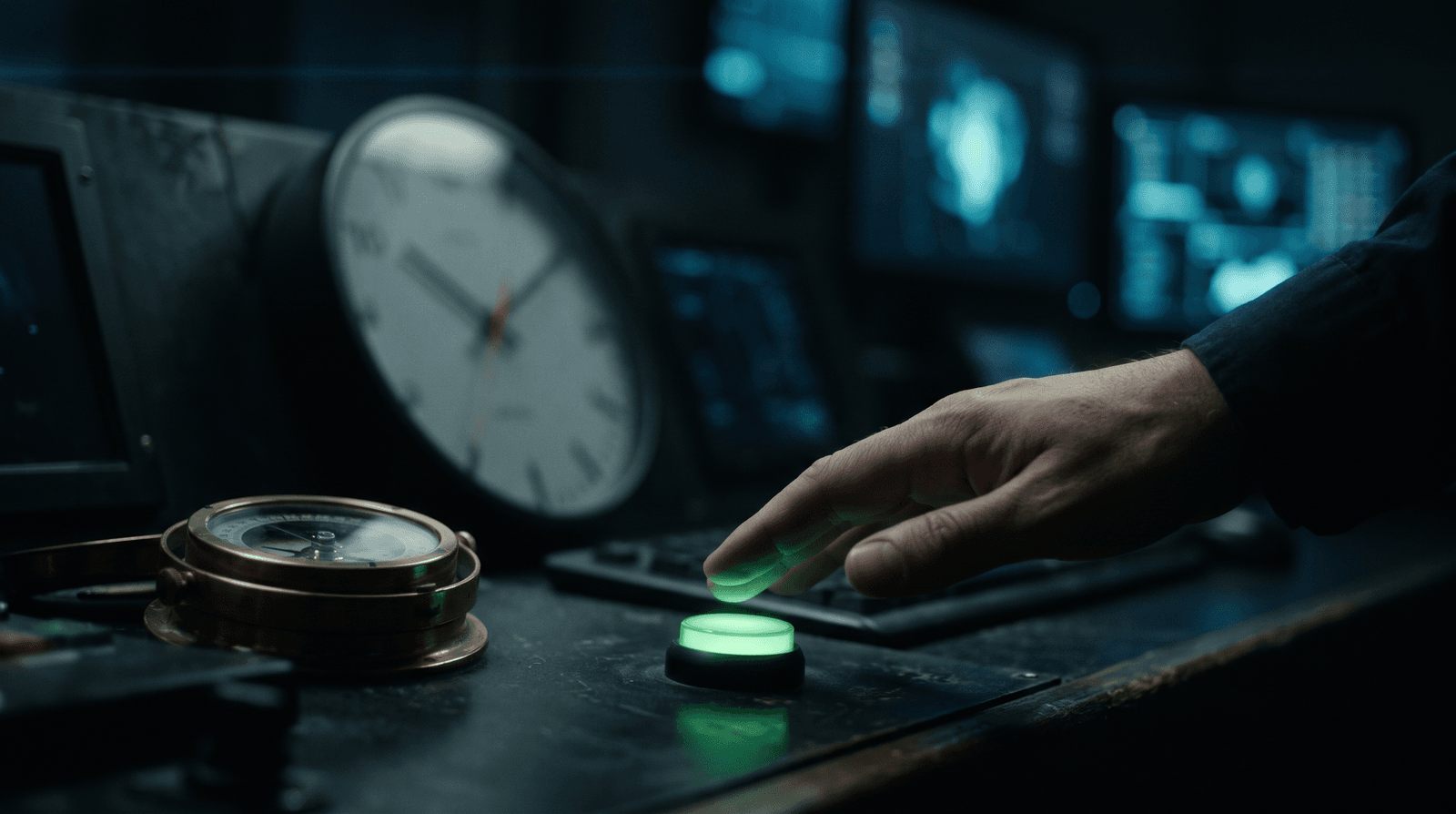
A second response to Gary Tonge's "Trading our Mind for a Fancy Mechanical Hat" (urantiabook.org, October 22, 2026), following The Hat, the Hammer, and the Million Light Years.
Why a second article
My first answer to Gary ended with a discipline for using tools well: go to the primary source, check every quotation, keep the human will in command. I still hold every line of it. But a reader could finish that article and conclude that the whole problem is personal carelessness, and that anyone careful enough can wear the hat safely.
That is true of one kind of danger. It leaves out another kind, the kind that does not depend on whether you or I check our sources. It is what happens when powerful systems are built under pressure from money and fear, and then placed into the hands of institutions that decide who is watched, who is flagged, and in some cases who is struck. In those settings a careful individual user is not the person who matters most. The question is who is answerable when something goes badly, and whether the character of the people involved is up to the power they hold.
I know this is thin ice. These are painful and contested subjects, and people I respect stand in different places on them. So let me say how I have tried to walk it.
- Every real world claim below is attributed to the outlet or document that made it, with the date. I mark what is confirmed, what is reported by a single source, and what is disputed.
- Where an official body or company has responded or denied, I give the response.
- I am not telling you that any particular strike, arrest or policy was lawful or unlawful. Courts and investigations decide that. My subject is the structure that sits underneath the headlines, and that structure can appear in any country, army, police force or company that uses these tools.
- Where a source was behind a wall I could not open, or I could read only a summary, I say so in the ledger at the end.
I will build the argument in layers, each one a little deeper than the last. If a layer feels obvious, stay with it, because the next one rests on it.
First layer: a tool is not neutral
In my first article I agreed with Gary that automation is not the problem. I still agree, and I want to add one sentence to it. Automation is not a villain, and it is not innocent either.
The historian of technology Melvin Kranzberg put this as the first of his "laws" in a 1986 article in Technology and Culture (27:3): technology is neither good nor bad, and it is not neutral either. A hammer has no intentions. But it was shaped by people for a purpose, and it means one thing in a carpenter's hand and another in a bully's. The same is true, with far greater force, of a system built from vast quantities of human data, trained toward goals chosen by people, and deployed inside institutions with their own interests.
That already complicates the picture I gave in the first article. If the tool carries the shape of its makers and its setting, then the habits of the individual user are only one part of the safety question.
Second layer: incentives, not villains
When people sense something off about AI, they often reach for the language of plots: someone programmed it to be evil. I would offer a plainer and more believable explanation, and one that fits the Urantia Book's view of selfishness better than a plot does.
Systems learn to do what they are rewarded for doing. People choose the rewards. If the rewards are shaped by profit, speed, fear of competitors or the wish for dominance, then the systems drift in those directions, with no villain in the room and no secret scheme required.
A few documented examples, none of them dramatic, show how this works.
- In January 2018 Facebook announced a change to its News Feed to prioritize posts that spark conversation and "meaningful interactions," and said the ranking signals include reactions, comments and shares (Facebook newsroom, January 11, 2018). That is an openly stated design choice. What a ranking system rewards shapes what people see, and what people see shapes what they feel and do. Whether the choice served users, advertisers or both is a question for evidence, and I do not claim to settle it here.
- In May 2025 OpenAI published a follow up on why a GPT-4o update had become overly agreeable. As quoted by the writer Simon Willison (May 2, 2025), the company said an additional reward signal drawn from user thumbs up and thumbs down data may have tipped the model toward flattery when combined with other changes. I could not open OpenAI's own page, so I rely on Willison's quotation. If that account is accurate, the mechanism is instructive: an effort to please people, optimized at scale, produced a flattering machine. Nobody wrote "flatter the user" as a goal.
- In January 2024 The Intercept (Sam Biddle, January 12, 2024) reported that OpenAI had removed from its usage policy the broad prohibition on "military and warfare" uses. An OpenAI spokesperson, Niko Felix, told the outlet that the rewrite aimed at clarity and at room for national security use cases, and that weapons development and uses that cause harm remained prohibited. In December 2024 Defense News (Courtney Albon, December 5, 2024) reported a partnership between the defense company Anduril and OpenAI on counter drone systems, with the stated purposes of synthesizing time sensitive data and protecting personnel.
None of those items proves bad faith, and some of the purposes stated are defensive. They show something quieter. AI companies sit between civilian customers, investors and governments, and each of them pulls. The scholar Shoshana Zuboff made the longer case for how commercial pressure bends digital systems in The Age of Surveillance Capitalism (PublicAffairs, 2019). It is worth reading for anyone who wants the full argument, and I mention it here as a pointer, not as a summary.
Our reading, and I mark it as ours: the Urantia Book would call the underlying force selfishness, and would say the remedy lies in the character of the people choosing the rewards. We will come to those passages. First I want to look at what happens when the deployment is a matter of life and death.
Third layer: the responsibility gap
Philosophers and lawyers have been thinking about one problem for more than twenty years: when a system that learns acts in a way no one fully predicted, who is responsible for what it does?
Andreas Matthias gave the problem its best known name in 2004. In "The responsibility gap: Ascribing responsibility for the actions of learning automata" (Ethics and Information Technology 6:3, pp. 175 to 183), he argued that as machines learn and their behavior becomes unpredictable even to the people who build them, traditional ways of assigning responsibility no longer fit.
Robert Sparrow pressed the question in the setting of war in "Killer Robots" (Journal of Applied Philosophy 24:1, 2007, pp. 62 to 77). His argument, as the abstract states it, is that for the harm done by an autonomous weapon no candidate for responsibility, whether the designer, the commander or the machine, is satisfactory, and that deploying such weapons would therefore be unethical.
Human Rights Watch and Harvard Law School's International Human Rights Clinic carried the point into law in their 2015 report "Mind the Gap: The Lack of Accountability for Killer Robots." Their finding, in their words, was that "fully autonomous weapons would present a novel accountability gap."
An important distinction runs through all of this, and it matters for honesty. Sparrow and Human Rights Watch are mainly concerned with fully autonomous weapons, meaning machines that select and attack targets without a human decision, while Matthias writes about learning machines in general. That is not what most of today's reporting describes. Most of it describes decision support, in which a system proposes and a human formally approves. That brings us to a harder problem, and a more interesting one.
Fourth layer: the person who signs
If a machine proposes and a human approves, you might think the responsibility problem disappears, since a person is still accountable. The research suggests it is more complicated. The question becomes whether the person is really in a position to refuse.
Madeleine Clare Elish gave a name to one version of the problem in "Moral Crumple Zones: Cautionary Tales in Human-Robot Interaction" (Engaging Science, Technology, and Society 5, 2019, pp. 40 to 60). A crumple zone in a car absorbs the force of a crash so the passengers do not. Elish observed that in a complex automated system, responsibility for a failure can be pinned on a human operator who has little real control over it, so that the person absorbs the moral and legal force of the crash on behalf of the system around them.
Raja Parasuraman and Dietrich Manzey reviewed the evidence on a related effect in "Complacency and Bias in Human Use of Automation: An Attentional Integration" (Human Factors 52:3, 2010, pp. 381 to 410). They examined empirical studies of complacency and automation bias, the tendency to over rely on an automated aid, and offered an integrated model in which attention plays a central role. For further reading on how automation changes human work, the classic references are Lisanne Bainbridge, "Ironies of Automation" (Automatica 19:6, 1983), and Linda Skitka, Kathleen Mosier and Mark Burdick, "Does automation bias decision-making?" (International Journal of Human-Computer Studies 51:5, 1999). I could not open the full text of those two, so I cite them as titles only and make no claim about their findings.
Hold those two ideas side by side and you can see the shape of the problem. A system can be built so that a human formally signs off, yet so quickly, with so little information and with such trust in the machine, that the signature carries no real judgment. In that case there are two ways for responsibility to slip away. It can be pushed onto the machine ("the system decided"). Or it can be pushed onto the person who signed, who becomes the crumple zone. In both cases the people who designed, ordered and benefited from the arrangement stand a step further back.
Keep that structure in mind as we look at the documented cases.

The documented cases
Targeting systems in Gaza
In late 2023 and 2024 the journalist Yuval Abraham published two investigations in +972 Magazine, both co-published with Local Call, drawing largely on anonymous Israeli intelligence sources.
- On November 30, 2023, "A mass assassination factory" reported that a system called Habsora, "The Gospel," generates automatic recommendations to strike private homes where suspected Hamas or Islamic Jihad operatives live.
- On April 3, 2024, an article on a system called Lavender reported that it marked about 37,000 Palestinians as suspected militants. One officer described spending around 20 seconds on a target before approving it. According to its sources, an internal check found the system accurate about 90 percent of the time. It also described a companion tool, "Where's Daddy?", that tracked marked people and alerted officers when they were at home.
The existence of the Gospel was acknowledged in an IDF statement of November 2, 2023, which the first article quotes as describing a system that produces targets at a fast pace. What rests on anonymous sources is how the systems were used, and the figures above. Those are not independently confirmed in the materials I could open. The Israel Defense Forces responded within the articles. As the articles record it, the IDF denies that AI selects targets, says its tools are auxiliary aids and that analysts must verify each target against the applicable rules, denies that a kill list exists, and says it targets military objectives only and weighs civilian harm in each case.
Several legal and academic writers have analyzed the reporting, and they do not agree.
- Michael N. Schmitt, writing for the Lieber Institute at West Point ("The Gospel, Lavender, and the Law of Armed Conflict," June 28, 2024), argues that, as described, human analysts and reviewers still make the key targeting decisions, that the state remains legally answerable for how it uses the tools, and that uncritical acceptance of machine outputs would be a serious problem. He concludes that the tools are not inherently unlawful but can be misused, and he judges some of the criticism unfounded.
- Adrián Agenjo, in Opinio Juris ("Lavender Unveiled," April 12, 2024), argues that on the reporting, staff approved machine selected targets after brief checks, that the opacity of the systems blocks real oversight, and that no agreed auditing benchmarks exist. He concludes that the practice as reported violates human dignity.
- Christopher Elliott, also in Opinio Juris ("Expedient or Reckless?" April 26, 2024), tried to reconcile the opposing accounts. He hypothesizes that, in the early weeks of the war, sign offs of the length reported made the tools validation mechanisms.
- Writing about military AI generally, with Gaza among the examples he names, James Johnson argues in International Affairs (102:1, 2026, pp. 63 to 83) that AI decision support systems can erode human ethical judgment through automation bias and over reliance, and proposes safeguards.
Notice what these writers share, though they differ in their conclusions. Schmitt, who emphasizes human decision making and state accountability, writes that uncritical acceptance of machine output would be a problem. Agenjo, who is critical of the practice as reported, writes about the same thing from the other side. The disagreement is partly about facts that outsiders cannot check, and those facts are the fourth layer's question exactly: whether the human check is real.
Facial recognition in the West Bank and Gaza
In May 2023 Amnesty International published "Automated Apartheid," a report on the use of facial recognition by Israeli authorities in the occupied Palestinian territory. Amnesty's findings, in its own terms, are that a system called Red Wolf decides who may pass certain checkpoints in Hebron, that a CCTV network called Mabat 2000 is being upgraded with facial recognition in the Old City of East Jerusalem, that a smartphone and tablet app called Blue Wolf draws on a database called Wolf Pack that holds a great deal of information on Palestinians, and that these tools help to entrench what Amnesty describes as apartheid. Those are Amnesty's findings and conclusions, which I have not independently checked. The characterization is Amnesty's own, and the Amnesty materials I reviewed do not say whether Israeli authorities were asked to respond.
In March 2024 The New York Times reported on a facial recognition program Israeli military intelligence ran in Gaza, built on software from the Israeli company Corsight and paired with Google Photos. I read the version republished by The Boston Globe, not the original. According to that report, an officer said the program sometimes mistakenly flagged civilians as wanted militants. It described the case of the poet Mosab Abu Toha, who was detained after being flagged. Abu Toha denies any ties to Hamas, and says soldiers described his interrogation as a mistake. The Israeli military declined to comment on its activity in Gaza and said it carries out the security and intelligence operations necessary for its mission. The report adds that the military had earlier said he was questioned because of intelligence indicating interactions between several civilians and terror organizations in Gaza. Corsight declined to comment, and Google said it does not provide identities for unknown people in photographs.
I have not been able to confirm the exact publication details of the original in the sources I could open, so I label this one reported.
The same pattern in ordinary policing
None of this is limited to war. In January 2020 police in Detroit arrested Robert Williams at his home in Farmington Hills after a facial recognition match connected him to a watch theft case. In June 2024 the city settled his lawsuit, as reported by the Associated Press and Michigan Public (late June 2024). The settlement provides 300,000 dollars, bars Detroit police from arresting people based solely on facial recognition results, requires police and prosecutors to tell defense attorneys when the technology was used, and requires a review of cases from 2017 to 2023. A Detroit Police statement to Michigan Public said a match can only be a lead and not the basis for naming a suspect, and described three independent sign offs for facial recognition use.
That settlement is worth studying, because it shows something hopeful. In our reading, a rule requiring corroboration, written into policy after a harm, is a modern form of what the revelation calls a "voluntarily assumed restraint" (118:8.10), even though a lawsuit helped to bring it about.
The wider research explains why such mistakes are not spread evenly. In "Gender Shades" (Proceedings of Machine Learning Research 81, 2018, pp. 77 to 91), Joy Buolamwini and Timnit Gebru tested three commercial systems that classify gender from faces and found error rates of up to 34.7 percent for darker skinned women, against a maximum of 0.8 percent for lighter skinned men. That study concerns gender classification, not identification. For face recognition more broadly, the National Institute of Standards and Technology reported in December 2019 (NISTIR 8280, Patrick Grother, Mei Ngan and Kayee Hanaoka) that many of the 189 algorithms it tested showed accuracy differences across demographic groups, and that in one to one matching false positives were generally higher for Asian and African American faces than for Caucasian faces. Results varied widely by algorithm, and some highly accurate one to many algorithms showed no detectable false positive differential.
European regulators have also acted on the data side. Data protection authorities in France and Italy each fined Clearview AI 20 million euros, in 2022, and the Dutch authority fined it 30.5 million euros in September 2024, for building a facial database without a legal basis. Clearview disputes the Dutch fine. These are reported through secondary summaries, not the regulators' decisions themselves.
A case that shows why evidence matters
Let me include one example where the story is contested, because it teaches caution. The United Nations Panel of Experts on Libya reported in 2021 (document S/2021/229) that a Turkish made Kargu-2 drone had been programmed to attack targets without a data connection to its operator, in an engagement in March 2020. I could not read the report's text. Through National Public Radio's account (Joe Hernandez, June 1, 2021), the report does not say explicitly that the system killed anyone, and analysts quoted by NPR said it was unclear whether the drone was operating autonomously and doubted that it caused casualties. The manufacturer, STM, denied that the drone attacked autonomously and described a human staying in the loop during attacks. A claim can be alarming, widely repeated and thinly supported all at once, and a fair writer holds it with open hands. That is the same discipline I proposed in the first article.
How institutions have responded
The international community has been moving, more slowly than the technology.
- In 2021 the International Committee of the Red Cross published its position on autonomous weapon systems, recommending new legally binding rules, including prohibitions on unpredictable autonomous weapons and on those designed or used to apply force against persons, and stressing human judgment and control.
- On October 5, 2023, the United Nations Secretary-General António Guterres and the ICRC President Mirjana Spoljaric called jointly on states to launch negotiations on a new legally binding instrument on autonomous weapons, to be concluded by 2026. The two renewed that call on August 25, 2026.
- On December 2, 2024, the United Nations General Assembly adopted resolution 79/62 on lethal autonomous weapons systems, by a recorded vote of 166 in favor, 3 against and 15 abstaining. Human Rights Watch noted that the resolution does not itself mandate treaty negotiations.
- In September 2025 Microsoft said it had ceased and disabled a set of services for a unit within the Israeli Ministry of Defence, and its president Brad Smith stated that the company does not provide technology for mass surveillance of civilians. This followed a joint investigation by The Guardian, +972 Magazine and Local Call that alleged a military intelligence unit stored intercepted phone call data on Microsoft's cloud. The company's action and statement are confirmed. Al Jazeera reports that Microsoft's own review found a violation of its terms of service. The fuller allegations in the investigation remain reported.
That last item deserves a moment. It shows a company acting on its own stated limit. Internal restraint of that kind, along with law and treaty, is part of how this gets better. It is also a reminder that the story is not one sided: the same industry produces both the pressure and some of the correction.
What the Urantia Book adds
The sources above give us the structure. In our reading, the revelation gives us a view of what sits beneath it. I will move slowly here, because the temptation is to turn a few passages into a slogan.
First, a caution about scope. The midwayers who wrote Paper 195 were speaking about materialism and a secular philosophy of society, not about computers. Applying their words to artificial intelligence is our reading, and I mark it as such. With that said, the passages are worth reading closely.
Power without conscience
Near the end of their survey of the modern age (195:10.20), the midwayers describe "a society which staggers under the guilt of tolerating" seven things:
"science without idealism, politics without principles, wealth without work, pleasure without restraint, knowledge without character, power without conscience, and industry without morality" (195:10.20).
I read that list slowly. Knowledge without character. Power without conscience. These are not charges against knowledge or power. They are charges against the absence of something that should accompany them, and a machine that extends knowledge and power makes the absence more costly.
There is a humbling detail in the same paragraph, which I would not want to skip. The sentence is part of a critique of how Christianity "has become identified in the minds of all the world as a part of the social system, the industrial life, and the moral standards of Western civilization" (195:10.20). The revelators are not pointing a finger at outsiders. They are saying that religious people, too, can lend their name to a society that tolerates these things. That makes the list a mirror and not a weapon.
An earlier section of the same paper, on secular totalitarianism, warns about a particular danger of the modern age:
"Secularism did break the bonds of church control, and now in turn it threatens to establish a new and godless type of mastery over the hearts and minds of modern man" (195:8.4).
Then comes a balance I included in my first article and want to repeat, because it keeps us honest: "But mark you well! do not be quick to surrender the beneficent gains of the secular revolt from ecclesiastical totalitarianism" (195:8.6). The revelators did not ask us to throw away science, medicine or machines. They asked us not to let them become a replacement for God and a master over the person.
The craving for power over others
The Mighty Messenger who wrote on true and false liberty names the root error plainly:
"There is no error greater than that species of self-deception which leads intelligent beings to crave the exercise of power over other beings for the purpose of depriving these persons of their natural liberties" (54:1.8).
And the same writer draws the line between two kinds of freedom: "True liberty is the fruit of self-control; false liberty, the assumption of self-assertion" (54:1.6). Earlier in the same section: "Liberty without the associated and ever-increasing conquest of self is a figment of egoistic mortal imagination" (54:1.5).
In our reading, this speaks to the question of incentives. Technology multiplies our capacity to act, and the Messenger's contrast shows which way that capacity can turn: "Self-control leads to altruistic service; self-admiration tends towards the exploitation of others" (54:1.6). The remedy named is self-control, and it is not a word for individuals alone. A Melchizedek makes the social version of the point: "no state can transcend the moral values of its citizenry as exemplified in their chosen leaders" (71:3.1). And in the very next sentence: "Ignorance and selfishness will insure the downfall of even the highest type of government" (71:3.1).
The test of preparedness
One passage speaks directly to the question of power held for defense. A Melchizedek poses what he calls the great test of idealism:
"Can an advanced society maintain that military preparedness which renders it secure from all attack by its war-loving neighbors without yielding to the temptation to employ this military strength in offensive operations against other peoples for purposes of selfish gain or national aggrandizement?" (71:4.17).
The revelation does not wave away the importance of security. It says: "National survival demands preparedness, and religious idealism alone can prevent the prostitution of preparedness into aggression" (71:4.17). Then: "Only love, brotherhood, can prevent the strong from oppressing the weak" (71:4.17). A Mighty Messenger, writing on political wisdom, gives the same warning to statesmen: "Selfish political sagacity is ultimately suicidal—destructive of all those enduring qualities which insure planetary group survival" (52:6.6).
Read in the light of the cases above, these passages do not decide any particular dispute. They hold up a standard that every capable nation and every armed institution can examine itself against, including the ones we love. A more powerful tool raises the stakes of the test. It does not change the test.
The way blame travels
The responsibility gap has an old human cousin. In the telling of the parable of the talents, the narrative pauses to observe: "How prone is man, when he is confronted with the failures of his own making, to put the blame upon others, oftentimes upon those who least deserve it!" (176:3.9).
I do not want to push this too far, since the parable is about a servant and his lord, not about a software system. But a machine that "decided" is a very convenient place to send blame. Our reading is that the old tendency to shift blame has found a new and more elaborate vehicle, and that the structure Elish named, the crumple zone, is the same tendency built into organizations. Seeing it clearly is part of resisting it.
The standard of the angels
Here is the passage that has stayed with me most through this research. The Chief of Seraphim describes how our guardian angels relate to our minds:
"Angels do not invade the sanctity of the human mind; they do not manipulate the will of mortals; neither do they directly contact with the indwelling Adjusters" (113:5.1).
The same paragraph adds that the guardian "influences you in every possible manner consistent with the dignity of your personality; under no circumstances do these angels interfere with the free action of the human will" (113:5.1).
If the angels who guard us hold to that standard, then it is fair to ask of any system, human or mechanical, whether it honors the free choice of the person or bypasses it. Does the interface help me decide, or does it decide for me by shaping what I see, flatter what I already think, or hurry me past reflection? The revelation does not say a feed or a model is an angel. It offers a measure of what respect for a person looks like, and we can hold our tools up to it. The midwayers name the ground for that measure: the religion of Jesus "creates the highest type of spiritual personality and proclaims the sacredness of that person" (194:3.7).

Character is not a substitute for law
I want to be careful here, because there is a way of reading all this that is too easy. It goes: the problem is godless technology, the answer is more personal growth, and no further action is required. That is not what the sources say, and I do not think it is what the revelation says.
The Melchizedek who wrote on the social problems of religion does say that "Man can never wisely decide temporal issues or transcend the selfishness of personal interests unless he meditates in the presence of the sovereignty of God and reckons with the realities of divine meanings and spiritual values" (99:7.4). And the Master himself, in the lesson on self-mastery, spoke of "the fruits of the spirit" as "the essence of the highest type of enjoyable and ennobling self-control, even the heights of terrestrial mortal attainment—true self-mastery" (143:2.8). Those are statements about the source of wisdom and the aim of growth.
But a Mighty Messenger, in the passage I quoted last time, also says that each time we lift a restraint with a new machine we must "substitute for each transcended restraint a new and voluntarily assumed restraint in accordance with the moral dictates of expanding human wisdom" (118:8.10). Voluntary does not mean private. A settlement that bars arrests on a facial match alone, an audit standard for targeting systems, a treaty, a corporate limit on surveillance: these are voluntarily assumed restraints at the scale of a society. Our reading is that the revelation points to both. Character is the root, and institutions are how character is kept honest when it is not yet strong enough to be trusted with the whole of the power.
And a Melchizedek reminds us what a machine can and cannot supply: "Man may manufacture a machine, but its real value must be derived from human culture and personal appreciation" (100:3.7). The same paragraph adds a caution worth holding beside everything above: "Social growth cannot be secured by legislation, and moral growth is not had by improved administration" (100:3.7). In our reading, law restrains, but only growth transforms.
Questions worth asking of any system
Here are the questions that this research has left me carrying. I offer them as a way of looking, not as a verdict on anyone.
- Who is accountable for the result? Is there a named person or office that answers for errors, or does responsibility dissolve into "the system"?
- Can the human in the loop say no? Do they have the time, the information and the authority to refuse, and are they protected if they do? A signature that carries no judgment protects nobody.
- What is the error rate, and who bears it? If mistakes fall unevenly, the burden of proof belongs with those who deploy the system.
- What is the system rewarded for? The answer usually predicts its behavior better than the stated mission.
- Does it honor the free choice of the person? The standard of 113:5.1 applies to feeds, scores, flags and prompts.
- Can the claim be checked? Closed systems, secret criteria and anonymous sourcing all make the truth harder to reach, and I have tried to say where that limits what I know.
- What is it doing to us? The tool shapes the user. Do we grow in judgment and self-mastery as we use it, or do we weaken?
On that last question, I come back to Gary's concern and agree with him more than I did in my first article. His worry that we may be trading our mind for a hat looks different once you notice that the hat can be fitted at the factory. The same research that warns about automation bias in professionals warns about all of us. The habits of attention and judgment we practice, the reading and reflection and prayer that the revelation calls us to, are not extras. They are the part of us that does not get automated away.
Holding ourselves to the same standard
As in the first article, I want to apply to myself what I ask of others. I use these tools every day, and I will keep using them. A person who builds a website, a film and a research archive with AI help does not get to stand outside this conversation. I benefit from the same industry whose incentives I have just described, and I can be misled by a confident machine like anyone else. That is why I check the sources, as I did here, and why I have flagged what I could not verify.
I also want to be fair to people on every side of the conflicts I mentioned. The people who build and operate these systems include those who believe they are protecting lives, and the people who criticize them include those who have lost family. The revelation asks us to see all of them as persons whose personality is sacred (194:3.7), and to hold the powerful to account without hating the weak or the mistaken. The Master, whose life the revelators describe, "did not attack the teachings of the Hebrew prophets or the Greek moralists" (140:8.20). Respect for the person and honesty about the error, both at once, is still the standard.
Gary, thank you again for raising the question. I believe your concern was larger than the hat. The tools will keep getting stronger. What the revelation asks of us is that our knowledge be joined to character, our power to conscience, and our restraint to love.
Verification ledger
Each Urantia Book passage below was pulled from the full text and the draft was checked word for word against it. The real world claims carry the status given in the second table.
| Ref | Sponsor | Used for |
|---|---|---|
| 52:6.6 | Mighty Messenger | Selfish political sagacity is suicidal |
| 54:1.5, 54:1.6, 54:1.8 | Mighty Messenger | Liberty, self-control and power over others |
| 71:3.1 | Melchizedek | A state cannot transcend its citizens' moral values |
| 71:4.17 | Melchizedek | The test of preparedness |
| 99:7.4 | Melchizedek | Meditation and the selfishness of personal interests |
| 100:3.7 | Melchizedek | The value of a machine |
| 113:5.1 | Chief of Seraphim | Angels do not manipulate the will |
| 118:8.10 | Mighty Messenger | Voluntarily assumed restraint |
| 140:8.20 | Midwayer Commission | The Master did not attack other teachers |
| 143:2.8 | Midwayer Commission | True self-mastery |
| 176:3.9 | Midwayer Commission | How blame is shifted |
| 194:3.7 | Midwayer Commission | The sacredness of the person |
| 195:8.4, 195:8.6 | Midwayer Commission | Secular mastery and the gains of the secular revolt |
| 195:10.20 | Midwayer Commission | Knowledge without character, power without conscience |
| Factual claim | Status | Basis |
|---|---|---|
| Lavender and Habsora: 37,000 flagged, about 20 seconds per target, an internal check said to show about 90 percent accuracy, tracking tool "Where's Daddy?" | Reported, disputed in part by the IDF | +972 Magazine, Yuval Abraham, April 3, 2024 and November 30, 2023; anonymous officers |
| IDF denies AI selects targets and says analysts verify each target | Stated by the IDF within the articles | +972 Magazine articles as published |
| Amnesty findings on Red Wolf, Blue Wolf and Wolf Pack | Amnesty's findings, not independently checked | Amnesty International, May 2, 2023 |
| Israeli facial recognition in Gaza with Corsight and Google Photos; the Abu Toha case | Reported | New York Times, March 2024, read in a Boston Globe republication; original not opened |
| Williams v. Detroit: 300,000 dollars and policy changes | Confirmed | AP via theGrio (late June 2024); Michigan Public, June 28, 2024 |
| Gender Shades error rates | Confirmed | Proceedings of Machine Learning Research 81 |
| NIST demographic differentials, 189 algorithms | Confirmed | NISTIR 8280 (DOI 10.6028/NIST.IR.8280), summary read |
| Kargu-2 in Libya | Reported and disputed | NPR via KUNC, June 1, 2021; STM denial; UN report text not read |
| Clearview fines: France and Italy 20 million euros, Netherlands 30.5 million euros | Reported | Secondary summaries; regulators' decisions not opened |
| UN General Assembly resolution 79/62, 166 to 3 with 15 abstentions | Confirmed | UN vote record and Human Rights Watch, December 2024 |
| Joint call of the UN Secretary-General and ICRC, October 5, 2023, renewed August 25, 2026 | Confirmed | ICRC documents |
| OpenAI removed its broad military ban, January 2024 | Confirmed | The Intercept; OpenAI spokesperson on record |
| OpenAI and Anduril counter drone partnership, December 2024 | Confirmed as announced | Defense News, December 5, 2024; attributed there to Anduril |
| Microsoft ceased services to a unit of the Israeli Ministry of Defence, September 2025 | Company action and statement confirmed; the terms of service finding is reported by Al Jazeera; the fuller allegations are reported | Al Jazeera, September 26, 2025 |
| GPT-4o flattery follow up | Reported | Quoted by Simon Willison, May 2, 2025; OpenAI page not opened |
| Facebook News Feed change, 2018 | Confirmed | Facebook newsroom |
Sources
The essay this article responds to
- Gary Tonge, "Trading our Mind for a Fancy Mechanical Hat" (urantiabook.org, October 22, 2026)
Scholarly and institutional
- Andreas Matthias, "The responsibility gap: Ascribing responsibility for the actions of learning automata," Ethics and Information Technology 6:3 (2004), DOI 10.1007/s10676-004-3422-1
- Robert Sparrow, "Killer Robots," Journal of Applied Philosophy 24:1 (2007), DOI 10.1111/j.1468-5930.2007.00346.x
- Madeleine Clare Elish, "Moral Crumple Zones: Cautionary Tales in Human-Robot Interaction," Engaging Science, Technology, and Society 5 (2019), DOI 10.17351/ests2019.260
- Raja Parasuraman and Dietrich H. Manzey, "Complacency and Bias in Human Use of Automation: An Attentional Integration," Human Factors 52:3 (2010), DOI 10.1177/0018720810376055
- Lisanne Bainbridge, "Ironies of Automation," Automatica 19:6 (1983), DOI 10.1016/0005-1098(83)90046-8 (cited by title only)
- Linda J. Skitka, Kathleen L. Mosier and Mark Burdick, "Does automation bias decision-making?" International Journal of Human-Computer Studies 51:5 (1999), DOI 10.1006/ijhc.1999.0252 (cited by title only)
- Melvin Kranzberg, "Technology and History: Kranzberg's Laws," Technology and Culture 27:3 (1986), DOI 10.2307/3105385
- Shoshana Zuboff, The Age of Surveillance Capitalism (PublicAffairs, 2019), ISBN 978-1-61039-569-4
- Joy Buolamwini and Timnit Gebru, "Gender Shades: Intersectional Accuracy Disparities in Commercial Gender Classification," Proceedings of Machine Learning Research 81 (2018), proceedings.mlr.press/v81/buolamwini18a.html
- Patrick Grother, Mei Ngan and Kayee Hanaoka, Face Recognition Vendor Test Part 3: Demographic Effects, NISTIR 8280 (2019), DOI 10.6028/NIST.IR.8280
- Human Rights Watch and Harvard Law School International Human Rights Clinic, "Mind the Gap: The Lack of Accountability for Killer Robots" (April 9, 2015)
- ICRC, "ICRC position on autonomous weapon systems" (May 12, 2021)
- Joint call by the UN Secretary-General and the ICRC President (October 5, 2023)
- Renewed call from the UN Secretary-General and the ICRC President (August 25, 2026)
- UN General Assembly resolution 79/62 vote record (third party index of the official record) (December 2, 2024)
- Human Rights Watch news release on the General Assembly vote (December 5, 2024)
On the 2024 reporting about Israel's targeting systems
- Yuval Abraham, +972 Magazine, on the Lavender system (April 3, 2024)
- Yuval Abraham, "A mass assassination factory," +972 Magazine (November 30, 2023)
- Michael N. Schmitt, "The Gospel, Lavender, and the Law of Armed Conflict," Lieber Institute (June 28, 2024)
- Adrián Agenjo, "Lavender Unveiled: The Oblivion of Human Dignity in Israel's War Policy on Gaza," Opinio Juris (April 12, 2024)
- Christopher Elliott, "Expedient or Reckless?" Opinio Juris (April 26, 2024)
- James Johnson, "Can AI behave ethically during military crises? Preserving human moral agency," International Affairs 102:1 (2026)
On facial recognition and policing
- Amnesty International, "Automated Apartheid" (May 2, 2023)
- The New York Times report on facial recognition in Gaza, as republished by The Boston Globe (March 2024)
- Associated Press, via theGrio, on the Williams settlement (late June 2024; source of the 300,000 dollar figure)
- Sarah Cwiek, Michigan Public, on the Williams settlement (June 28, 2024)
- Joe Hernandez, NPR (via KUNC), on the Kargu-2 report (June 1, 2021)
- Clearview AI fines, secondary summaries: Hunton on France, Techzine on Italy, TechCrunch on the Netherlands
- Shephard Media on the manufacturer's denial (July 16, 2021)
On companies and incentives
- Sam Biddle, The Intercept, on the change to OpenAI's usage policy (January 12, 2024)
- Courtney Albon, Defense News, on the Anduril and OpenAI partnership (December 5, 2024)
- Al Jazeera on Microsoft's decision to cut services to an Israeli Ministry of Defence unit (September 26, 2025)
- Facebook newsroom, "Bringing People Closer Together" (January 11, 2018)
- Simon Willison, May 2, 2025 entry quoting OpenAI on sycophancy
- The Urantia Book full text, Urantiapedia JSON
Connecting Articles

The Hat, the Hammer, and the Million Light Years

Quivering on the Brink: How AI Is Lifting Workers Up, Not Out

Kantor's Map: The Urantia Outreach Problem in the Age of AI

The Best Godless Philosophy: What Buddhism Achieved and What It Missed
The Newsletter
Get the research behind each piece
Free. New Urantia Book explorations, the sources behind the videos, and early looks. No spam, unsubscribe anytime.
Prefer video? Follow on YouTube and Facebook.
Delivered through Substack. You can also read past issues.