
Disclosure and the Inhabited Universe: A Calm Reading of a Loud Moment
Congressional hearings, whistleblowers, and a culture holding its breath for the big announcement. The strange truth is that the question is ancient, the universe really is inhabited, and the traffic looks nothing like the hype. A reading for everyone who wants the wonder without the whiplash.

Disclosure and the Inhabited Universe: A Calm Reading of a Loud Moment
Derek Samaras | Urantia Book Network | July 2026
We are living through a Disclosure moment. Congressional hearings take sworn testimony about recovered craft. Former intelligence officers speak of "non-human intelligence" into C-SPAN microphones. Foundations convene physicists and theologians to prepare position papers for the day after contact. Streaming platforms have built a small economy on the question, and every few months a new push notification promises that the veil is about to lift.
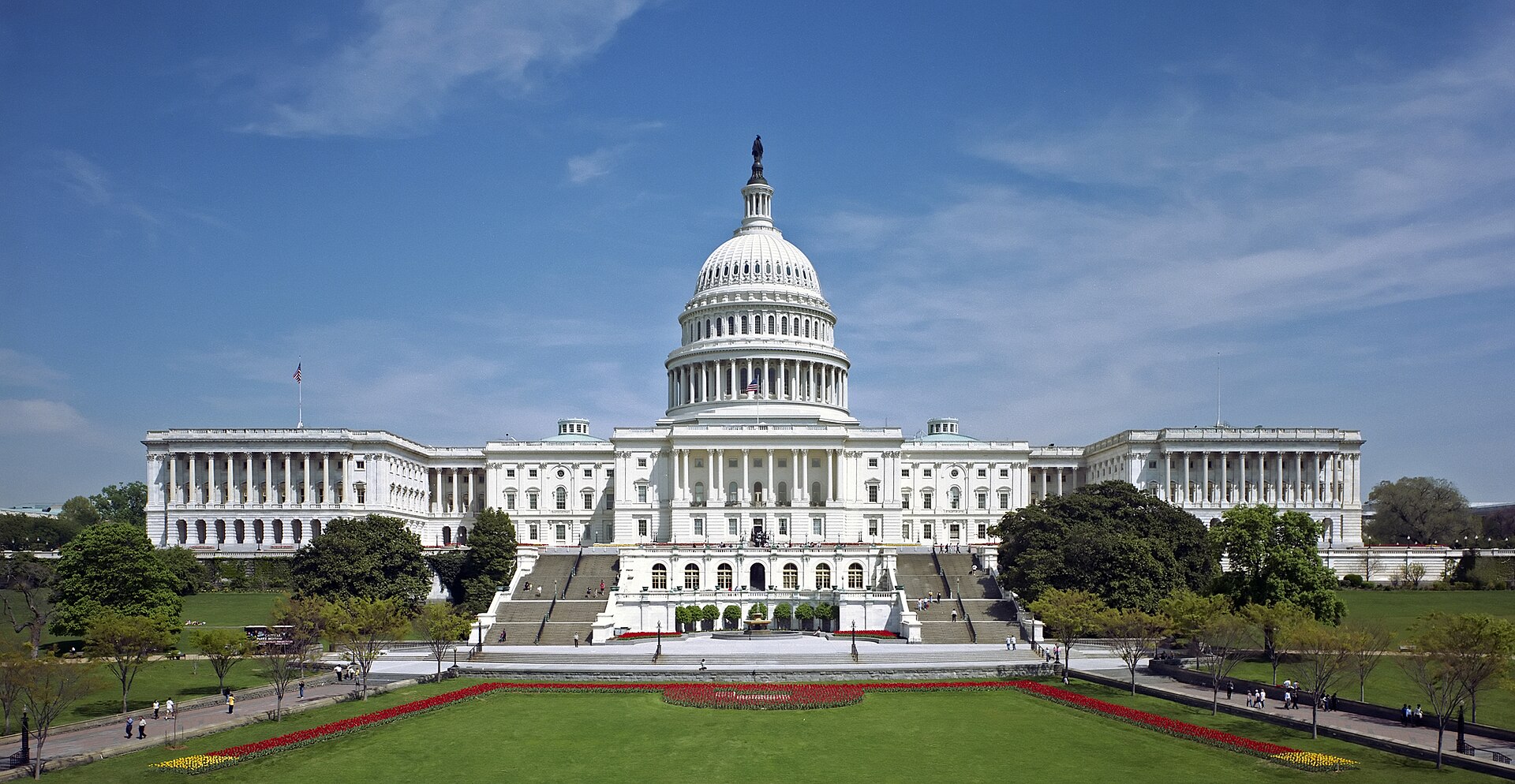 The hearings convene, the witnesses are sworn, and the announcement stays perpetually scheduled for next year. Photo: Architect of the Capitol, public domain.
Some people find all of this thrilling. Some find it exhausting. A great many people, and perhaps you are one of them, find themselves holding two feelings at once: a settled conviction that we are not alone in the universe, and a growing suspicion that the announcement industry itself may not be dealing straight with them.
This article is written for that reader. It does not mock the hunger, because the hunger is pointed at something real. It does not demand that you accept or reject any particular testimony, because most of us are in no position to verify any of it. What it offers instead is perspective from two places: the long and surprisingly warm history of religious thought on other worlds, and the specific, detailed account given in the Urantia Book of how an inhabited universe actually conducts its business with a planet like ours.
The short version is this. The universe is inhabited, more richly than the boldest Disclosure advocate imagines. Visitors do come here, constantly, on scheduled business. And the reason none of that looks like a saucer fleet on the White House lawn is one of the most interesting and, in the end, most comforting stories the revelation has to tell.
An Ancient Conversation, Not a Modern Craze
It is easy to assume the question of life on other worlds was born in 1947 with headlines out of Roswell, or in 1961 when Frank Drake wrote his famous equation. It was not. The retired theology professor Paul Thigpen, in his history of Catholic thought on extraterrestrial intelligence, traces the conversation back twenty-six centuries, through Greek philosophers, Church Fathers, medieval scholastics, popes, friars, and saints.
The outline of that history is worth knowing, because it quietly dismantles the idea that faith and an inhabited cosmos are natural enemies.
In 1277 the Bishop of Paris publicly condemned a list of propositions circulating in the universities, and among them was the claim that God "cannot make many worlds." The Church's own logic cut against a lonely cosmos: an all-powerful Creator is not limited to one act of creation. That condemnation cracked a door that never fully closed again.
In the fifteenth century Cardinal Nicholas of Cusa, a papal advisor in good standing, walked straight through it. He wrote that rather than think the stars uninhabited "and that this earth of ours alone is peopled," we should "suppose that in every region there are inhabitants, differing in nature by rank and all owing their origin to God." His contemporary William of Vorilong went where no theologian had gone before and asked the hard questions directly: would inhabitants of other worlds share Adam's fall, and could Christ redeem them? His answers, remarkably, were no to the first and yes to the second.
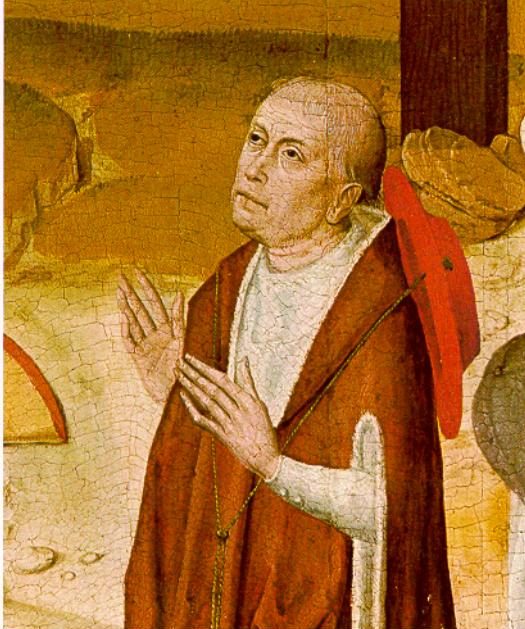 Cardinal Nicholas of Cusa, who proposed an inhabited cosmos in the 1440s and kept his job. Detail from an altarpiece by the Master of the Life of the Virgin, public domain.
By the nineteenth century, openness to other inhabited worlds was so common among the faithful that Cardinal John Henry Newman complained that doubting it was treated in religious circles as near blasphemy. The French philosopher Joseph de Maistre ridiculed theologians who imagined the other planets as dead globes that God had "launched into space, apparently like a tennis-player, for his amusement solely."
The twentieth century kept the thread. Padre Pio, the celebrated Capuchin mystic, said plainly in private conversation that "on other planets other beings exist who did not sin and fall as we did." When a child asked Pope John Paul II whether there are aliens, he answered, "Always remember: They are children of God as we are." And in 2008 the head of the Vatican Observatory, Father José Gabriel Funes, gave an interview to the Vatican's own newspaper under the headline "The extraterrestrial is my brother," suggesting that other races may have "remained in full friendship with their creator" while humanity plays the part of the lost sheep.
Nor is this a Catholic peculiarity. The Latter-day Saint tradition carries the same intuition in its founding texts. The Book of Moses has God declare, "And worlds without number have I created," and church president Spencer W. Kimball answered the question of whether planets out in space are inhabited by intelligent creatures with two words: "Without doubt."
Hold that history against the current moment and something becomes clear. The world's great faith communities are not bracing against the idea of an inhabited universe. Many of their finest minds arrived there centuries ago, by reasoning from the character of God rather than from radar returns. If official confirmation of life beyond Earth ever comes, the traditions will not shatter. Several of them have been waiting politely for the rest of us to catch up.
What the Revelation Says: The Cosmos Is Crowded
The Urantia Book does not treat the inhabited universe as a possibility to be defended. It treats it as the plain administrative reality within which our planet has a file, a registry number, and a case history. The count is given without drama:
"Seven superuniverses make up the present organized grand universe, consisting of approximately seven trillion inhabitable worlds plus the architectural spheres and the one billion inhabited spheres of Havona." (15:2.9)
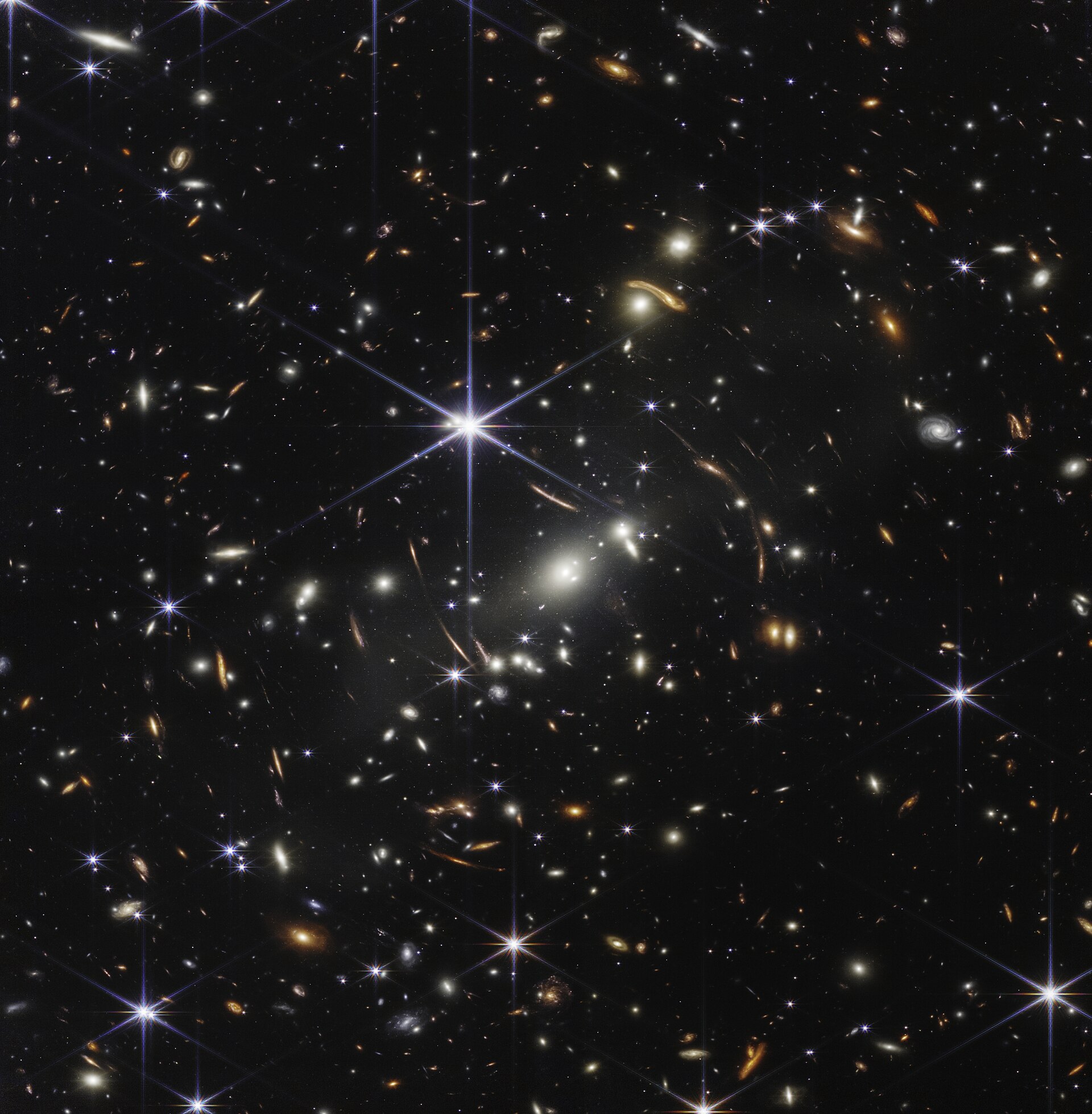 Webb's First Deep Field. Every smudge of light is a galaxy, and the whole scene covers a patch of sky about the size of a grain of sand held at arm's length. Photo: NASA, ESA, CSA, STScI, public domain.
Seven trillion worlds, populated by mortal beings of seven distinct physical types, adapted to every range of gravity, atmosphere, and temperature, all of them will creatures, all of them children of the same Father. We have walked through that census in detail in Other Inhabited Worlds, and this article will not repeat the tour. The point here is simpler: on the central question, the revelation sides with the most expansive hopes of the Disclosure community. The universe is not merely inhabited. It is administered, organized, and busy.
Which makes what comes next all the more striking.
The Visitors Are Already Here, and They Keep Office Hours
Here is a detail that surprises nearly everyone who first encounters it. According to the Urantia Book, our planet hosts a standing population of celestial personalities and a steady stream of arriving and departing visitors, right now, today. The planetary government it describes is not hypothetical:
"Each administrative day on Urantia begins with a consultative conference, which is attended by the governor general, the planetary chief of archangels, the Most High observer, the supervising supernaphim, the chief of resident Life Carriers, and invited guests from among the high Sons of the universe or from among certain of the student visitors who may chance to be sojourning on the planet." (114:5.5)
Student visitors, sojourning on the planet. The text elsewhere describes the transport corps that brings such travelers in and out:
"The planetary transporters serve the individual worlds. The majority of enseraphimed beings brought to this planet are in transit; they merely stop over; they are in custody of their own special seraphic transporters; but there are a large number of such seraphim stationed on Urantia." (39:5.10)
Even the seconaphim, the great "living mirrors" of the superuniverse whose full services our world currently lacks, are described as "frequent visitors on your world, accompanying assigned personalities" (28:7.4).
And those are just the travelers. The resident staff is on another scale entirely. The Chief of Seraphim on duty here reports that the planetary registry at the time of the revelation showed 1,002,469,238 individual angels present on this world, with another 191,924,362 away on transport, messenger, and death duty (114:0.2). Over a billion angels, on the clock, right now. If Disclosure means learning that non-human intelligence operates on Earth, the revelation discloses a workforce that would make it one of the largest employers in human experience.
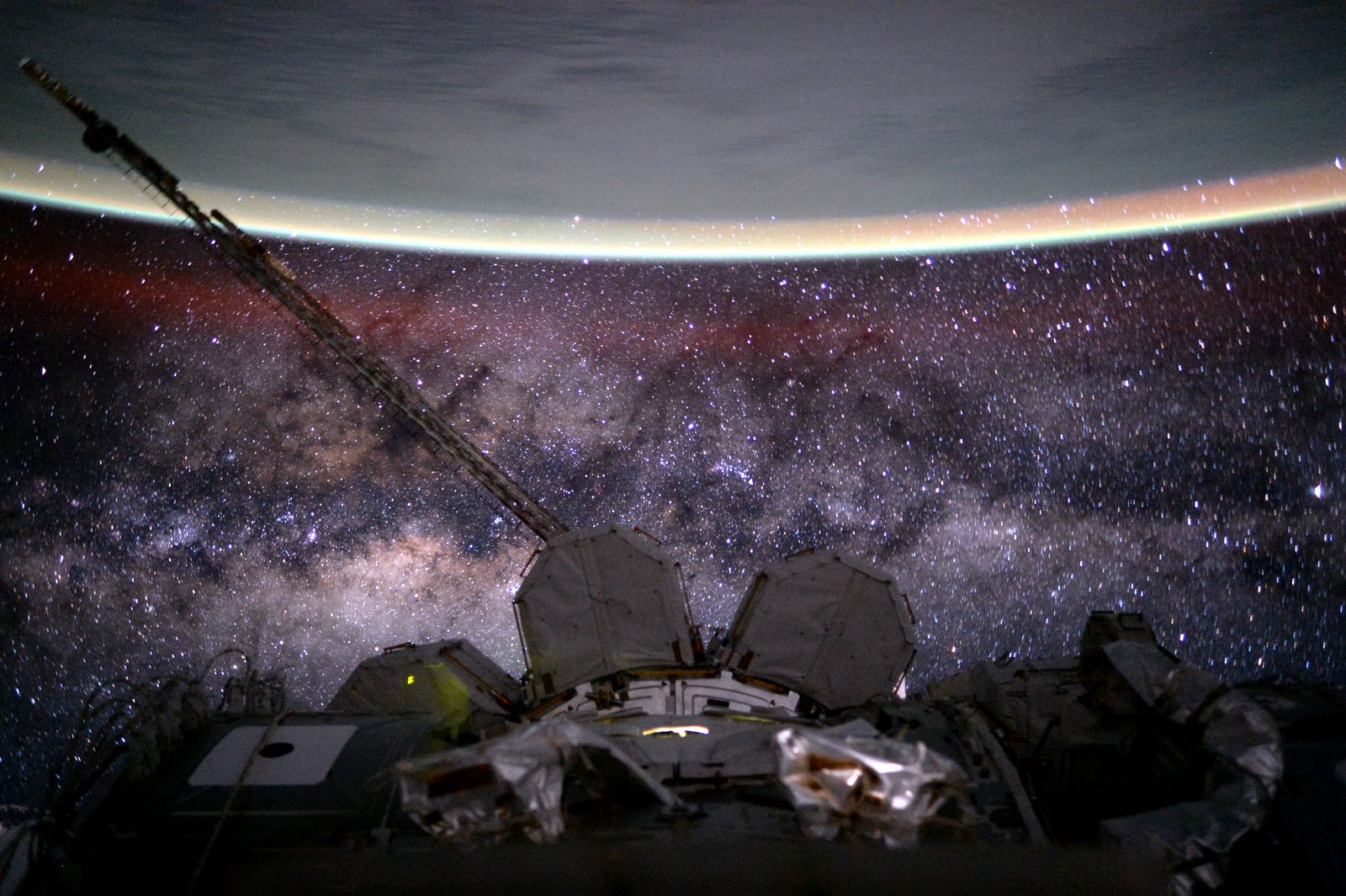 The view from the front porch. The Milky Way beyond the curve of Earth, photographed from the International Space Station. Photo: NASA/Scott Kelly, public domain.
So the picture the revelation paints is almost mischievous in how it relates to the Disclosure narrative. Is Earth being visited by intelligences from beyond? Constantly. Daily. There is a morning meeting. But the traffic is spiritual and morontial rather than metallic, it arrives by seraphic transport rather than by propulsion, and it goes about its work with no more interest in buzzing fighter jets than a hospital administrator has in startling the patients.
The strangeness in our skies, whatever mixture of misidentification, classified hardware, and genuine unknowns it turns out to be, deserves honest investigation. We looked at the specific claims, from the Greys to Roswell to the whistleblower testimony, piece by piece in You Deserve a Better Map. But the revelation's account of who is actually here, and why, runs on an entirely different register from the one the hearings are tuned to.
The Quarantine Is Spiritual, Not a Fence in Space
There is a reason the two registers do not meet, and it is the part of the story most often misunderstood, even by longtime readers of the book.
The Urantia Book teaches that our planet has been isolated since the Lucifer rebellion, which it dates to two hundred thousand years ago (61:7.8). Many readers over the years have pictured that isolation as something physical, a sort of exclusion zone or blockade, as if Earth sat inside a cordon of cosmic caution tape. A fellow reader recently walked through the text on this point and made the case, quotation by quotation, that the record describes nothing of the kind. The quarantine is spiritual, and what was severed was communication circuitry.
The evidence is consistent everywhere the subject appears. The book calls it a "spiritual quarantine" outright:
"The Lucifer rebellion produced many changes in your system of inhabited worlds and on Urantia, but we do not observe that the resultant spiritual quarantine of your planet in the least affected the presence and function of either the omnipresent spirit of the Eternal Son or the associated spirit-gravity circuit." (7:1.7)
What the quarantine actually suspended was the planet's participation in the universe broadcast and reflectivity services, the interplanetary communication grid:
"The universe broadcast is extended to all inhabited worlds regardless of their spiritual status. Planetary intercommunication is denied only those worlds under spiritual quarantine." (33:6.5)
"This sphere is still under partial spiritual quarantine, and some of the circuits essential to their services are not here at present. When your world is once more restored to the reflective circuits concerned, much of the work of interplanetary and interuniverse communication will be greatly simplified and expedited." (28:7.4)
And the identity of the official who carried out the isolation settles the question of what kind of isolation it was. It was not the power directors, the beings who manage physical energy. It was the supervisor of spirit circuits:
"Andovontia is the name of the tertiary Universe Circuit Supervisor stationed in our local universe. He is concerned only with spirit and morontia circuits, not with those under the jurisdiction of the power directors. It was he who isolated Urantia at the time of the Caligastia betrayal of the planet during the testing seasons of the Lucifer rebellion. In sending greetings to the mortals of Urantia, he expresses pleasure in the anticipation of your sometime restoration to the universe circuits of his supervision." (37:8.3)
Notice what that last sentence does. The very officer who pulled the plug sends his greetings and looks forward to plugging us back in. This is not the language of a prison warden. The book explains the purpose of such quarantines in terms that sound almost immunological, a defensive mercy on behalf of the whole neighborhood:
"And all this, as it operates on Urantia, is a spiritually defensive reaction of the majority of the worlds to save themselves, as far as possible, from suffering the isolating consequences of the alienating acts of a headstrong, wicked, and rebellious minority." (3:1.10)
 What actually went down in the quarantine. Not the roads, the switchboard. Photo: Seattle Municipal Archives, 1952, CC BY 2.0.
Personalities still come and go. The daily conference still convenes. What Earth lost was not visitation but connectivity: the broadcasts, the reflectivity relays, the routine interplanetary news service that normal worlds enjoy. We are, in the book's picture, a world with visitors in the building and the phone lines down.
This one clarification quietly reframes the entire Disclosure conversation. The question "when will they finally make contact?" assumes the universe has been either absent or hiding. The revelation's answer is that the universe has been present all along, and that what is actually pending is not an arrival but a restoration, the reconnection of circuits, on a timetable that belongs to universe administration and not to any terrestrial press office (46:8.2).
A Fair Word About the Kingdoms of Men
Now for the part that calls for both fairness and frankness.
Believing the universe is inhabited does not obligate anyone to believe every claim made about it, and it especially does not obligate anyone to assume that governments, media enterprises, and self-appointed spokesmen handle this subject with clean hands. A person can be fully persuaded of the seven trillion worlds and still notice that the Disclosure economy runs on monetized anticipation. The cliffhanger is the product. An announcement perpetually scheduled for next year keeps subscriptions active, documentaries funded, and hearings televised in a way that a resolved question never could.
None of that requires believing in vast coordinated deception. Ordinary institutional behavior explains most of it. Defense establishments classify things reflexively, including their own confusion. Witnesses can be sincere and mistaken at the same time. Journalists reward the most dramatic framing available. Entertainment companies follow the audience. Stir those together for eighty years and you get exactly what we have: a fog in which something real may well be present, but in which every party with a microphone has an incentive to keep the fog picturesque.
Jesus faced his own version of this dynamic, a crowd that wanted the spectacle more than the substance, and his response is on record:
"How is it, then, that you would have me turn aside from my work for the gratification of the curious and for the satisfaction of those who seek for signs and wonders?" (145:5.6)
That is not a rebuke of curiosity. It is a diagnosis of appetite. A revelation of the Father was standing in front of them, and the queue was for the fireworks. The Disclosure moment deserves the same gentle question. If the point of an inhabited universe is what it tells us about the character of God and the destiny of every mortal, then the substance is already available, in full, to anyone who wants it. The fireworks, whenever and whatever they turn out to be, were never the point.
There is one more note of caution the record requires, stated without alarm. The rebellion that isolated this world had an author on this world, and the book is precise about both his continued presence and his strict limits:
"Caligastia, your apostate Planetary Prince, is still free on Urantia to prosecute his nefarious designs, but he has absolutely no power to enter the minds of men, neither can he draw near to their souls to tempt or corrupt them unless they really desire to be cursed with his wicked presence." (53:8.6)
And since Pentecost, even the door he might knock on has been reinforced from the inside:
"Regardless of the presence of the Thought Adjusters, the pouring out of the Spirit of Truth upon all flesh forever made it impossible for disloyal spirits of any sort or description ever again to invade even the most feeble of human minds. Since the day of Pentecost there never again can be such a thing as demoniacal possession." (77:7.8)
No power unless invited, and no possibility of invasion at all. That is the whole security briefing, and it is why the revelation's counsel on unverified voices, channeled councils, and anonymous cosmic authorities is worth taking seriously. We examined that counsel at length in What Genuine Cosmic Contact Looks Like. The rule of thumb is simple and kind: any message whose main effect is to keep you waiting on the sky, rather than growing in love, patience, and service where you stand, is not coming from the universe administration, whatever letterhead it claims.
The Agondonter Privilege: Why the Silence Is Not Neglect
And here the story turns, because the revelation does something with our isolation that no Disclosure narrative has ever thought to do. It makes the silence an honor.
The book acknowledges the obvious: a world cut off from the circuits, deprived of the visible superhuman administration that normal planets enjoy, looks unlucky. Then it flatly reverses the verdict:
"But isolation of these spheres affords their races a unique opportunity for the exercise of faith and for the development of a peculiar quality of confidence in cosmic reliability which is not dependent on sight or any other material consideration. It may turn out, eventually, that mortal creatures hailing from the worlds quarantined in consequence of rebellion are extremely fortunate." (50:7.1)
The universe has a name for people who come from worlds like ours, and it is a title carried all the way to Paradise:
"On Jerusem the ascenders from these isolated worlds occupy a residential sector by themselves and are known as the agondonters, meaning evolutionary will creatures who can believe without seeing, persevere when isolated, and triumph over insuperable difficulties even when alone." (50:7.2)
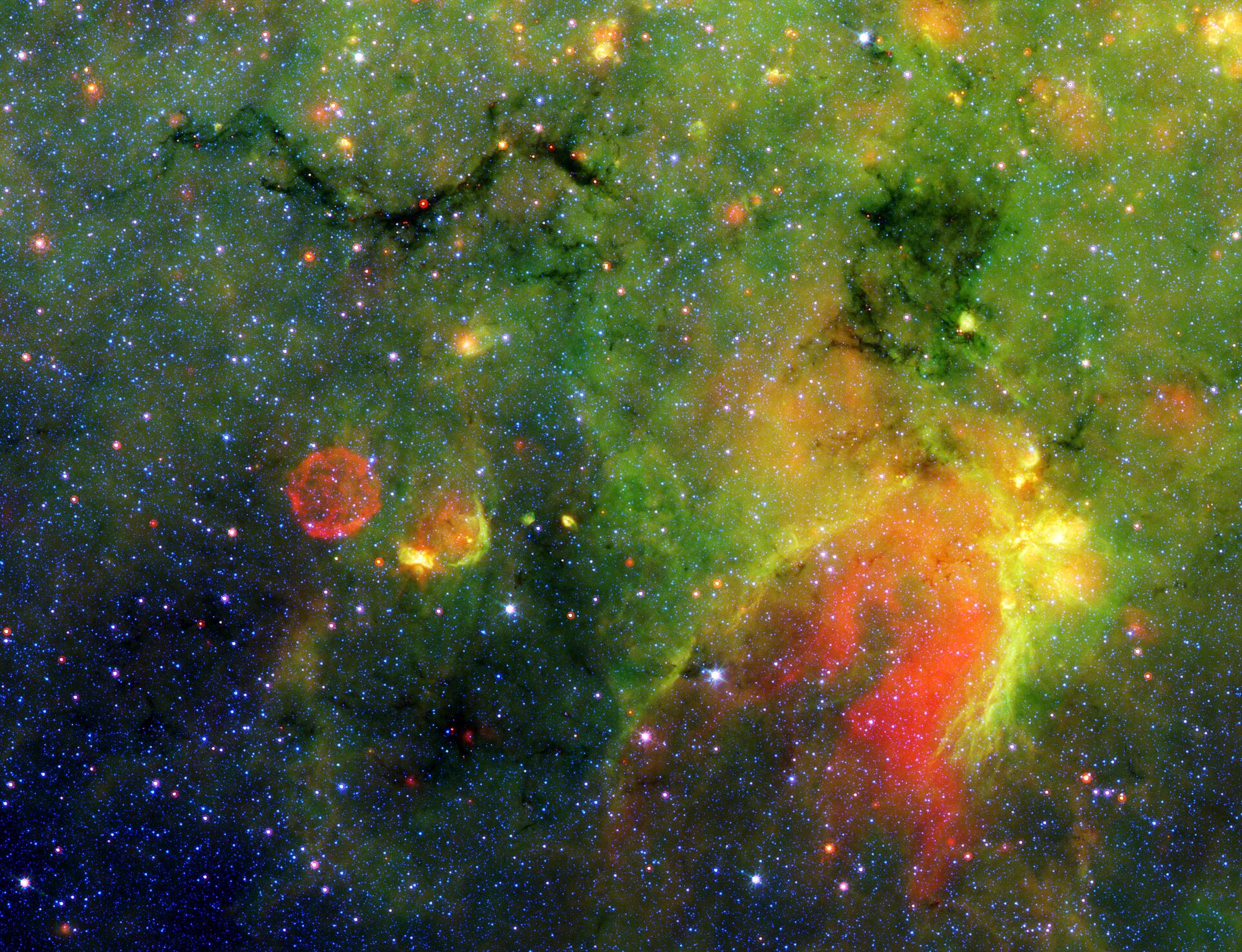 A dark cloud winding across a bright creation, photographed in infrared by NASA's Spitzer Space Telescope. This same image opened the essay on Catholic thought that helped inspire this article. Photo: NASA/JPL-Caltech, public domain.
Read that definition slowly, because it is a portrait of every person who has kept faith on this planet. Believe without seeing. Persevere when isolated. Triumph over insuperable difficulties even when alone. The same paragraph notes that such ascenders are trusted early with assignments "where unquestioned faith and sublime confidence are essential to achievement" (50:7.1). In the economy of the universe, a childhood spent on a quarantined world is not a handicap to be pitied. It is a credential that cannot be earned anywhere else.
This is the nourishment the Disclosure conversation has been missing. The hype teaches people to experience the silence of the sky as either evidence of absence or proof of cover-up, and both readings breed a kind of chronic spiritual impatience, a life spent waiting for the announcement that will finally make faith unnecessary. The revelation reads the same silence as a training environment, deliberately preserved, producing a rare and valued kind of soul. You are not being kept in the dark. You are being trusted in the dark.
Never Alone, Even Now
None of which means we have been left to manage by ourselves. The deepest teaching of the revelation on this subject is that the most important contact was never going to come through the sky in the first place. A fragment of the Father himself indwells the human mind. The Spirit of Truth, poured out at Pentecost, ministers to every person on this world without exception; we have told that story in After Pentecost, We Are Never Alone. Seraphim serve here in the billions, the registry showing 1,002,469,238 individuals (114:0.2). The planetary government convenes every morning. The circuits will be restored, and the officer who severed them is already anticipating the reconnection with what the text calls pleasure.
In fact, the Chief of Seraphim closes the loop on this whole subject in a single quiet sentence:
"Planetary isolation is, of course, of little concern to individual mortals since the pouring out of the Spirit of Truth upon all flesh nineteen hundred years ago." (114:5.4)
The quarantine, the severed circuits, the long silence: of little concern to you. The connection that matters most was never routed through the switchboard.
So a reader can hold this whole subject with a light and cheerful grip. Watch the hearings if they interest you. Keep your healthy questions about the kingdoms of men, for the record earns you that right. Extend warmth to the experiencers, the earnest investigators, the Catholic theologians and Latter-day Saint elders and hopeful watchers of every tradition who intuited an inhabited creation long before any telescope or tribunal weighed in. They were reasoning from the generosity of God, and on the central point they were correct.
And when the next breathless announcement arrives promising that everything is about to change, you can smile, because for you, nothing needs to change. The universe was never empty, the visitors were never absent, the silence was never abandonment, and the family you belong to has known your address the entire time:
"Your planet is a member of an enormous cosmos; you belong to a well-nigh infinite family of worlds, but your sphere is just as precisely administered and just as lovingly fostered as if it were the only inhabited world in all existence." (15:14.9)
That is the disclosure. It has already been made.
A note on sources: the historical survey of Catholic thought draws on Paul Thigpen's "Extraterrestrial Intelligence and the Catholic Faith" (TAN Books, 2022) and his 2024 essay on the same subject; the Funes interview was reported by Reuters in May 2008; the Latter-day Saint material draws on the Book of Moses and Spencer W. Kimball's "Faith Precedes the Miracle." Thanks to the fellow reader whose close reading of the quarantine passages sharpened the central section of this article. Photographs are public domain via NASA, the Architect of the Capitol, and Wikimedia Commons, except the 1952 switchboard photograph, courtesy of the Seattle Municipal Archives under CC BY 2.0. Every direct quotation from the Urantia Book was mechanically verified word for word against the canonical text of the cited paragraphs.
For the full census of the inhabited worlds: Other Inhabited Worlds
For the specific UAP and contact claims, taken seriously one at a time: You Deserve a Better Map
For how genuine cosmic contact actually works: What Genuine Cosmic Contact Looks Like
Connecting Articles


The Newsletter
Get the research behind each piece
Free. New Urantia Book explorations, the sources behind the videos, and early looks. No spam, unsubscribe anytime.
Prefer video? Follow on YouTube and Facebook.
Delivered through Substack. You can also read past issues.