
The Shadow Never Leads, Part 5: The Rewrite
The Babylonian scribes took an extraordinarily complex tragedy involving good people with sincere motivations and compressed it into a single image: a snake, a woman, a piece of fruit, a curse. That compression erased Caligastia, blamed Eve, and gave the might-makes-right tradition a theological foundation that persists to this day.

Series Note: This is Part 5 of seven. Parts 3 and 4 described the compromised hardware and the mission that was supposed to fix it. This part tells the story of what powerful institutions did with that tragedy once they got their hands on it.
The Corridor
There is a strip of eastern Mediterranean coastline, running roughly from the mouth of the Euphrates northwest through what we now call Syria, Lebanon, and Israel, that has absorbed more human history than almost any comparable stretch of geography on earth. Empires rose and fell there. Alphabets were invented there. Monotheism was argued into existence there. And according to the Urantia Book, something happened in that corridor tens of thousands of years before any of that, something that shaped the entire subsequent history of the region.
The first Garden of Eden was located on a peninsula projecting westward from the eastern shores of the Mediterranean Sea. Paper 73:3.1 identifies it as one of three candidate sites considered by Van's committee: a long narrow peninsula, almost an island, projecting westward from the eastern Mediterranean. The neck connecting it to the mainland was only twenty-seven miles wide at the narrowest point (73:3.4). The great river that watered the Garden flowed east through that neck to the mainland and then across the lowlands of Mesopotamia to the sea. Four tributaries fed it from the coastal hills. Those four tributaries are the origin of the Genesis reference to four rivers going out of Eden, a reference that later scribes confused with the river system surrounding the second Garden in Mesopotamia.
The peninsula is now submerged. The Mediterranean coastline was different ten thousand years ago. But the memory of the Garden persisted in the peoples who had lived near it or heard of it, and when the Babylonian captivity scribes compiled their rewritten narrative, they were working in the same geographic corridor, with access to traditions that were ancient even then.
The chain of events that produced the Genesis account is one of the most consequential acts of institutional editing in human history. And it did not happen in a vacuum.
The Serpent They Made
Across the ancient Mediterranean world, from Canaan to Egypt to Crete to Mesopotamia, the serpent was a symbol of wisdom, healing, and sacred knowledge. The Hebrews themselves maintained serpent veneration as an active religious practice well into the period of the divided monarchy. The Urantia Book is explicit about this.
"The Hebrews worshiped serpents down to the days of King Hezekiah."
The Urantia Book, 85:3.3
Hezekiah reigned around 715 to 686 BC. That means Hebrew serpent worship persisted for roughly a thousand years after the Exodus. The biblical account in 2 Kings 18 confirms it: Hezekiah had to physically destroy the bronze serpent that Moses had made, called the Nehushtan, because the people of Israel had been burning incense to it for centuries. It was not a fringe practice. It was mainstream Hebrew religious observance until a reforming king decided to end it.
Paper 88:1.5 adds the geographic precision: the serpent was revered in Palestine, especially by the Phoenicians, who along with the Jews considered it to be the mouthpiece of evil spirits. There is the pivot. The serpent cult that had been sacred, a symbol of divine wisdom and healing, the caduceus that still appears on medical insignia today, was gradually reframed as the symbol of evil. The same creature, the same tradition, reinterpreted through the lens of a theological project that needed a villain.
The actual villain, the actual deceiver who operated behind the default, was Caligastia. Invisible. Unable to enter minds without invitation. Operating through sincere people who had no idea they were serving his purposes. He was not a serpent. He was the planetary administrator who had been in rebellion for more than one hundred and fifty thousand years, working through a Nodite leader named Serapatatia who was entirely honest and thoroughly sincere and had no idea he was being used.
Serapatatia was what you might call the original stool: an instrument of Caligastia's purposes who never once suspected he was playing that role. The Babylonian scribes took the actual Caligastia-Serapatatia-Cano-Eve chain, an extraordinarily complex tragedy involving good people with sincere motivations, a murdered man, a compassionate plan that crossed a cosmic line, and a planetary rebellion stretching back hundreds of thousands of years, and compressed it into a single image. A snake. A woman. A piece of fruit. A curse.
That compression did three things simultaneously. It erased Caligastia's role entirely, removing from the narrative the actual source of the planetary problem. It placed all responsibility for the default on Eve, making a woman the primary agent of humanity's fall from grace. And it transformed the serpent, which had been a sacred symbol in Hebrew religious practice for a millennium, into the personification of evil, giving the reformers grounds to destroy the old traditions without explicitly condemning the ancestors who had practiced them.
This is not careless mythology. It is precise institutional theology in service of a political project.
What the Scribes Did and What They Destroyed
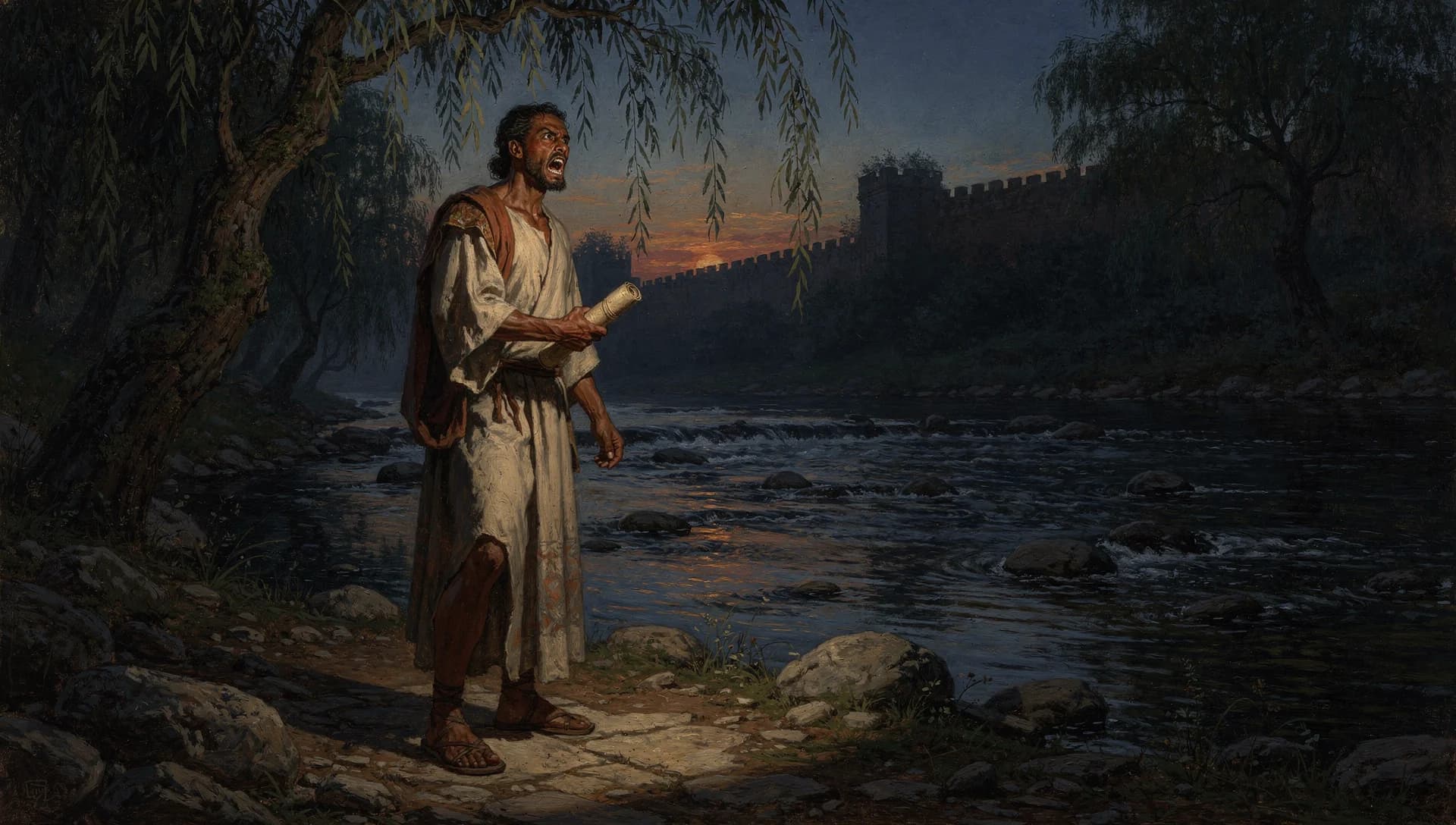
The Babylonian captivity began around 597 BC and lasted roughly seventy years. During that period, a group of priestly scribes undertook what was essentially a complete rewrite of Hebrew national history. The Urantia Book describes the motivation directly.
"The national ego of the Jews was tremendously depressed by the Babylonian captivity. In their reaction against national inferiority they swung to the other extreme of national and racial egotism, in which they distorted and perverted their traditions with the view of exalting themselves above all races as the chosen people of God."
The Urantia Book, 93:9.9
A people in exile, humiliated by defeat and displacement, needed a story that made sense of their suffering while preserving their sense of divine election. The scribes provided one. They wrote a narrative in which Yahweh was not simply the god of Israel but the creator of the entire universe, in which the Hebrews were not simply one people among many but the chosen instruments of cosmic history, and in which their current humiliation was not a sign of divine abandonment but a temporary correction that would give way to ultimate vindication.
To write that narrative, they first had to destroy the competing ones. Paper 97:8.1 names the books they burned.
"After the priests of the Babylonian exile had prepared their new record of God's supposedly miraculous dealings with the Hebrews, the sacred history of Israel as portrayed in the Old Testament, they carefully and completely destroyed the existing records of Hebrew affairs, such books as 'The Doings of the Kings of Israel' and 'The Doings of the Kings of Judah,' together with several other more or less accurate records of Hebrew history."
The Urantia Book, 97:8.1
They wrote their version. Then they destroyed the originals. Every citation in the Old Testament to these source documents, and there are many, refers to records that the compilers of the Old Testament subsequently made sure no longer existed. The secular corrective to the sacred narrative was eliminated before the sacred narrative was presented as ancient and authoritative.
And the records about Melchizedek were the most consequential loss of all. Paper 93:9.9 says the scribes destroyed every record of those momentous times they could find, preserving only the single story of Abraham and Melchizedek after the battle of Siddim because it reflected honor on Abraham. Everything else about the man who had run the world's most significant monotheist teaching center for nearly a century, who had directly prepared Abraham for his mission, and whose entire ministry was specifically oriented toward preparing the world to receive the coming bestowal Son, was gone.
The consequence is spelled out in Paper 93:9.10 with the clarity of a verdict: in losing sight of Melchizedek, the Hebrew people also lost sight of the spiritual mission of the promised bestowal Son, lost it so completely that very few of their progeny were able or willing to recognize and receive Michael when he appeared. The Teacher arrived into a religious establishment that had been specifically constructed, through the systematic destruction of the relevant records, to be unable to recognize him.
Moses Did Not Write the Torah
This is one of those points that the UB makes quietly and matter-of-factly, and the implications are enormous.
"The Hebrews had no written language in general usage for a long time after they reached Palestine. They learned the use of an alphabet from the neighboring Philistines, who were political refugees from the higher civilization of Crete. The Hebrews did little writing until about 900 B.C."
The Urantia Book, 74:8.9
The Exodus is conventionally dated to around 1400 to 1200 BC. The Hebrews acquired a written alphabet from the Philistines, Cretan refugees, around 900 BC. They began writing their history in earnest around that point. They went into Babylonian captivity around 600 BC. The Mosaic documents were compiled and attributed to Moses during and after the captivity, between 600 and 500 BC.
Paper 96:5.2 states the situation plainly: there is so little on record of the great work of Moses because the Hebrews had no written language at the time of the exodus. The record of the times and doings of Moses was derived from the traditions extant more than one thousand years after the death of the great leader.
Moses could not have written the Torah. The language to write it in did not exist until five centuries after his death. What was eventually written was not his actual teaching anyway. Paper 74:8.7 is direct: the Old Testament account of creation dates from long after the time of Moses, and he never taught the Hebrews such a distorted story.
The Philistines from Crete gave the Hebrews the alphabet. Cretan civilization was, as the UB notes, genuinely advanced by the standards of its time. The cultural diffusion from the Aegean world through the Levant coast is historically documented: proto-Sinaitic script, Phoenician alphabet, early Hebrew script. The chain is real and the UB confirms the Cretan origin of the people who carried it. The irony that the nation whose religious canon would eventually shape Western civilization received its writing system from the political refugees of a different civilization is not lost on the text.
What They Did to Women
The Babylonian rewrite did not simply compress the default narrative. It weaponized it. The compression of Caligastia-Serapatatia-Cano-Eve into woman, apple, snake, and curse did something specific to the theological status of women in the traditions that inherited the Genesis account.
Before the rewrite, women in Hebrew culture held a more complex and in some respects more honored position. The UB notes in Paper 84:4.1 that the status of women in any society is a fair gauge of the evolution of its moral standards. By that measure, the Babylonian rewrite represents a step backward, the institutionalization of a theological argument that placed the entire weight of what they called humanity's fallen condition on a woman's decision.
Paper 84:5.3 describes the general mechanism: when might is right, men lord it over women. When fairness begins to prevail, women begin to emerge into their actual contribution. The rewrite gave the might-makes-right tradition a theological foundation that would persist for centuries and in some quarters persists still. If woman was the primary agent of the fall, then male domination could be framed not as the exercise of power but as the correction of a cosmic error. Not oppression. Restoration of proper order.
This is the counterfeit sovereignty pattern applied to domestic life. The same structural move that Lucifer made at the cosmic level, claiming to liberate while actually consolidating control, appears here at the intimate scale of the family. The theological argument that woman is the source of corruption justifies the elimination of her legitimate intermediate sovereignty within the household, her moral authority, her spiritual intuition, her role as the natural keeper of the relational and devotional life of the family.
Paper 80:7.7 describes what happened to the genuine hunger for the feminine expression of the divine when that expression was suppressed theologically. It generated a mother cult, a chain of projection that ran from Eve through the Cainites through Cybele and Astarte to the eventual veneration of Mary. People recognized that something essential was missing in a purely patriarchal theology. The hunger for the feminine face of God did not disappear. It went underground, reappeared in various distorted forms, was repeatedly suppressed, and eventually surfaced in the modern movements that are trying to recover something they can sense but cannot precisely name.
What they are reaching for is real. Paper 33:3.5-6 describes what the UB calls the Jubilee of Jubilees: the moment in Nebadon's history when the Universe Mother Spirit publicly acknowledged the sovereignty of the Creator Son, and the Creator Son responded by issuing a Proclamation of Equality. The UB says explicitly that this event serves as the transcendent pattern for the family organization and government of the worlds of space. Not patriarchy. Not matriarchy. A voluntary, love-based mutual acknowledgment of distinct but equal roles and contributions.
That pattern was available to the Adamic culture of the first Garden. It was not encoded in the Genesis text that the Babylonian scribes produced.
The Apple and the Memory It Carries
The apple as a symbol travels through human culture in ways that the conventional biblical commentary almost never notices. The Norse golden apples of Idun, whose consumption maintained the immortality of the gods. The Greek golden apple of the Hesperides, the prize at the center of the Trojan War. The Celtic Avalon, the isle of apples, the place of divine restoration. The folk traditions of apple veneration that run from the Levant coast westward through Anatolia, the Aegean, southern France, and into the Basque country at the foot of the Pyrenees.
The Basque people are one of the most genetically distinct populations in Europe. Their language has no known relatives. Their bloodlines show origins that predate the Indo-European migrations by thousands of years. They are, by the available genetic evidence, among the most direct descendants of the ancient European populations that the UB associates with the blue man lineage, the honest, somewhat susceptible to persuasion Andonite peoples who populated the western Mediterranean long before the Andite expansions.
The best traditional cider in the world still comes from the Basque country. Apples fermented in the old way, pressed and left to do what fermented things do. Sacred agricultural practice encoded in fruit, carrying a cultural memory that stretches back through the Levant and the Mediterranean to a geographical and theological origin most practitioners of that tradition have no conscious knowledge of.
The apple of Genesis is not a fruit. Paper 75:4.4 gives the actual warning in the actual language it was given: in the day that you commingle good and evil, you shall surely become as the mortals of the realm. The forbidden fruit is a decision. The decision to combine a good end with a compromised means, to mix legitimate compassion with unauthorized action, to let sincerity become a stool for something operating behind it.
The Babylonian scribes turned that theological concept, the commingling of good and evil, into an apple because the apple was already a sacred object in the religious landscape of the eastern Mediterranean. They used the existing symbol and redirected its meaning. The tree of wisdom, which had been the sacred tree of the old traditions, became the tree of forbidden knowledge. The eating of the sacred fruit, which had signified participation in divine wisdom, became the act that condemned humanity. Same fruit, opposite valence. That is not accidental mythology. That is precise editorial theology.
The Teacher knew this. He knew what had been done in that corridor. He knew Melchizedek had been erased. He knew the records had been burned. He knew the serpent narrative had been fabricated from existing cult symbols. He knew Moses had been misrepresented. And when he spoke to the scribes and Pharisees who were the institutional descendants of the Babylonian editorial project, he was precise about what he was dealing with.
"The children of evil follow only in the ways of their father, who was a deceiver and stood not for the truth because there came to be no truth in him. But now comes the Son of Man speaking and living the truth, and many of you refuse to believe."
The Urantia Book, 162:7.3
He was not speaking abstractly. He was describing the structural pattern he could see operating in the theology that had been constructed in that same geographic corridor where the default had occurred, where Melchizedek had worked, where the records had been burned. The father of lies did not operate through obvious malice. He operated through sincere people with good institutional intentions who became stoops for a pattern they were not aware they were serving.
The Anti-Rewrite
The Teacher's response to the Babylonian editorial project was not a counter-history. He did not produce a corrective document that could be edited, burned, or misattributed. He did something the scribal tradition had no mechanism to handle.
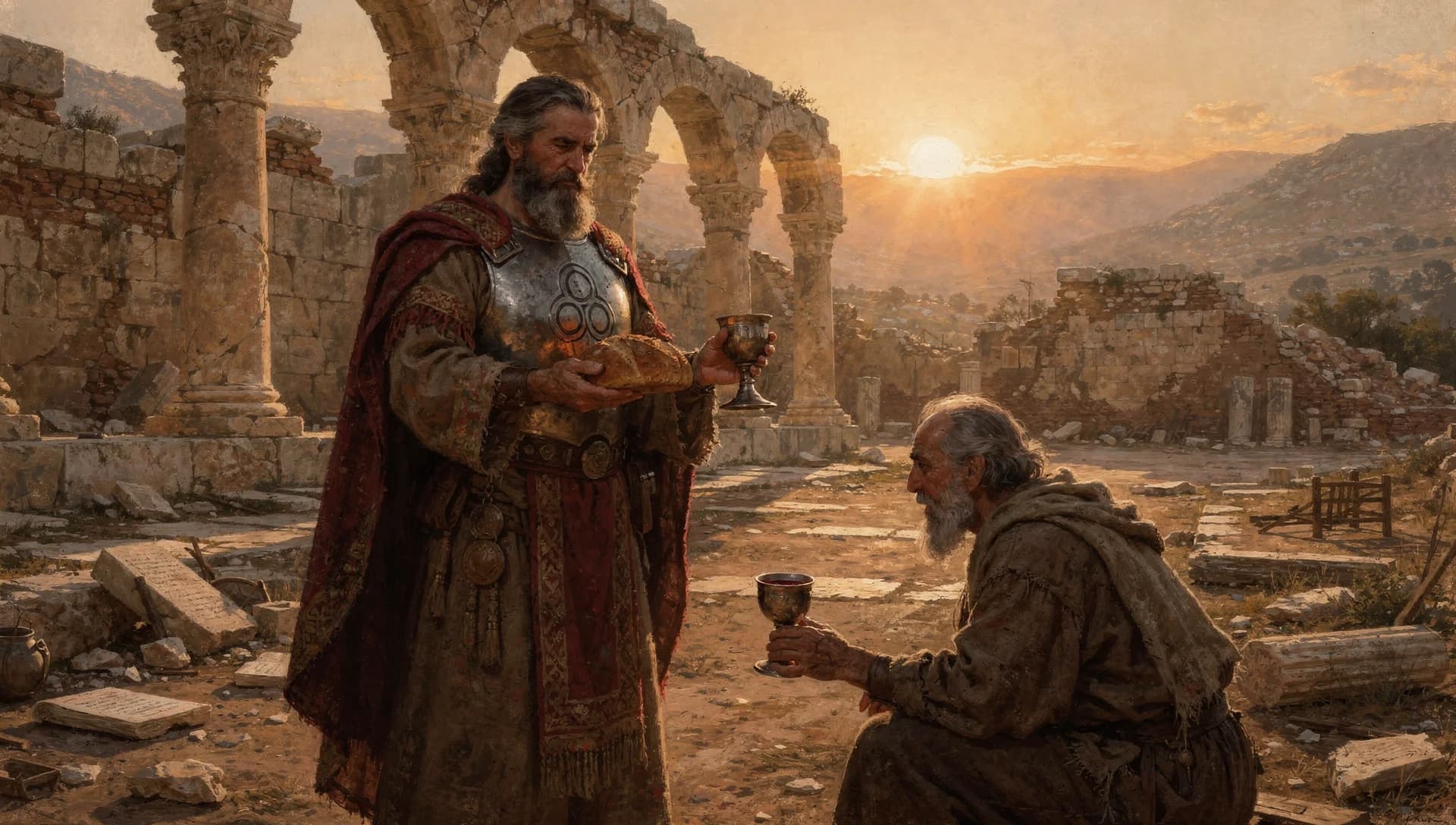
At his last meal with the people he had poured three years into, he instituted a remembrance ceremony. Bread and wine. Simple materials available to anyone, anywhere, at any time. No temple required. No priesthood necessary. No official scroll of authorization.
And he told them exactly why he was using symbols instead of definitions.
"In instituting this remembrance supper, the Master resorted to parables and symbols. He employed symbols because he wanted to teach certain great spiritual truths in such a manner as to make it difficult for his successors to attach precise interpretations and definite meanings to his words. In this way he sought to prevent successive generations from crystallizing his teaching and binding down his spiritual meanings by the dead chains of tradition and dogma."
The Urantia Book, 179:5.4
He designed the remembrance supper specifically to resist institutional capture. He built in interpretive flexibility on purpose. He refused to define the symbols precisely because he knew what happened when institutional handlers received a precise formula: they edited it, they systematized it, they eventually controlled who had access to the authorized interpretation, and the living reality beneath the formula died.
He also named what the new supper was replacing. The old Passover looked backward to the emergence of a people from national slavery into political freedom. Paper 179:5.2 names what the new supper points toward: the enslaved individual emerging from the bondage of ceremonialism and selfishness into the spiritual joy of the brotherhood and fellowship of the liberated faith sons of the living God.
Not a nation. An individual. Not political freedom. Spiritual liberty. Not a priestly-mediated covenant. A direct personal experience of sonship with the Father, available to everyone, sealed by a Spirit that would be poured out on all flesh and that no scribal project could erase because it was not written on any scroll that could be burned.
Part 6 describes what modern systems have done with the same compromised hardware, running the same counterfeit sovereignty pattern through economics, politics, and technology. And what the actual response looks like for a person who has figured out what is going on.
About This Series
"The Shadow Never Leads" is a seven-part exploration of how a sabotaged biological mission left humanity running on compromised neurological hardware, and why the Father's countermeasure is already in place.
Part 6: The Assault. Modern exploitation of the compromised hardware. The counterfeit sovereignty pattern in economics, politics, and technology. And the masculine crisis that no movement has correctly diagnosed.
About the Author
Derek Samaras is a videographer, content creator, and independent researcher based in Colorado. He runs the Urantia Book Network YouTube channel and the Sermons of Jesus channel. He can be reached through the Urantia Book Network.
All Urantia Book citations reference the standard text. | © 2026 Derek Samaras / Urantia Book Network
Connecting Articles

The Newsletter
Get the research behind each piece
Free. New Urantia Book explorations, the sources behind the videos, and early looks. No spam, unsubscribe anytime.
Prefer video? Follow on YouTube and Facebook.
Delivered through Substack. You can also read past issues.