
Growing the Supreme
There is a level of Deity that grows. The Urantia Book calls it the Supreme Being, and what you do today helps make it real.
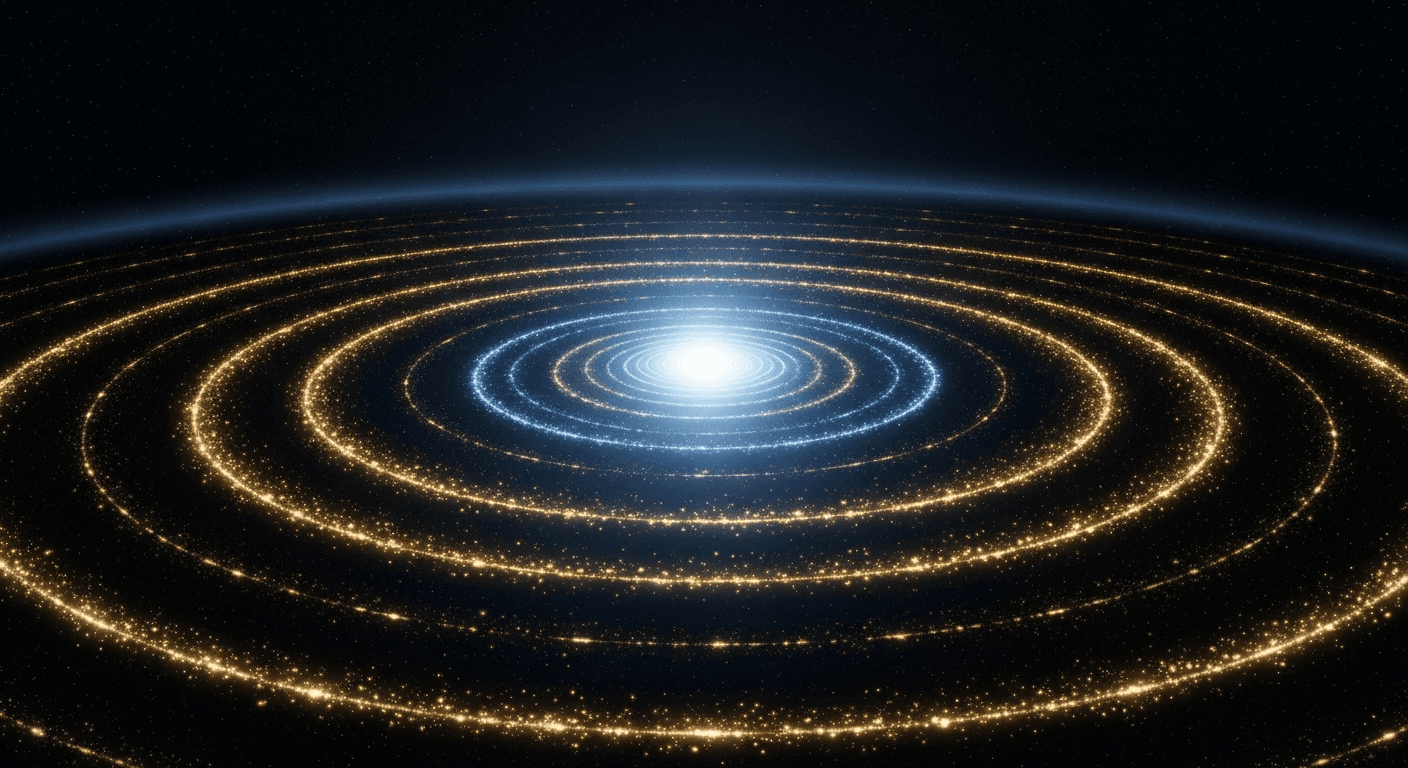
Almost every picture of God we inherit describes a Being who is already finished: eternal, perfect, complete before time began. The Urantia Book affirms that God without reservation. Then it does something the older theologies rarely attempt. Alongside the eternal Deity of Paradise, it describes a level of divinity that is still arriving, a God who genuinely grows, and whose growth is bound up with the choices of ordinary creatures like us. The revelation calls this evolving God the Supreme Being, and taking it seriously reorders how a person sees an ordinary day.
A word of caution belongs at the front. The revelators are candid that finite minds cannot take the measure of Deity. We are, they say, limited to "distorted reflections and attenuated conceptions" of a reality whose comprehension "is really beyond" our ability (115:3.1). What follows is therefore not a definition that contains the Supreme, but an account of the most graspable face of God the text offers us. For the Supreme is precisely the "maximum Deity reality fully comprehensible by evolutionary finite creatures" (0:3.20). If any level of divinity is meant to be intelligible to a human being, it is this one.
The Supreme in the architecture of Deity
One distinction does most of the work in this subject: the difference between Deity that has always existed and Deity that comes into being through experience. The first the book calls existential, the second experiential.
"Having achieved existential Deity expression of himself in the Son and the Spirit, the Father is now achieving experiential expression on hitherto impersonal and unrevealed deity levels as God the Supreme, God the Ultimate, and God the Absolute; but these experiential Deities are not now fully existent; they are in process of actualization." (0:7.6)
The Universal Father, the Eternal Son, and the Infinite Spirit are eternal and complete; they were never less than they are. The Supreme belongs to the other category. It is the first of the experiential Deities, the one nearest to the worlds of time, defined as the "actualizing or evolving God of time and space" whose distinctive work is "the time-space experiential achievement of creature-Creator identity" (0:2.15). In plainer terms, the Supreme is the God being realized as creatures and Creators grow together. That phrase, creature-Creator identity, is the key: this Deity is not assembled apart from us and then revealed, but actualized in and through the shared experience of the evolving universe.
One reality, two phases
To say the Supreme grows is not loose language; the revelation specifies how. The Supreme unfolds in two phases that are finally one. There is a phase of power, the gradual unification and control of the entire grand universe, which the text names the Almighty Supreme; and there is a phase of person, the spirit being who reflects the Paradise Trinity from the central universe. These are not two gods. As the Foreword puts it, the evolving power and the spirit person are "one reality—the Supreme Being" (0:8.10), drawing together into a single Deity.
What makes this account striking is its candor about the Supreme's incompleteness. The Almighty Supreme is "a living and evolving Deity of power and personality" whose "destiny is perfection" but whose "present experience encompasses the elements of growth and incomplete status" (116:0.4). Here is a real God with a beginning, a present that is genuinely unfinished, and a future still to be won. And the material out of which that future is built is experience, including yours: "The experience of every evolving creature personality is a phase of the experience of the Almighty Supreme" (116:1.1). The lives of creatures are not merely observed by this God; they are constitutive of it.
Cocreating an evolving God
Here the doctrine stops being cosmology and becomes personal. With the Universal Father, the great relationship is sonship, simply belonging. With the Supreme, the text says, something further is asked: "achievement is the prerequisite to status—one must do something as well as be something" (115:0.1). What we do registers in the life of God.
The paper on God the Supreme opens by stating the mechanism without hedging: "TO THE extent that we do the will of God in whatever universe station we may have our existence, in that measure the almighty potential of the Supreme becomes one step more actual" (117:0.1). The decision to seek and do the divine will is not only good for the one who makes it; it advances the actualization of a Deity. When a person chooses the eternal life, the text says, "he is cocreating destiny," and in that ascending life "the finite God finds an increased measure of personality self-realization" (117:4.2).
It would be easy to read this as poetry. The revelation refuses to let us. It frames the matter as a genuine cosmic responsibility and states the dependence in terms that are almost vertiginous:
"Herein lies the great cosmic responsibility of self-conscious personalities: That Supreme Deity is in a certain sense dependent on the choosing of the mortal will. And the mutual progression of creature evolution and of Supreme evolution is faithfully and fully indicated to the Ancients of Days over the inscrutable mechanisms of universe reflectivity." (117:4.9)
A God dependent, in a certain sense, on the choices of creatures: this is the center of the teaching, and what sets the Supreme apart from the static Absolute of classical philosophy. Yet the text is careful to preserve the worth of the individual against the scale of the whole. No single human act may seem to weigh much against the totality of Supremacy, and yet "the personality of each human being represents an irreplaceable meaning-value in the finite" (117:4.5). The whole depends on the parts, and the parts are never interchangeable. What you contribute, only you can contribute.
Morality as the bridge
If our choices are the substance of what we offer to the Supreme, then morality is not a code imposed from outside. It is the channel by which a finite creature touches a growing God. The revelation makes the connection explicit, grounding ethics itself in this relationship:
"The temporal relation of man to the Supreme is the foundation for cosmic morality, the universal sensitivity to, and acceptance of, duty. This is a morality which transcends the temporal sense of relative right and wrong; it is a morality directly predicated on the self-conscious creature's appreciation of experiential obligation to experiential Deity." (117:4.8)
Morality, on this account, is the inward recognition of an obligation to a real and present Deity; ethics is its outward form, "the external social or racial mirror which faithfully reflects the otherwise unobservable progress of internal spiritual and religious developments" (102:8.4). How we treat one another is the visible trace of an invisible growth. And the moral life begins early: the indwelling spirit, the Thought Adjuster, is "not actually assigned until the human subjects make their first moral personality decision" (108:2.1). From the first real choice onward, the work is underway.
How, then, does one choose well? Writing for the Urantia Book Fellowship, Buck Weimer distills a workable test from these teachings: after a decision, ask whether it helped you adapt to your changing circumstances, and whether it helped your character develop and progress spiritually. He notes, too, the manner of Jesus, who preferred the positive invitation, the "it is better," to bare prohibition. A choice that helps us grow, and helps those around us, is in the end exactly what is gathered up into the Supreme.
Why it matters
The Supreme answers a question many people carry quietly: does any of this finally add up to anything? The answer the revelation gives is unusually direct. It does, and at the highest level there is. Because the Supreme grows from the experience of its creatures, nothing genuine is wasted. The patient kindness, the honest decision, the faithful and unspectacular day, all of it is taken up into the experience of an evolving God and made permanent. The text even describes the indwelling Adjuster as drawing "upon the Supreme" to weave "the patterns of the eternal nature of an ascending son of God" (117:4.8), so that the character we build in time becomes the very material of an eternal self.
This is not, in the end, a doctrine to be argued so much as an invitation to be lived. The Father gives us being and asks only that we accept it. The Supreme invites us to help complete something vast and unfinished. We are not spectators of the cosmos. In a small, real, and irreplaceable way, we are among its contributors.
A note on sources and further reading
Every quotation above is drawn verbatim from the cited paragraph of The Urantia Book. Where the source sets a word off with a dash, it has been rendered here as a comma to suit house style; the wording is otherwise unchanged. Readers are encouraged to verify each citation against the canonical text, and to read Papers 115 through 118 in full, where these themes are developed far beyond this introduction.
For book-length treatment, see Stuart R. Kerr III, God, Man, and Supreme: Origin and Destiny, which traces the arc from God to man to the Supreme. See also Buck Weimer, "Morality, Ethics, and Decision-Making" (Urantia Book Fellowship, March 2026), which connects the growth of the Supreme to the moral choices of everyday life.
Connecting Articles
Dark Islands of Space: How Astronomers Learned to Find What Cannot Be Seen
The Breathing Universe, Act Two: Dark Energy Begins to Weaken
The Runaway Particles: The Record and the Physics of a Collapsing Star
The Universe Might Be Spinning: The Record's Strangest Claim Just Got Interesting
The Newsletter
Get the research behind each piece
Free. New Urantia Book explorations, the sources behind the videos, and early looks. No spam, unsubscribe anytime.
Prefer video? Follow on YouTube and Facebook.
Delivered through Substack. You can also read past issues.