
The Garden of Eden: Real Geography, Real History
The Garden of Eden is not a metaphor. According to the Urantia Book, it was a physical location on a peninsula extending into the eastern Mediterranean Sea, a peninsula that no longer exists because it sank beneath the water approximately 34,000 years ago.

The Question Everyone Has
Where was the Garden of Eden?
Genesis places it at the source of four rivers: the Pishon, Gihon, Tigris, and Euphrates. Two of those rivers still exist. The Tigris and Euphrates flow through modern Iraq, with their headwaters in the mountains of Turkey. The other two, Pishon and Gihon, are unidentified. Various scholars have proposed locations from Ethiopia to Iran to the Persian Gulf to somewhere now submerged beneath the Black Sea.
The mainstream academic consensus is that Eden is a literary myth, a cultural memory of paradise, not a historical place. The rivers are symbolic geography, the garden a poetic setting for theological narrative.
The Urantia Book disagrees. And it gives a specific answer with specific coordinates.
The Peninsula in the Eastern Mediterranean
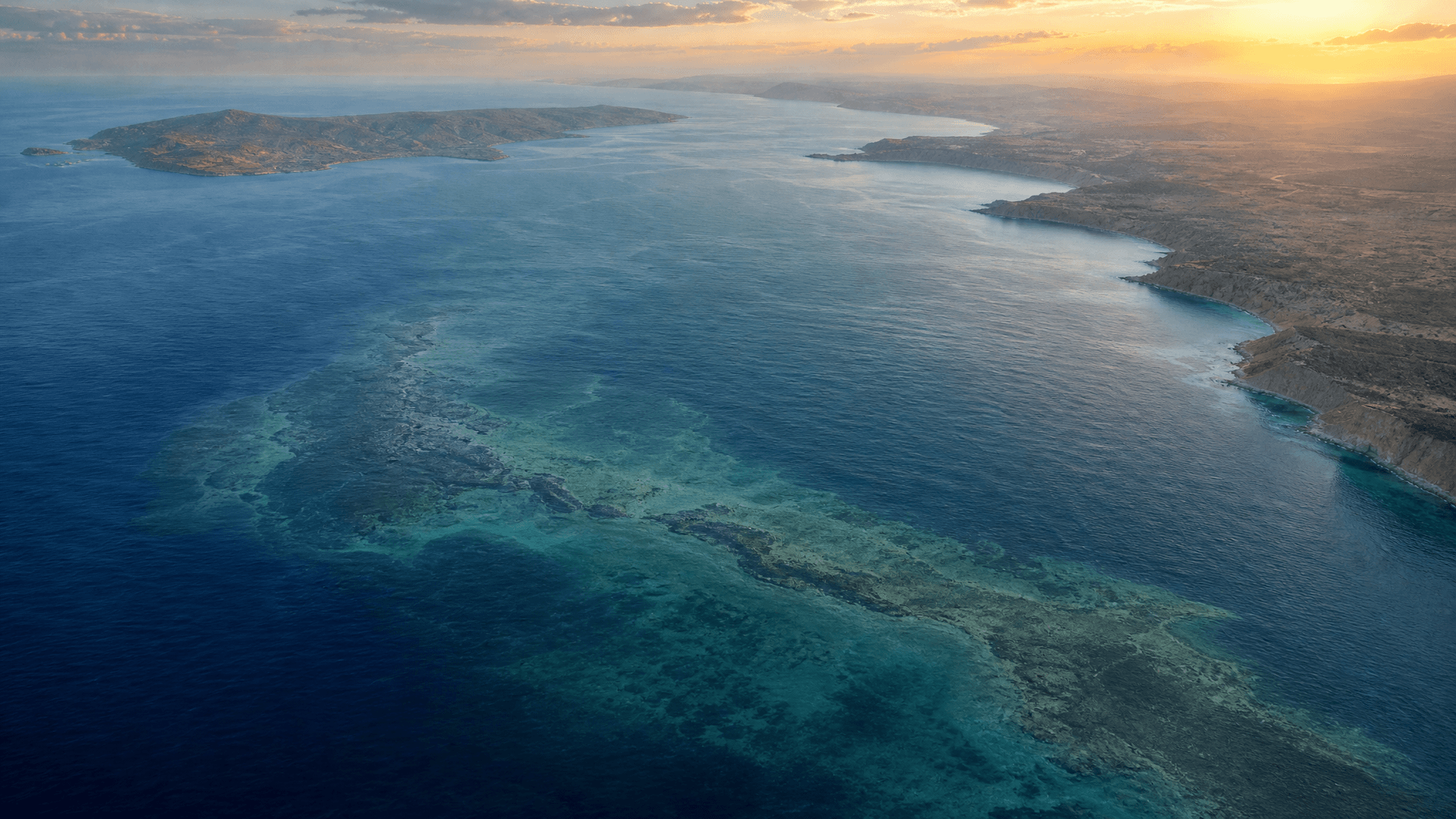
According to the Urantia Book, the Garden of Eden was constructed on a long peninsula extending westward from the eastern shore of the Mediterranean Sea, in the area of what is now the coast of Syria and Lebanon (UB 73:3.1).
The peninsula projected into the Mediterranean like a finger, with a narrow neck, only twenty-seven miles wide, connecting it to the mainland on the east (UB 73:3.4). This geography was chosen deliberately: easy to defend, temperate in climate, isolated enough to allow controlled development.
The garden itself was a planned installation. Adam and Eve, biological uplifters sent to this planet 37,848 years before 1934 CE, arrived at a garden that Van and Amadon had spent 83 years preparing (UB 74:0.1). The Urantia Book describes the physical layout in some detail: the Father's temple at the center of the peninsula, the garden walls, the orchards and groves, the irrigation systems, the nurseries, the workshops (UB 73:4.1-73:6.1).
It was, in essence, a civilization seed bank: the most advanced installation on the planet at the time, designed to serve as the radiating center of a global upgrade.
Why You Can't Find It
The peninsula is gone.
Approximately 34,000 years ago, some millennia after Adam and Eve left the garden, the eastern floor of the Mediterranean Sea sank, taking the entire Edenic peninsula beneath the water (UB 73:7.1). The submergence was connected to the same tectonic activity that shaped the broader Mediterranean basin.
The eastern Mediterranean floor between the modern coastlines of Syria, Lebanon, Israel, and Cyprus contains substantial shallow-water plateau areas that would have been dry land during the glacial maximum, exactly the geological conditions the Urantia Book's account requires.
This is not unique geological speculation. The broader eastern Mediterranean region lost enormous amounts of coastline to rising post-glacial sea levels. The city of Yarmuta, archaeologically documented as a major Bronze Age Levantine center, had predecessor settlements that are now underwater. Submerged ruins are a known feature of this coastline. The question is not whether land went underwater (it demonstrably did) but how far back that process extended.
If the Eden peninsula was submerged 34,000 years ago, well within the Last Glacial Maximum period, no trace of its installation would be expected to survive. The wood, the fabric, the organic materials of a garden are gone. The landscape itself is gone. The absence of physical evidence is exactly what we should expect from a site that has been underwater for 34 millennia.
The Atlantis Connection
The resonance between the Urantia Book's description of Eden and the Atlantis tradition is difficult to ignore.
Plato's account of Atlantis, recorded in the Timaeus and Critias (circa 360 BCE), describes a large island or peninsula in the Atlantic Ocean beyond the Pillars of Hercules, home to an advanced civilization, which sank beneath the sea in a single catastrophic day and night approximately 9,000 years before Solon's time, roughly 11,500 years ago by modern reckoning.
The Urantia Book's Eden sank approximately 34,000 years ago, and its location was the Mediterranean, not the Atlantic, so there is not a direct one-to-one identification. The Urantia Book notes that the Andite descendants of Adam and Eve, who spread across the ancient world over tens of thousands of years, carried memories of the garden, of the island civilization, of the catastrophic loss of their ancestral home, as they migrated outward.
Those memories, carried for tens of thousands of years through oral tradition, artistic representation, and mythological encoding, almost certainly contributed to what eventually became the Atlantis legend. Plato was not inventing from nothing. He was drawing on a compressed, distorted, but genuine cultural memory of a civilization that had existed, been advanced beyond its time, and been lost beneath water.
This is how mythology works: real events that happened long ago, filtered through thousands of years of oral transmission and reinterpretation, eventually reach us as myth. The Biblical story of Noah and the Flood is a documented example of this exact process, with multiple real regional floods and real people compressed into one cosmic event (UB 78:7.2-5).
Eden is one layer of that sediment. Atlantis is another name for the same layer.
Adam and Eve: The Real History
The Urantia Book's account of Adam and Eve is simultaneously more literal and more complex than either the Genesis account or mainstream dismissal.
Adam and Eve were not the first humans. They were biological uplifters, a Material Son and Daughter, a pair of beings of higher spiritual order, who materialized in a physical form compatible with human biology and were dispatched to this planet 37,848 years before 1934 CE (UB 74:0.1). Their purpose was genetic: they carried a biological endowment that, spread through the evolving human races over several generations, was intended to raise the intellectual and spiritual capacity of humanity as a whole.
This was a known and repeated cosmic process. Multiple inhabited worlds have received Material Sons and Daughters. The success rate varies. On Urantia, the mission ran into difficulty.
The specific failure is described in Paper 75. Serapatatia, a Nodite leader of significant political influence, presented Eve with an argument. The progress of the racial uplift program was slower than necessary, he said. Humanity in the Eastern lands was suffering while the plan proceeded at its careful pace in the Garden. He proposed a shortcut: Eve could begin the reproductive program immediately with a Nodite man, producing offspring who would be superior to pure Nodite stock and could accelerate the mission timeline (UB 75:3.1-75:4.6).
Eve, motivated by genuine concern for the struggling people she saw, agreed. It was a unilateral decision, made without Adam's knowledge, that violated the terms of the mission. When Adam discovered what had happened, he made the deliberate choice to participate in the same breach, not out of deception but out of unwillingness to let Eve face the consequences alone.
The result: their special circuit connection to the universe life system was severed. Their plan for biological uplift was irreversibly altered. They left the Garden and spent the rest of their lives trying to do good with what remained (UB 75:5.1).
This is the real story encoded in Genesis as "the Fall." Not a primal sin transmitted to all of humanity as inherited guilt. A specific, historical decision by specific historical people, with specific biological and administrative consequences. The Urantia Book says we are still living with those consequences, because the intended genetic uplift was only partially completed (UB 76:4.7).
What This Changes
If Eden was a real place that sank beneath the sea 34,000 years ago, several things follow.
First, the Genesis account is not pure mythology. It is a heavily compressed, symbolically encoded version of an actual historical memory, transmitted across 35,000 years of oral tradition before being written down by scribes who had lost most of the original context (UB 74:8.1).
Second, the "Fall" was not a metaphysical event that corrupted all human nature in some spiritual sense. It was a specific administrative failure that left the planet's biological development incomplete and its spiritual supervisory circuits disrupted, which is why things are harder here than they should be (UB 75:8.1).
Third, humanity is not under a curse. The Urantia Book explicitly rejects the doctrine of original sin, the idea that Adam's transgression was transmitted to all descendants as inherited guilt requiring divine punishment. As the book states, no mortal subsequently born on Urantia has suffered in personal spiritual experience because of these blunders (UB 67:7.7). What was transmitted was a partial biological uplift and a world without normal celestial administration. Both are serious disadvantages, but neither a permanent moral stain.
And fourth, the Atlantis and Eden traditions, along with dozens of other "paradise lost" myths across human cultures, are not fantasies. They are the fossil record of genuine human memory, preserved imperfectly across enormous spans of time. The memory is real. The place was real. It is under water. And that changes how we should read every culture's deepest stories about where we came from.
What to Read Next
The Urantia Book's account of Eden is in Paper 73 through Paper 76. Adam and Eve's arrival, the preparation of the garden, the default decision, the consequences, and Adam's second garden in Mesopotamia are described in more detail than any other source available.
For the geographical and archaeological framework: The Interactive Map
For the mythology connections, from Eden to Atlantis to Inanna to the Huluppu Tree: The Mythology Decoder
For the full Andite history that traces what happened after the Garden fell: The Andite Emergence
For the scientific investigation of the submerged peninsula: Search for Eden
Byline: Derek Samaras | Urantia Book Network | April 2026
Connecting Articles

Ancient Astronauts and the Urantia Book: A Better Origin Story
The Submerged Peninsula: A Geophysical and Textual Case for the Levantine Location of the First Eden

Cano and Eve's Default: The Real Story

The Shadow Never Leads, Part 4: The Unpatched Planet
The Newsletter
Get the research behind each piece
Free. New Urantia Book explorations, the sources behind the videos, and early looks. No spam, unsubscribe anytime.
Prefer video? Follow on YouTube and Facebook.
Delivered through Substack. You can also read past issues.